Exploring the Meaning of Nikao in Greek
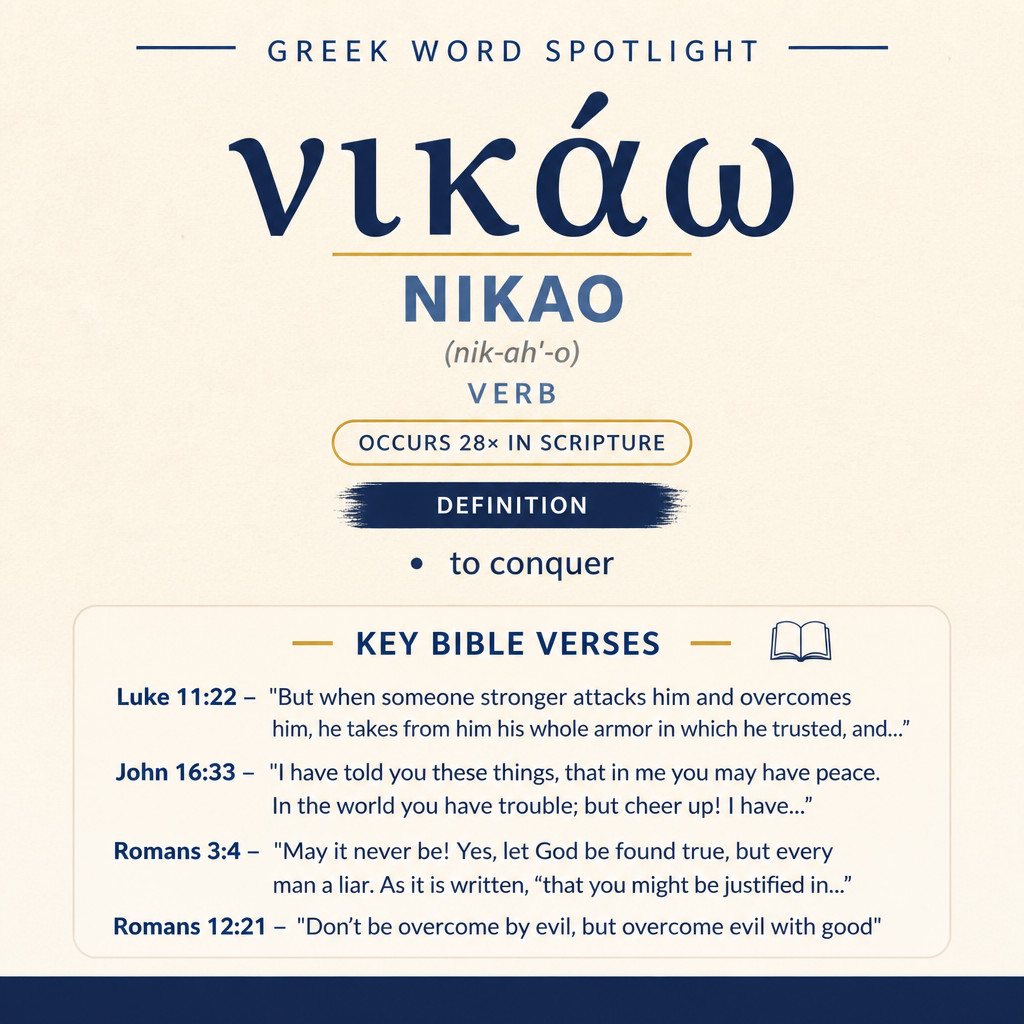
νικάω (Nikao) means “to conquer” and occurs 28 times in Scripture, including Luke 11:22, John 16:33, Romans 12:21, and 1 John 5:4.
Core Meaning
νικάω means “to conquer.” It is used for overcoming an opponent or evil.
Learn More →New Testament Examples
Luke 11:22 uses it for a stronger attacker who “overcomes.” John 16:33 records Jesus saying, “I have overcome the world.”
Learn More →1 John Emphasis
In 1 John it describes believers who “have overcome them” (4:4) and faith that “has overcome the world” (5:4). It also appears in 1 John 2:13–14.
Learn More →νικάω expresses the action of conquering in scenes of conflict, testing, and final vindication. In the passages below, it ranges from physical overpowering to moral and spiritual conquest, including the promised outcome for “him who overcomes.”
Occurrences
Luke 11:22 — “But when someone stronger attacks him and overcomes him, he takes from him his whole armor in which he trusted, and divides his plunder.”
Here νικάω is pictured as decisive superiority in a contest of strength: a “stronger” attacker not only wins, but strips the defeated party of “his whole armor in which he trusted.” Conquering is shown to have concrete consequences—loss of defenses and the division of “plunder”—so the verb marks a turning point where control passes from one combatant to another.
John 16:33 — “I have told you these things, that in me you may have peace. In the world you have trouble; but cheer up! I have overcome the world.”
νικάω is set against the ongoing reality of “trouble” in “the world.” The conqueror speaks in the first person (“I have overcome the world”), and the stated result is not the removal of trouble but the grounding of “peace” “in me” and encouragement (“cheer up!”). Conquering in this saying frames present hardship as something faced within a larger, already-won victory.
Romans 3:4 — “May it never be! Yes, let God be found true, but every man a liar. As it is written, “that you might be justified in your words, and might prevail when you come into judgment.”
In this argumentative setting, νικάω appears as “prevail” in the context of speech and evaluation: being “justified in your words” and prevailing “when you come into judgment.” The verb presents conquest not as physical domination but as winning a case—emerging as the one whose words stand and whose position is upheld under scrutiny.
Romans 12:21 — “Don’t be overcome by evil, but overcome evil with good.”
νικάω is used twice to contrast two possible outcomes. First, a person may be “overcome by evil,” portrayed as being conquered or mastered by it; second, the imperative calls for an active reversal: “overcome evil with good.” The verb thus characterizes moral conflict in terms of victory and defeat, and it depicts “good” as the means by which evil is conquered.
1 John 2:13 — “I write to you, fathers, because you know him who is from the beginning. I write to you, young men, because you have overcome the evil one. I write to you, little children, because you know the Father.”
In this address to different groups, νικάω defines the young men’s situation: “you have overcome the evil one.” Conquering is presented as an accomplished fact tied to their identity and standing, placed alongside relational knowledge (“you know him who is from the beginning”; “you know the Father”). The victory here is personal and adversarial, directed toward “the evil one.”
1 John 2:14 — “I have written to you, fathers, because you know him who is from the beginning. I have written to you, young men, because you are strong, and the word of God remains in you, and you have overcome the evil one.”
νικάω again marks completed conquest of “the evil one,” but this time the sentence supplies supporting features: “you are strong,” and “the word of God remains in you.” The conquering is thus set within a portrayal of inner steadiness and endurance—strength and abiding—which cohere with victory over a hostile opponent.
1 John 4:4 — “You are of God, little children, and have overcome them; because greater is he who is in you than he who is in the world.”
νικάω is broadened from overcoming a singular adversary to overcoming a plural “them.” The reason given is comparative: “greater is he who is in you than he who is in the world.” The conquest is rooted in a superiority that is internal (“in you”) over against a rival presence associated with “the world.” The verb signals that the community’s triumph is derivative of a greater indwelling power.
1 John 5:4 — “For whatever is born of God overcomes the world. This is the victory that has overcome the world: your faith.”
νικάω is presented as a characteristic action of “whatever is born of God”: it “overcomes the world.” The line then names “the victory that has overcome the world,” identifying it as “your faith.” Conquering is cast as the hallmark of new origin (“born of God”) and is linked with “victory” language, with faith described as the means or expression through which the conquest is realized.
1 John 5:5 — “Who is he who overcomes the world, but he who believes that Jesus is the Son of God?”
νικάω appears in a defining question: the world-conqueror is specified as “he who believes that Jesus is the Son of God.” The conquest is thus tied to confession and belief, not to external force. The verb functions to mark the believer’s identity: overcoming “the world” belongs to the one characterized by this particular belief.
Revelation 2:7 — “He who has an ear, let him hear what the Spirit says to the assemblies. To him who overcomes I will give to eat from the tree of life, which is in the Paradise of my God.”
νικάω becomes a title-like description, “him who overcomes,” and it is attached to a promise. The reward imagery is concrete and Eden-like: eating “from the tree of life” located “in the Paradise of my God.” Conquering here is the condition for receiving life-giving access, and the verb frames endurance and victory as the pathway to a restored kind of provision.
Revelation 2:11 — “He who has an ear, let him hear what the Spirit says to the assemblies. He who overcomes won’t be harmed by the second death.”
Again “he who overcomes” is the addressed person, and νικάω carries an eschatological consequence: the conqueror “won’t be harmed by the second death.” The verb thus stands at the boundary between peril and safety; conquering identifies those for whom ultimate harm does not prevail.
Revelation 2:17 — “He who has an ear, let him hear what the Spirit says to the assemblies. To him who overcomes, to him I will give of the hidden manna, and I will give him a white stone, and on the stone a new name written, which no one knows but he who receives it.”
νικάω again defines the recipient of promised gifts. The conqueror receives “hidden manna,” “a white stone,” and “a new name written,” known only “but he who receives it.” Conquering here is associated with provision, acceptance, and a personal, concealed designation. The verb gathers the idea of victory into a status that qualifies one for intimate and enduring reward.

Sense and Usage
Across these passages, νικάω consistently marks a movement from being threatened or contested to being dominant, secure, or vindicated. In Luke 11:22, conquering is shown in straightforward martial terms: a stronger party attacks, wins, disarms the opponent, and distributes the spoil. That concrete picture supplies a baseline for the verb: conquest is not merely a momentary win but a reversal of power with visible results.
John 16:33 and the letters of John extend the verb into the sphere of lived pressure (“In the world you have trouble”) and community conflict (“have overcome them”). In these settings, conquering does not erase the existence of struggle; it establishes the conqueror’s stance within it. The repeated perfect-like framing (“have overcome”) portrays victory as something already achieved with continuing relevance: the community is addressed as standing on the far side of a decisive conquest, even as they remain in a contested “world.”
Romans employs νικάω in two distinct but connected ways. Romans 3:4 places it in the courtroom-like arena of judgment, where prevailing is linked with being justified in words. Here conquest is rhetorical and judicial: victory is the outcome of evaluation. Romans 12:21, by contrast, casts evil as an active power that can conquer a person; the command refuses that outcome and insists that good is not passive but victorious, able to conquer evil. Together these uses show νικάω operating both as something that can happen to a person (“be overcome”) and as something a person is called to enact (“overcome”).
Revelation 2 uses νικάω as an identifying label—“him who overcomes”—and pairs it with promises that are sensory and specific: eating from “the tree of life,” escape from harm by “the second death,” and receiving “hidden manna,” “a white stone,” and “a new name.” In these sayings, conquering is not described by the mechanics of battle but by its outcome: access, safety, and a bestowed gift. The verb thus becomes a marker of the faithful victor who reaches the promised end.
Imagery and Resonance
The imagery surrounding νικάω oscillates between conflict and gift. Luke’s plunder and armor depict conquest as stripping and redistribution; Revelation’s tree, manna, stone, and new name depict conquest as reception and life. Between these poles stand the moral and spiritual struggles of Romans and 1 John, where conquering is portrayed as resisting being mastered, prevailing under judgment, and standing firm because “greater is he who is in you than he who is in the world.” The verb gathers these scenes into one consistent notion: conquest that determines who holds the field, whose word stands, and who receives the promised inheritance.
Sources: Lexical data from Strong’s Exhaustive Concordance and the Translators Brief Lexicon of Extended Strongs for Greek (STEPBible, CC BY). Occurrence data from the Translators Amalgamated Greek New Testament (STEPBible, CC BY). Scripture quotations from the World English Bible (public domain).