
Exploring the Meaning of Petrodes in Greek
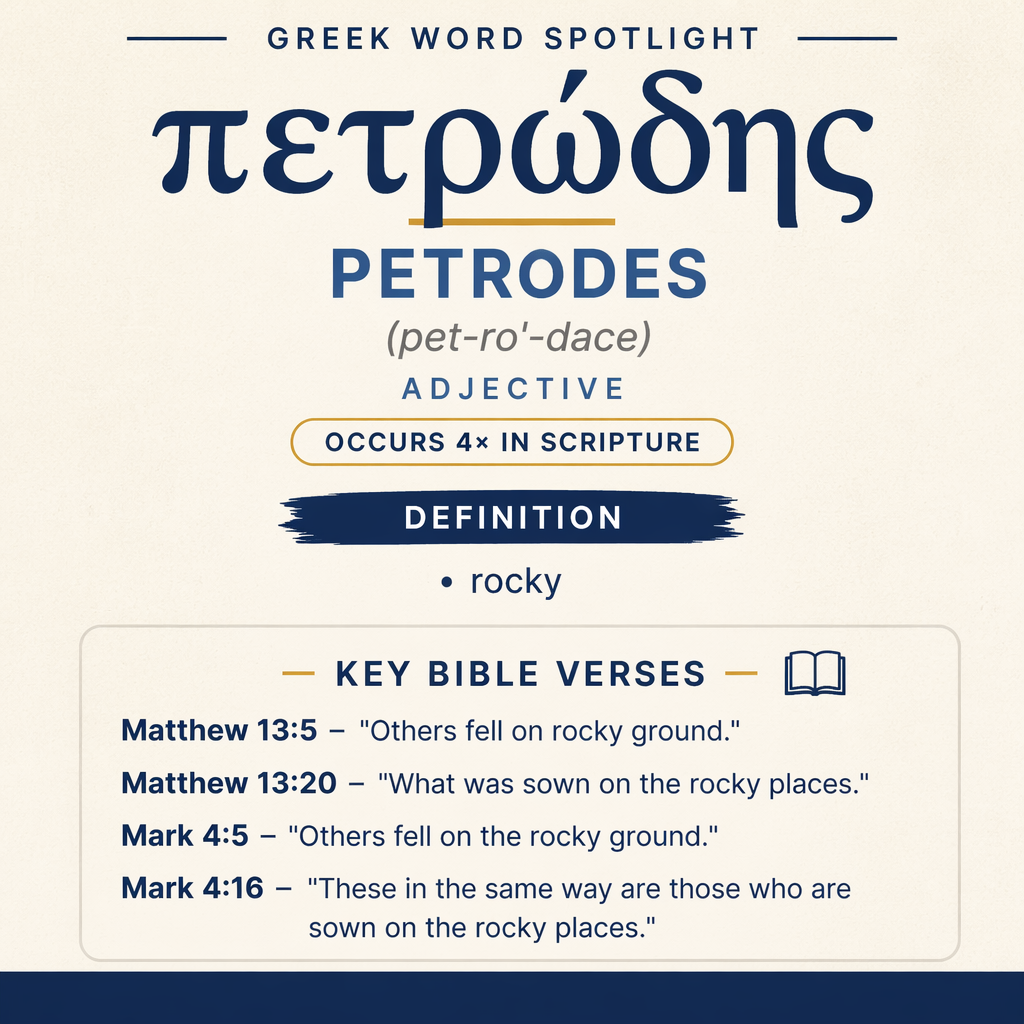
πετρώδης means “rocky” and appears four times in Scripture: Matthew 13:5, 13:20; Mark 4:5, 4:16.
Gospel Context
It describes “rocky ground” or “rocky places” in the sowing imagery of Matthew 13 and Mark 4.
Learn More →Verse Highlights
In Matthew 13:5 and Mark 4:5, seed falls on rocky ground with little soil and no depth. In Matthew 13:20 and Mark 4:16, it describes those sown on rocky places who receive the word immediately.
Learn More →πετρώδης means “rocky” and appears in the Synoptic accounts of the parable of the sower, describing ground where seed falls and the kind of hearer that corresponds to it. In these passages it marks a setting where growth is rapid but constrained by the character of the soil.
Root and Related Words
πετρώδης is connected with πέτρα (petra), “rock” (Strong’s G4073), and with εἶδος (eidos), “appearance” (Strong’s G1491). These relationships place the adjective within a word-family that draws on the idea of rock and the notion of an identifiable form or look.
Occurrences
“Others fell on rocky ground, where they didn’t have much soil, and immediately they sprang up, because they had no depth of earth.” (Matthew 13:5)
Here πετρώδης characterizes the place where the seed lands: “rocky ground.” The verse itself explains what “rocky” entails in this scene—“they didn’t have much soil” and there is “no depth of earth.” The adjective therefore frames a surface that allows quick sprouting (“immediately they sprang up”) while signaling a limitation built into the environment: the shallow layer of earth over what is rocky. The effect is to make the rapid appearance of life understandable, but also to hint at fragility because the growth is not supported by depth.
“What was sown on the rocky places, this is he who hears the word, and immediately with joy receives it;” (Matthew 13:20)
In this interpretive statement, the “rocky places” are no longer only a feature of a field; they become a way of describing a person’s reception of “the word.” πετρώδης helps map the physical image onto a human response: the reception is quick and enthusiastic—“immediately with joy receives it.” Even without additional description in this verse, the adjective carries forward the earlier portrayal of a setting marked by limited soil and lack of depth, now functioning as the scene’s shorthand for a kind of hearing that begins swiftly. The “rocky places” language keeps the parable’s concrete terrain in view while the focus shifts to the inner life of the hearer.
“Others fell on the rocky ground, where it had little soil, and immediately it sprang up, because it had no depth of soil.” (Mark 4:5)
Mark’s version parallels Matthew’s, again using πετρώδης to identify the landing place of some seed as “rocky ground.” The verse presses the point with two explicit explanations: it “had little soil” and “had no depth of soil.” The adjective thus sets up a contrast between what can be seen quickly (“immediately it sprang up”) and what is missing underneath (depth). In this depiction, “rocky” is not merely rough terrain; it is a growth environment where the amount and depth of soil are both restricted, shaping the plant’s earliest development.
“These in the same way are those who are sown on the rocky places, who, when they have heard the word, immediately receive it with joy.” (Mark 4:16)
As in Matthew, Mark applies the “rocky places” directly to people: “those who are sown on the rocky places.” πετρώδης keeps the parable’s agricultural metaphor intact even while interpreting it—people are spoken of in terms of the ground. The adjective underscores the same feature highlighted in the narrative description: a setting associated with a rapid start. That connection is made explicit in the response described here: when they hear the word, they “immediately receive it with joy.” The word “rocky” thus participates in Mark’s portrayal of immediacy, linking the quick sprouting of seed to the quick, joyful reception of the message.
Sense and Usage
Across these four occurrences, πετρώδης functions as a concrete descriptor within a farming picture and as a transferred descriptor within its interpretation. In the narrative portions (Matthew 13:5; Mark 4:5), it labels a kind of ground where the soil layer is thin—so thin that the text can describe it as having “little soil” and “no depth.” That physical configuration yields a recognizable effect: the seed’s growth shows itself quickly (“immediately they sprang up,” “immediately it sprang up”). In the interpretive portions (Matthew 13:20; Mark 4:16), the same adjective appears in the plural phrase “rocky places,” now designating the kind of hearer whose response parallels that quick sprouting: upon hearing “the word,” the person “immediately with joy receives it.”
The word’s usage also highlights how parables can compress meaning by reusing a single image-word. Once “rocky” has been established in the field scene as a place lacking depth of earth or soil, the later mention of “rocky places” can evoke that whole setup without repeating every detail. The adjective therefore operates as a hinge between the observable environment (where seeds land and plants emerge) and the described human reaction (how the word is heard and received), keeping the imagery consistent even when the referent shifts from ground to people.
In both Gospels represented here, πετρώδης is coupled with language of immediacy. The narrative says the plants sprang up “immediately” because there was no depth; the interpretation says the hearers receive “immediately” and do so “with joy.” The adjective “rocky” holds these moments together by supplying a stable picture: what looks promising at first—rapid emergence or rapid reception—occurs in a setting whose defining feature is the character of what lies (or does not lie) beneath the surface. Within the limits of the verses quoted, πετρώδης thus consistently serves the parable’s contrast between prompt outward response and the kind of underlying depth suggested by the repeated emphasis on “no depth of earth/soil.”
Imagery
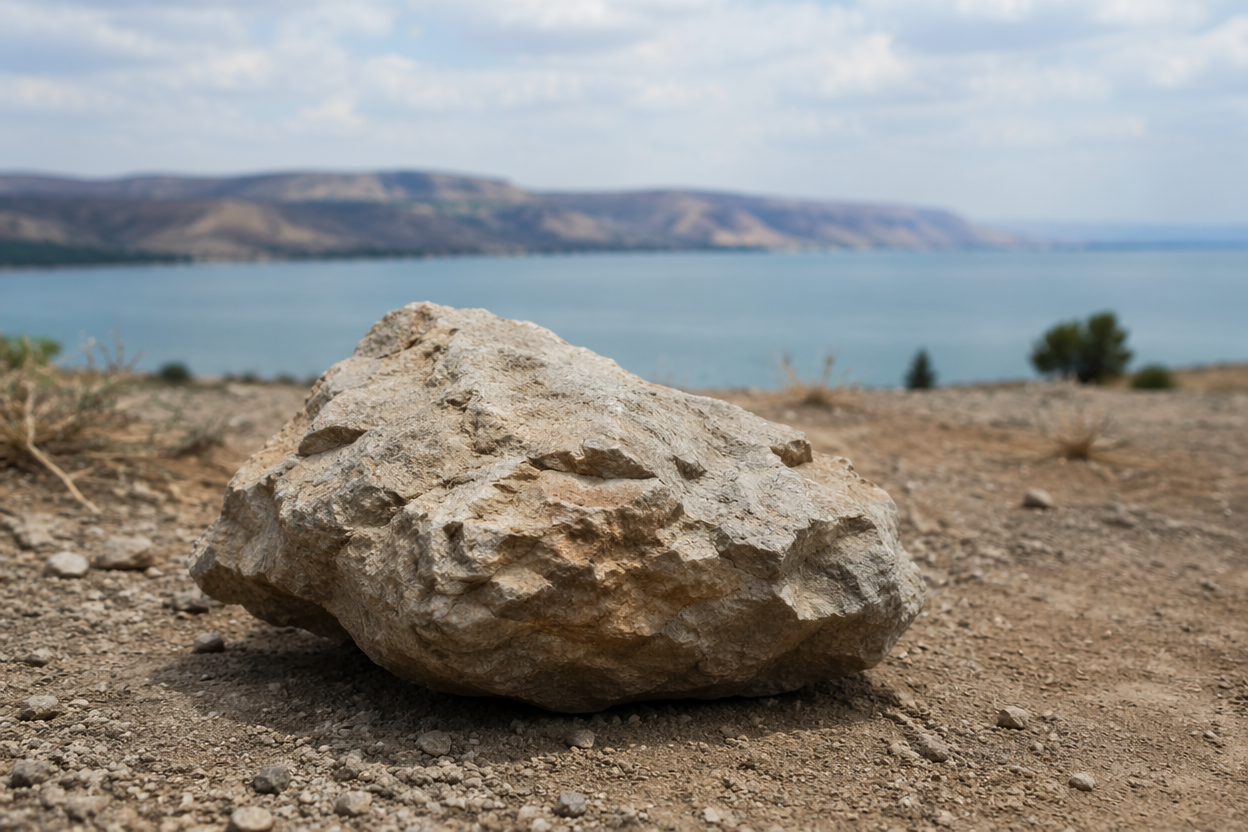
In these passages, “rocky” evokes a field where soil is present but shallow, enough for a seed to begin growth yet described as lacking depth. The repeated phrasing—“little soil” and “no depth of earth/soil”—keeps attention on what is underfoot, so that the hearer’s “immediate” joyful reception of the word is pictured with the same landscape logic: a quick start taking place on ground defined by rock close to the surface.
Sources: Lexical data from Strong’s Exhaustive Concordance and the Translators Brief Lexicon of Extended Strongs for Greek (STEPBible, CC BY). Occurrence data from the Translators Amalgamated Greek New Testament (STEPBible, CC BY). Scripture quotations from the World English Bible (public domain).





