
Exploring the Meaning of Perisseuo in Greek
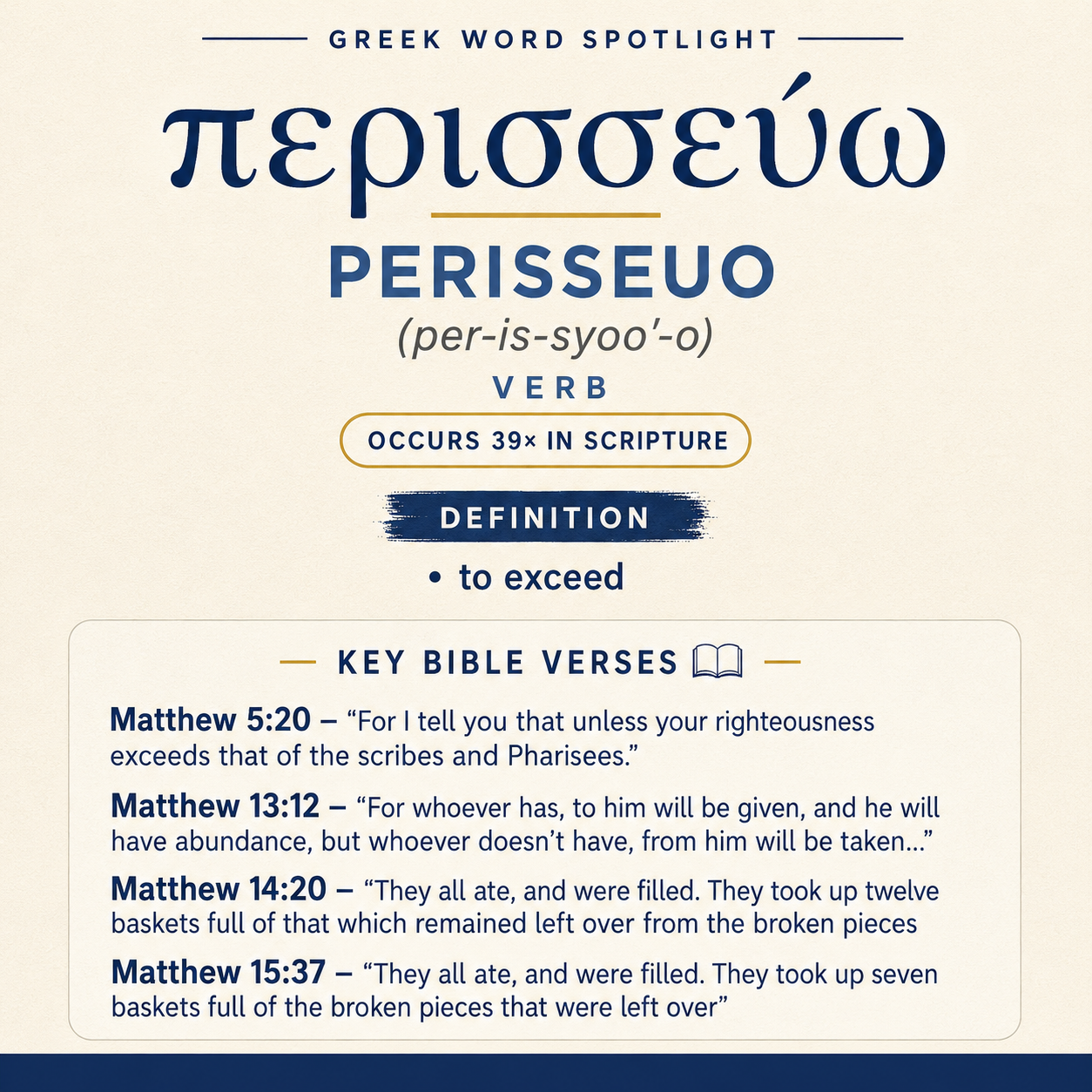
περισσεύω means “to exceed,” occurring 39 times in Scripture, including Matthew 5:20; 13:12; 14:20; 15:37; 25:29; Mark 12:44; Luke 9:17; 12:15.
Core Meaning
περισσεύω means “to exceed.” In key passages it describes exceeding righteousness and having abundance.
Learn More →Gospel Examples
In Matthew 14:20; 15:37 and Luke 9:17, it appears with the gathering of leftover broken pieces after all were filled. In Mark 12:44 it is used of giving out of abundance.
Learn More →Warnings & Contrast
In Luke 12:15, it appears in the warning that life doesn’t consist in abundance. In Matthew 13:12 and 25:29, it contrasts having abundance with losing what one lacks.
Learn More →περισσεύω expresses the idea of exceeding, appearing in sayings about righteousness, possession, and the contrast between having and lacking, as well as in narratives where food and gifts are present in quantities beyond immediate need. In the passages below, it marks what goes beyond a measure—whether moral, material, or physical.
Occurrences
Matthew 5:20 — “For I tell you that unless your righteousness exceeds that of the scribes and Pharisees, there is no way you will enter into the Kingdom of Heaven.”
Here περισσεύω sets a threshold: righteousness must go beyond the level associated with “the scribes and Pharisees.” The verb frames entry into “the Kingdom of Heaven” in terms of surpassing—an excess measured against a recognized standard.

Matthew 13:12 — “For whoever has, to him will be given, and he will have abundance, but whoever doesn’t have, from him will be taken away even that which he has.”
In this aphoristic contrast, περισσεύω describes the outcome for the one who already “has”: giving results not merely in having, but in a condition of exceeding (“abundance”). The verb helps sharpen the imbalance in the saying: possession tends toward more-than-enough, while lack tends toward further loss.
Matthew 14:20 — “They all ate, and were filled. They took up twelve baskets full of that which remained left over from the broken pieces.”
Within the feeding scene, exceeding is expressed as what remains after satisfaction: “They all ate, and were filled,” yet there is still “that which remained left over.” περισσεύω contributes the sense that provision outruns consumption, leaving a measurable surplus gathered into “twelve baskets full.”
Matthew 15:37 — “They all ate, and were filled. They took up seven baskets full of the broken pieces that were left over.”
This second feeding account parallels the first: fullness does not exhaust the supply. περισσεύω characterizes the “broken pieces that were left over,” again making excess visible as what can be collected after all have eaten to satisfaction—here quantified as “seven baskets full.”
Matthew 25:29 — “For to everyone who has will be given, and he will have abundance, but from him who doesn’t have, even that which he has will be taken away.”
Repeated in a different setting, the same structure reappears: having leads to a state of exceeding (“abundance”), while not having leads to subtraction even of what is present. περισσεύω pushes the first clause beyond simple increase; the endpoint is more-than-sufficient possession.
Mark 12:44 — “for they all gave out of their abundance, but she, out of her poverty, gave all that she had to live on.”
Here περισσεύω marks the condition of those who give without self-depletion: their gifts come “out of their abundance.” The verb supplies the contrastive backdrop for the woman’s action—others contribute from what exceeds their needs, while she gives “all that she had to live on,” leaving no excess behind.
Luke 9:17 — “They ate and were all filled. They gathered up twelve baskets of broken pieces that were left over.”
Luke’s wording again ties exceeding to leftovers after communal satisfaction: “They ate and were all filled,” and yet there are “broken pieces that were left over.” περισσεύω portrays excess as tangible remainder, gathered and counted as “twelve baskets.”
Luke 12:15 — “He said to them, “Beware! Keep yourselves from covetousness, for a man’s life doesn’t consist of the abundance of the things which he possesses.””
In this warning, περισσεύω defines the kind of possession that can tempt toward “covetousness”: “the abundance of the things which he possesses.” The verb helps describe an excess of belongings, and the sentence denies that life is constituted by such exceeding accumulation.
Luke 15:17 — “But when he came to himself he said, ‘How many hired servants of my father’s have bread enough to spare, and I’m dying with hunger!”
In the prodigal’s reflection, περισσεύω appears in a domestic-economic comparison: the father’s hired servants have “bread enough to spare,” while the speaker is “dying with hunger.” The verb marks a margin beyond sufficiency—bread that exceeds what is needed—highlighting the stark reversal between plenty and destitution.
Luke 21:4 — “for all these put in gifts for God from their abundance, but she, out of her poverty, put in all that she had to live on.”
This echoes the Markan contrast: many give “from their abundance,” while one gives from poverty, surrendering “all that she had to live on.” περισσεύω defines the resource-position of the larger group: their giving draws from what exceeds basic need, not from their last support.
John 6:12 — “When they were filled, he said to his disciples, “Gather up the broken pieces which are left over, that nothing be lost.””
In John’s feeding account, exceeding is implied by the sequence: “When they were filled” there still exist “broken pieces which are left over.” περισσεύω supplies the concept of surplus that must be gathered, and the instruction “that nothing be lost” treats the excess not as waste but as something to preserve.
John 6:13 — “So they gathered them up, and filled twelve baskets with broken pieces from the five barley loaves, which were left over by those who had eaten.”
This verse depicts the surplus in concrete detail: “filled twelve baskets” with pieces “which were left over by those who had eaten.” περισσεύω conveys exceeding in two directions at once—more bread than was required for the meal, and more remainder than could be ignored, since it fills multiple baskets.

Sense and Usage
Across these passages, περισσεύω marks exceeding as a relational idea: something is “more” only in comparison to a measure that is either stated or implied. In Matthew 5:20, the measure is moral and comparative—righteousness is weighed against the known example of “the scribes and Pharisees.” The verb does not describe righteousness in isolation, but as surpassing a benchmark that matters for the outcome named in the sentence (“enter into the Kingdom of Heaven”).
In Matthew 13:12 and Matthew 25:29, exceeding functions as the far end of a distribution: the one who “has” is not merely increased but brought into a condition characterized by surplus. The paired negative clause (“whoever doesn’t have…”) defines abundance by its opposite—lack that even loses what it had. In these sayings, περισσεύω gives language for an asymmetry: increase that runs past sufficiency on one side, and decrease that strips toward emptiness on the other.
Several occurrences attach exceeding to material plenty and its visible remains. The feeding narratives (Matthew 14:20; Matthew 15:37; Luke 9:17; John 6:12–13) all follow the same logic: satisfaction (“filled”) and remainder (“left over”) coexist. Excess is not abstract here; it is counted in baskets and described as “broken pieces.” John adds a directive that shapes how surplus is treated: what exceeds present need still carries value and is to be gathered so that “nothing be lost.” In these scenes, περισσεύω helps portray provision that goes beyond immediate consumption and results in recoverable, preservable remainder.
Mark 12:44 and Luke 21:4 shift from food to giving. Exceeding describes the donors’ resource situation (“out of their abundance”), and that surplus frames their gifts as contributions that do not reach into the last reserves required “to live on.” By contrast, the woman’s gift is narrated as total: she gives “all that she had to live on.” περισσεύω thus functions as a social-economic descriptor that clarifies the difference between giving from excess and giving without excess.
Luke 12:15 uses exceeding as a focal term in a warning: “a man’s life doesn’t consist of the abundance of the things which he possesses.” Here surplus is not denied as a reality—one can have “abundance”—but it is denied the power to define what life is. The verb’s contribution is to identify the tempting category precisely: not possessions as such, but possessions in excess. Luke 15:17 similarly casts exceeding as “bread enough to spare,” setting household plenty against personal starvation. The contrast depends on the notion of more-than-enough: the hired servants have a surplus margin, whereas the speaker lacks even the minimum.
Imagery
The dominant imagery accompanying περισσεύω in these passages is surplus made visible: baskets filled with leftover bread after everyone is “filled,” and gifts given “out of… abundance” rather than from what remains necessary “to live on.” Even where the setting is a saying rather than a narrative, the verb draws attention to what lies beyond a boundary—beyond a standard of righteousness, beyond the baseline of having, beyond sufficiency in food or possessions.
Sources: Lexical data from Strong’s Exhaustive Concordance and the Translators Brief Lexicon of Extended Strongs for Greek (STEPBible, CC BY). Occurrence data from the Translators Amalgamated Greek New Testament (STEPBible, CC BY). Scripture quotations from the World English Bible (public domain).





