
Exploring the Meaning of Perissos in Greek
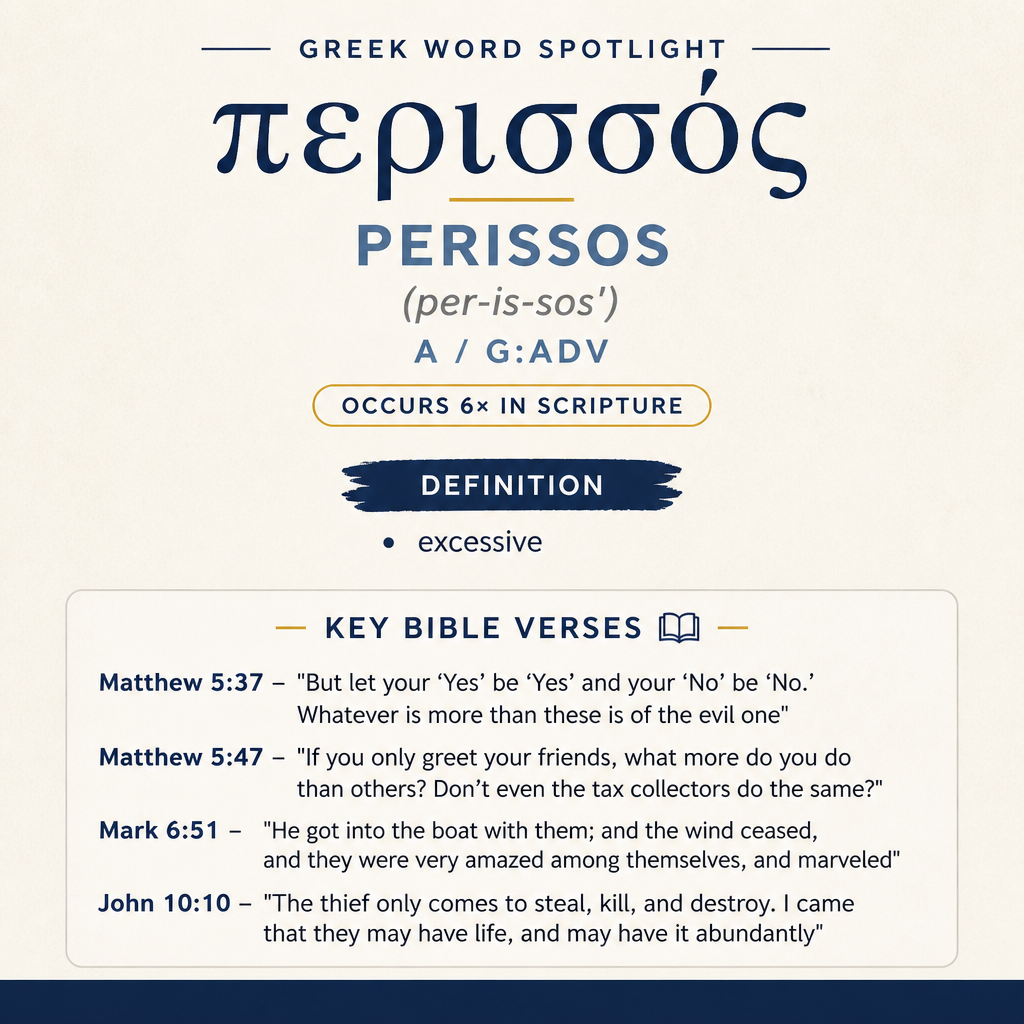
περισσός (Perissos) means “excessive” and occurs 6 times in Scripture: Matthew 5:37, 5:47; Mark 6:51; John 10:10; Romans 3:1; 2 Corinthians 9:1.
Core Meaning
περισσός means “excessive.” It is used for what goes beyond what is necessary or expected.
Learn More →Gospel Occurrences
It appears in Matthew 5:37 and 5:47, Mark 6:51, and John 10:10. These verses include “whatever is more,” “what more,” being “very amazed,” and life “abundantly.”
Learn More →Epistle Occurrences
It appears in Romans 3:1 and 2 Corinthians 9:1. These verses frame questions of “advantage/profit” and what is “unnecessary” to write.
Learn More →περισσός expresses the idea of what is “excessive,” and in the New Testament it is used in settings ranging from everyday speech and social conduct to astonishment, abundance of life, and the usefulness (or lack of usefulness) of further words. The passages below show how “excessive” can describe something that goes beyond a proper measure, beyond what is expected, or beyond what is necessary.
Root and Related Words
περισσός is related to peri (περί), “about” (Strong’s G4012).

Occurrences
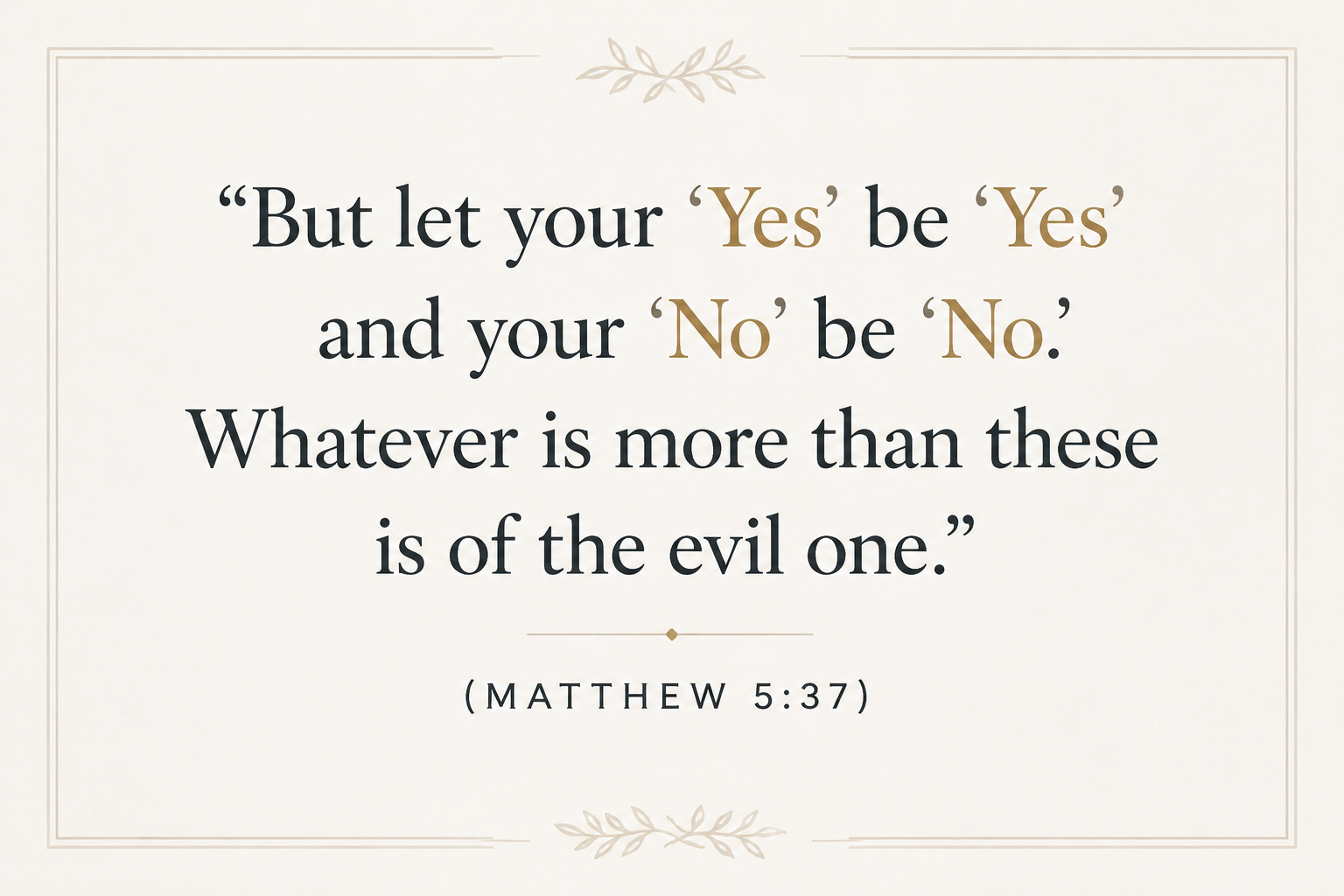
“But let your ‘Yes’ be ‘Yes’ and your ‘No’ be ‘No.’ Whatever is more than these is of the evil one.” (Matthew 5:37)
Here περισσός marks the boundary between plain, adequate speech and speech that has spilled into an excessive realm. The verse sets a simple pattern—affirmation and denial stated without additions—and then judges what goes beyond that simplicity. “Whatever is more than these” frames excess as something added on top of what is sufficient: extra layers, extra assurances, extra elaborations. In this scene, the word’s force is ethical and practical: it singles out an “excessive” remainder beyond a straightforward “Yes” or “No,” and the sentence places that excess under a negative moral evaluation (“of the evil one”).
“If you only greet your friends, what more do you do than others? Don’t even the tax collectors do the same?” (Matthew 5:47)
In this question, περισσός highlights the idea of exceeding a common baseline. The action described—greeting friends—does not set someone apart, because even a group held in low regard (“the tax collectors”) does it too. The phrase “what more do you do than others?” presses for what is excessive in the sense of going beyond the ordinary measure of social behavior. The word therefore contributes a comparative edge: it calls attention to any “excessive” surplus of conduct that would rise above what is typical, not merely what is comfortable or reciprocal.
“He got into the boat with them; and the wind ceased, and they were very amazed among themselves, and marveled;” (Mark 6:51)
Although the verse foregrounds the calming of the wind and the disciples’ reaction, περισσός shapes the description of that reaction by portraying amazement as excessive—beyond a normal degree of surprise. The wind’s cessation is immediate and dramatic, and the response is not a mild astonishment but an intensified, overflowing amazement “among themselves.” The word’s contribution is to signal that the emotional response has exceeded ordinary bounds; it is astonishment in excess, paired with continued marveling.
“The thief only comes to steal, kill, and destroy. I came that they may have life, and may have it abundantly.” (John 10:10)
In this contrast, περισσός describes the manner in which “life” is given: not merely life at the minimum, but life characterized by excess. The verse sets two arrivals side by side—one with a sequence of harms (“steal, kill, and destroy”), the other with a purpose of giving (“that they may have life”). By adding “and may have it abundantly,” the statement presents life as more than bare existence; it is life with an excessive quality, life that goes beyond a lower measure. The word thus carries a positive sense here: excess as fullness rather than overreach.
“Then what advantage does the Jew have? Or what is the profit of circumcision?” (Romans 3:1)
In this paired question, περισσός appears in the language of “advantage” and “profit,” turning the idea of excess toward what might be left over as a meaningful surplus. “Advantage” and “profit” both suggest a remainder beyond what is merely equal or neutral—something extra that counts. The word’s function in this context is to frame the discussion in terms of whether there exists an excessive margin, a genuine surplus benefit, attached to the identities and practices named. The questions themselves are pointed: they ask whether there is anything “excessive” in the sense of additional gain.
“It is indeed unnecessary for me to write to you concerning the service to the saints,” (2 Corinthians 9:1)
Here περισσός sits in the vocabulary of necessity and sufficiency. The speaker judges further writing “concerning the service to the saints” as something that would exceed what is needed. The word presses the idea that additional words, though possible, would be excessive—beyond the proper measure for the moment. Rather than condemning the topic, the sentence evaluates the act of writing more about it as surplus to requirements, emphasizing that the communication would go past necessity.
Sense and Usage
Across these passages, περισσός consistently signals what crosses a line of sufficiency into excess, but the “line” shifts with the setting. In Matthew 5:37 the limit is the sufficiency of plain truth-telling: “Yes” and “No” are presented as adequate, and what exceeds them becomes a morally charged excess. In Matthew 5:47 the measure is the ordinary level of social courtesy: greeting friends does not exceed the common standard, so the question presses for a surplus of action that would be recognizably beyond what “others” already do.
Mark 6:51 applies the same idea of excess to an internal response rather than an external act. Amazement is presented as not merely present but overflowing—excessive in intensity—so that the description itself conveys how far the disciples’ reaction went beyond an expected emotional measure. John 10:10, by contrast, makes excess a good: the life given is characterized as abundant, meaning it is not confined to the minimum threshold but is marked by surplus. Finally, Romans 3:1 and 2 Corinthians 9:1 show the word working in evaluative, almost accounting-like categories: advantage/profit on the one hand, unnecessary extra communication on the other. In both, the central question is whether there is a meaningful surplus—either a benefit that remains as extra, or an action (writing) that would be more than the situation calls for.
In these uses, “excessive” can therefore describe (1) an addition that should not be added (speech that goes beyond simple affirmation/denial; writing that is unnecessary), (2) an exceedance that would be desirable and distinguishing (conduct that goes beyond common reciprocity; life described by abundance), or (3) an intensity that surpasses normal expectation (amazement that is “very” great). The word’s flexibility lies not in changing away from excess, but in how the passages judge excess: sometimes as a problem, sometimes as a goal, sometimes simply as a vivid measure of magnitude.
Imagery and Emphasis
The scenes build a set of concrete measures by which excess is felt: extra words beyond a simple “Yes” or “No” (Matthew 5:37), actions that do more than a predictable greeting (Matthew 5:47), amazement that swells after the wind ceases (Mark 6:51), life described as abundant in contrast to destruction (John 10:10), surplus advantage or profit as a real remainder (Romans 3:1), and the decision that further writing would be unnecessary excess (2 Corinthians 9:1). In each case, περισσός points to a “more” that stands out—either because it oversteps, because it distinguishes, or because it overflows.
Sources: Lexical data from Strong’s Exhaustive Concordance and the Translators Brief Lexicon of Extended Strongs for Greek (STEPBible, CC BY). Occurrence data from the Translators Amalgamated Greek New Testament (STEPBible, CC BY). Scripture quotations from the World English Bible (public domain).





