Exploring the Meaning of Perikukloo in Greek
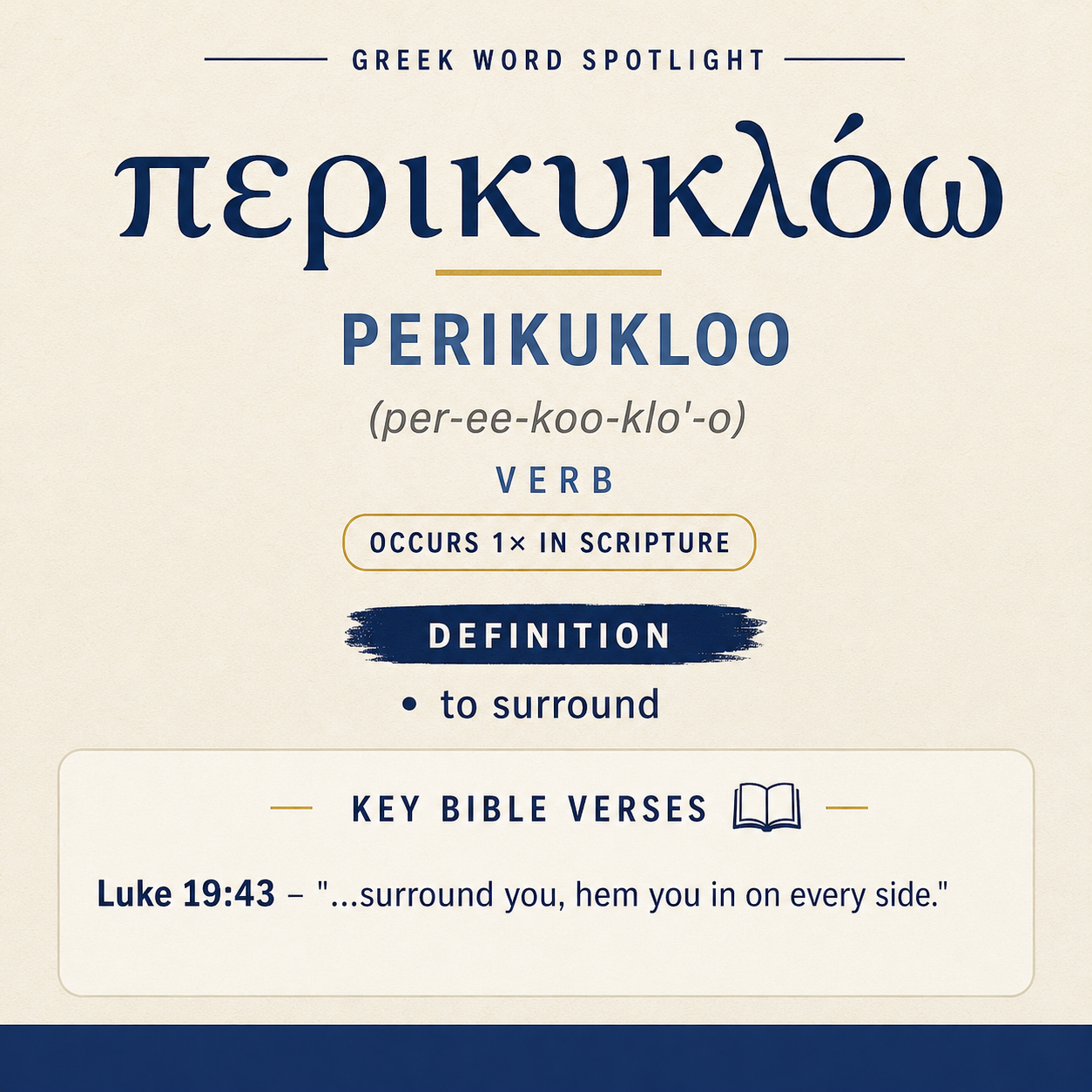
περικυκλόω means “to surround” and appears once in Scripture in Luke 19:43.
Biblical Usage
It occurs one time in Scripture. In Luke 19:43, enemies are described as surrounding and hemming in.
Learn More →Verse Context
Luke 19:43 speaks of days coming when enemies throw up a barricade against you. The verse includes the action of surrounding.
Learn More →περικυκλόω means “to surround” and is used once in the New Testament, in Luke 19:43. In that setting it appears in a forecast of hostile action directed against a city and describes the tightening of an enemy’s control.
Root and Related Words
περικυκλόω (Perikukloo) is formed from περί (peri), “about,” and κυκλόω (kykloo), “to surround.” The combined form expresses surrounding as an action carried out “around” a target, bringing the idea of encirclement into the verb itself.

Occurrences
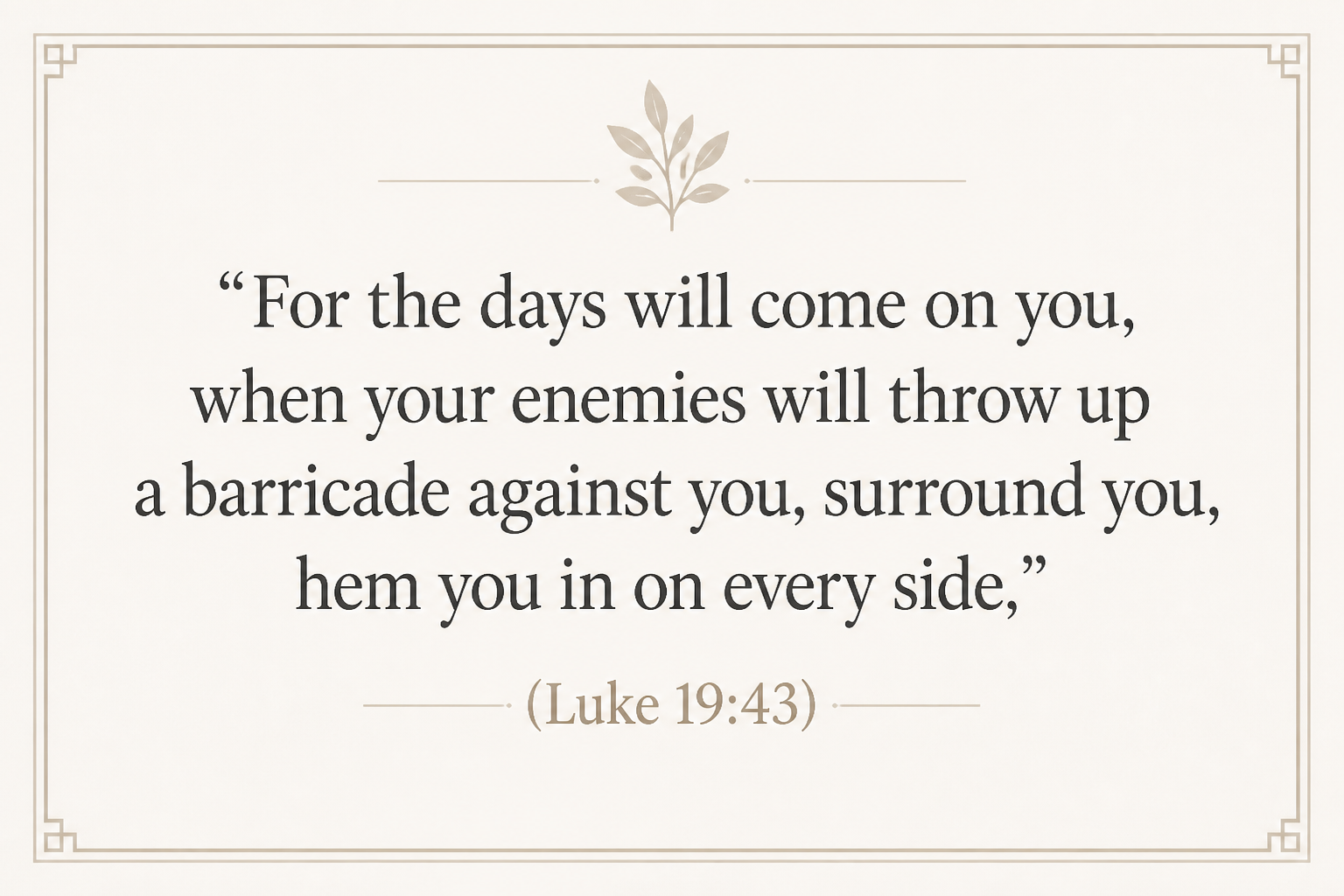
“For the days will come on you, when your enemies will throw up a barricade against you, surround you, hem you in on every side,” (Luke 19:43)
In Luke 19:43, περικυκλόω stands in a sequence of hostile measures: “throw up a barricade,” “surround you,” and “hem you in on every side.” The verb marks the moment when opposition becomes spatially decisive—enemies do not merely approach or threaten; they arrange themselves around their target. The surrounding is presented as deliberate and organized, coordinated with constructing a “barricade against you.” In other words, the line of attack is not a single strike but a designed enclosure.
The immediate neighbors of the verb sharpen the picture. A “barricade” implies an engineered obstruction set “against you,” and περικυκλόω then depicts the enemy’s movement into an around-you position. The next clause, “hem you in on every side,” reinforces that the surrounding is comprehensive rather than partial: the target is pressed from multiple directions. Within the verse’s grammar and imagery, the surrounding is not an abstract condition but a concrete military posture that limits freedom of movement and closes off routes of escape or relief.
The subject “your enemies” is explicit, and the object “you” places the action directly upon the addressed group. The surrounding therefore functions as an act of domination: the enemies take the perimeter, and the one surrounded becomes the enclosed party. The verse’s forward-looking frame (“the days will come on you”) also gives the surrounding a prophetic cast; it is a coming situation described with the clarity of a planned operation.
Sense and Usage
With its single New Testament use, περικυκλόω shows “to surround” in a context where surrounding is part of a larger strategy of constraint. The verb is not isolated; it is embedded among actions that intensify pressure. In Luke 19:43, surrounding is the act that changes the relationship between attacker and target from confrontation at a point to control of the whole space around it. The meaning is expressed spatially—enemies positioned “around”—and the resulting condition is described relationally—those inside are now the ones acted upon, while the ones outside dictate the terms.
The verse also demonstrates how “surround” can carry an implied directionality: the enemies are outside, moving to take up positions around; the object is inside, becoming enclosed. Even without additional occurrences, Luke 19:43 clarifies that the word can describe an active, imposed enclosing, not merely the fact that something happens to be encircled. It is an action performed by agents (“your enemies”), coordinated with other measures (“throw up a barricade”) and culminating in comprehensive confinement (“hem you in on every side”).
Because the surrounding is paired with a barricade and with being hemmed in, the verb’s contribution is to depict a tightening ring. The surrounding is the pivotal spatial step: once attackers are around the target, further restriction follows naturally in the line of thought. Thus, in usage, περικυκλόω serves to convey the seriousness of an impending siege-like enclosure—an image of pressure applied not from one direction, but from all around.
Imagery
The imagery of περικυκλόω in Luke 19:43 is the image of a ring closing in. The verse speaks of enemies who build a barricade “against you” and then “surround you,” so the scene is one of an occupied perimeter and an enclosed center. The final phrase “on every side” leaves the listener with the sense of space itself being taken away: the surrounding is not merely presence nearby, but an all-around constraint that turns the target into the besieged interior.
Sources: Lexical data from Strong’s Exhaustive Concordance and the Translators Brief Lexicon of Extended Strongs for Greek (STEPBible, CC BY). Occurrence data from the Translators Amalgamated Greek New Testament (STEPBible, CC BY). Scripture quotations from the World English Bible (public domain).