
Exploring the Meaning of Perikalupto in Greek
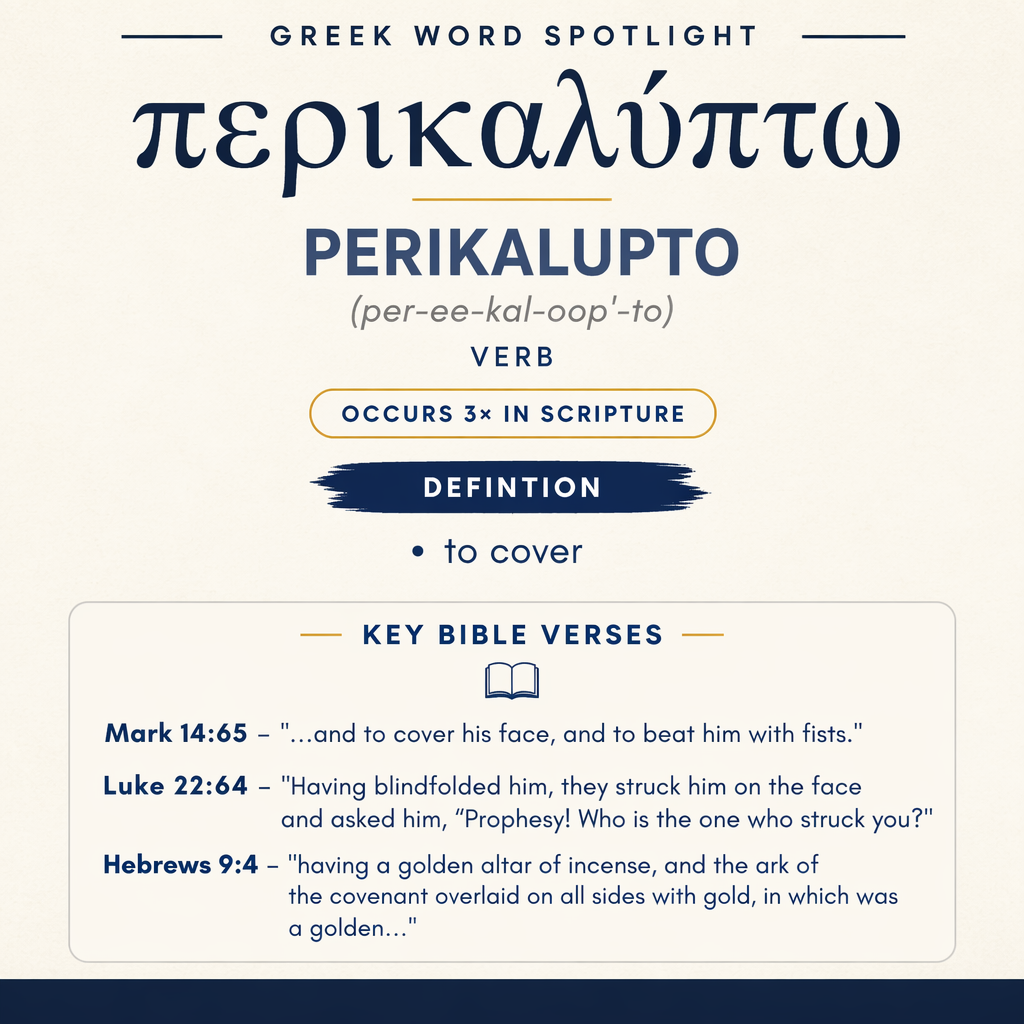
περικαλύπτω means “to cover” and occurs three times: Mark 14:65, Luke 22:64, and Hebrews 9:4.
Gospel Scenes
In Mark 14:65 it describes covering Jesus’ face during mistreatment. In Luke 22:64 it appears in the act of blindfolding him.
Learn More →Sanctuary Item
In Hebrews 9:4 it describes the ark of the covenant overlaid on all sides with gold.
Learn More →περικαλύπτω means “to cover,” and it appears in two Passion narratives describing the treatment of Jesus and once in Hebrews in a description of the tabernacle furnishings. In these three contexts the verb frames two very different kinds of covering: a hostile covering of a person’s face and a crafted covering of sacred objects with gold.
Root and Related Words
περικαλύπτω is formed from περί (peri), “about,” and καλύπτω (kalypto), “to cover.” Together they express the idea of covering in a way that involves an “about/around” dimension rather than a mere touch or partial concealment.

Occurrences
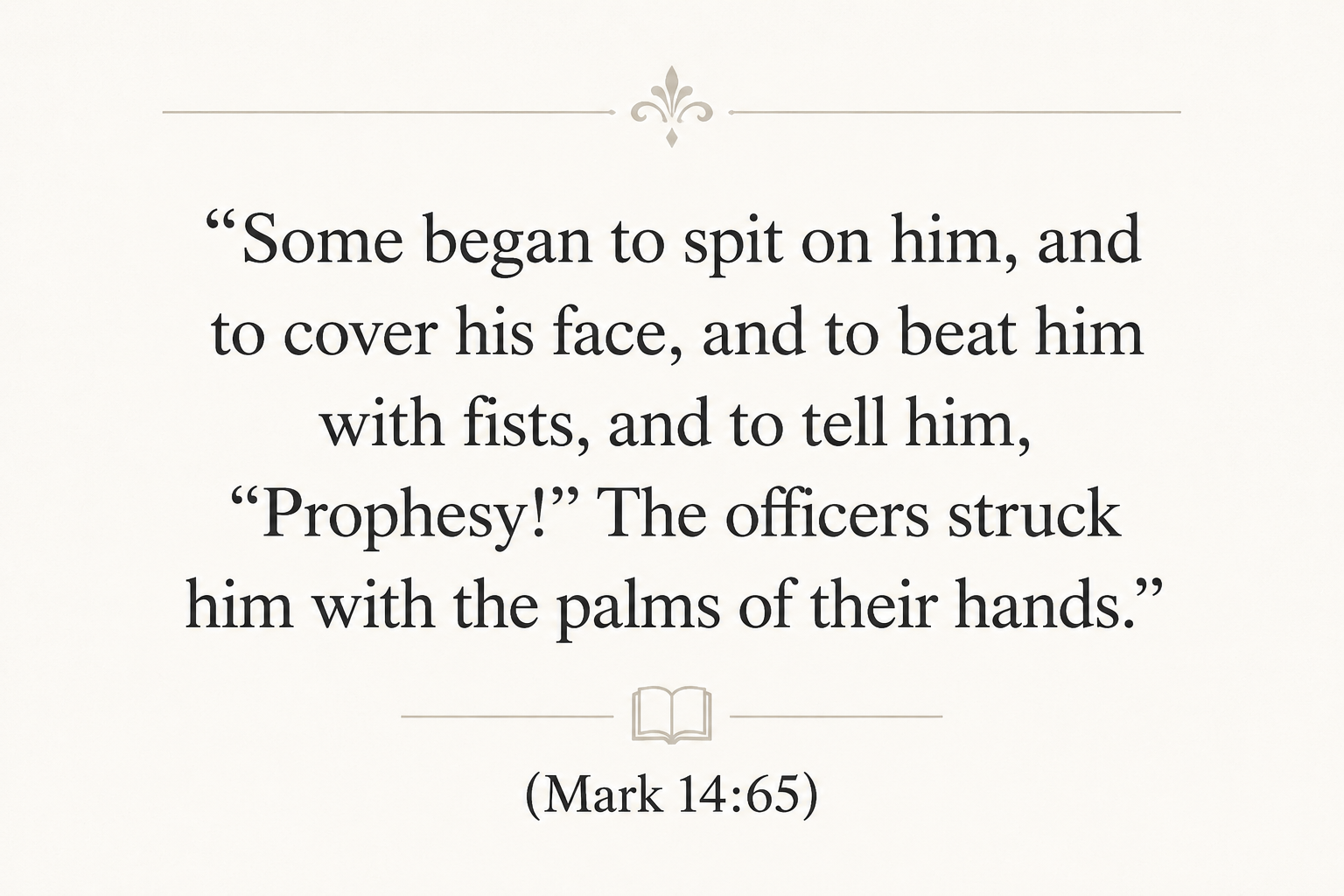
“Some began to spit on him, and to cover his face, and to beat him with fists, and to tell him, “Prophesy!” The officers struck him with the palms of their hands.” (Mark 14:65)
Here περικαλύπτω is one action in a chain of humiliations: spitting, covering his face, beating with fists, and taunting him to “Prophesy!” The covering functions as a deliberate impairment within the abuse. In the scene’s logic, the covered face pairs naturally with the mocking demand to prophesy: the abusers create conditions where identification of the assailant is obstructed, and then they ridicule him for not answering their challenge. The verb therefore contributes to the portrayal of coordinated contempt: it is not merely a physical act but an action that intensifies vulnerability and deepens the cruelty of what follows (“to beat him with fists”).
“Having blindfolded him, they struck him on the face and asked him, “Prophesy! Who is the one who struck you?”” (Luke 22:64)
Luke presents the same dynamic with a more explicit description of what the covering achieves: “Having blindfolded him.” The covering is not incidental; it is aimed at removing sight. The striking “on the face” becomes more degrading when paired with a blindfold, and the taunt is sharpened into a specific question: “Who is the one who struck you?” In this context περικαλύπτω contributes the element that makes the mockery intelligible: the abusers set up an impossible demand under imposed concealment. The verb’s force is thus tightly tied to bodily experience—sight taken away—while also serving the narrative’s emphasis on derision.
“having a golden altar of incense, and the ark of the covenant overlaid on all sides with gold, in which was a golden pot holding the manna, Aaron’s rod that budded, and the tablets of the covenant;” (Hebrews 9:4)
In Hebrews, περικαλύπτω describes the ark of the covenant as “overlaid on all sides with gold.” The covering here is purposeful craftsmanship: gold laid over the object comprehensively (“on all sides”), producing a finished surface that corresponds to the “golden” character of the furnishings mentioned in the same line (“golden altar of incense,” “golden pot”). The verb contributes a sense of thoroughness and completeness in the covering, matching the careful inventory style of the sentence. Unlike the Passion scenes, where covering is imposed to humiliate and disorient, here the covering is integral to the object’s description, specifying how the ark is made and presented.
Sense and Usage
Across these passages, “to cover” operates along two main lines: covering a person’s face and covering an object’s surface. In Mark and Luke, the verb is linked to the face and to violence. The covering is immediately adjacent to striking and is paired with taunting speech (“Prophesy!”). Because the covering is applied before or alongside blows, it heightens the asymmetry of the encounter: those doing the striking control what is seen and known, while the one struck is rendered unable to respond on ordinary terms. The action is therefore portrayed as a calculated part of the mistreatment, not as an aside.
Hebrews uses the same verb in a technical, descriptive way: the ark is “overlaid on all sides with gold.” The wording emphasizes extent—coverage that goes around and over the object rather than a small patch. In this setting, covering is not concealment but surface formation, the giving of an exterior. The verb’s contribution is material and spatial: it marks a relationship between an underlying structure and a covering layer applied to it, and it does so with language that suggests comprehensiveness (“on all sides”).
Read together, these uses show how a single act of covering can serve opposite narrative functions depending on its object and purpose. When the covered target is a face, the act restricts perception and participates in shame and assault. When the covered target is the ark, the act denotes complete overlay and belongs to a catalog of sacred items whose composition is highlighted by repeated references to gold. The shared core idea remains the same—covering—but the scenes reveal how that covering can either deprive and degrade or finish and define.
Imagery
The word’s imagery is strikingly tactile in all three passages. In Mark and Luke the covering is close and immediate—cloth or hands at the face, followed by blows—so the verb evokes enforced darkness and exposure to harm at the same time. In Hebrews the covering is still tactile, but in a different register: gold laid over an object “on all sides,” evoking a continuous gleaming surface. The same verb thus moves from the rough handling of a prisoner’s face to the careful overlay of a revered vessel, placing “covering” at the intersection of bodily vulnerability and crafted enclosure.
Sources: Lexical data from Strong’s Exhaustive Concordance and the Translators Brief Lexicon of Extended Strongs for Greek (STEPBible, CC BY). Occurrence data from the Translators Amalgamated Greek New Testament (STEPBible, CC BY). Scripture quotations from the World English Bible (public domain).




