
Exploring the Meaning of Periergazomai in Greek
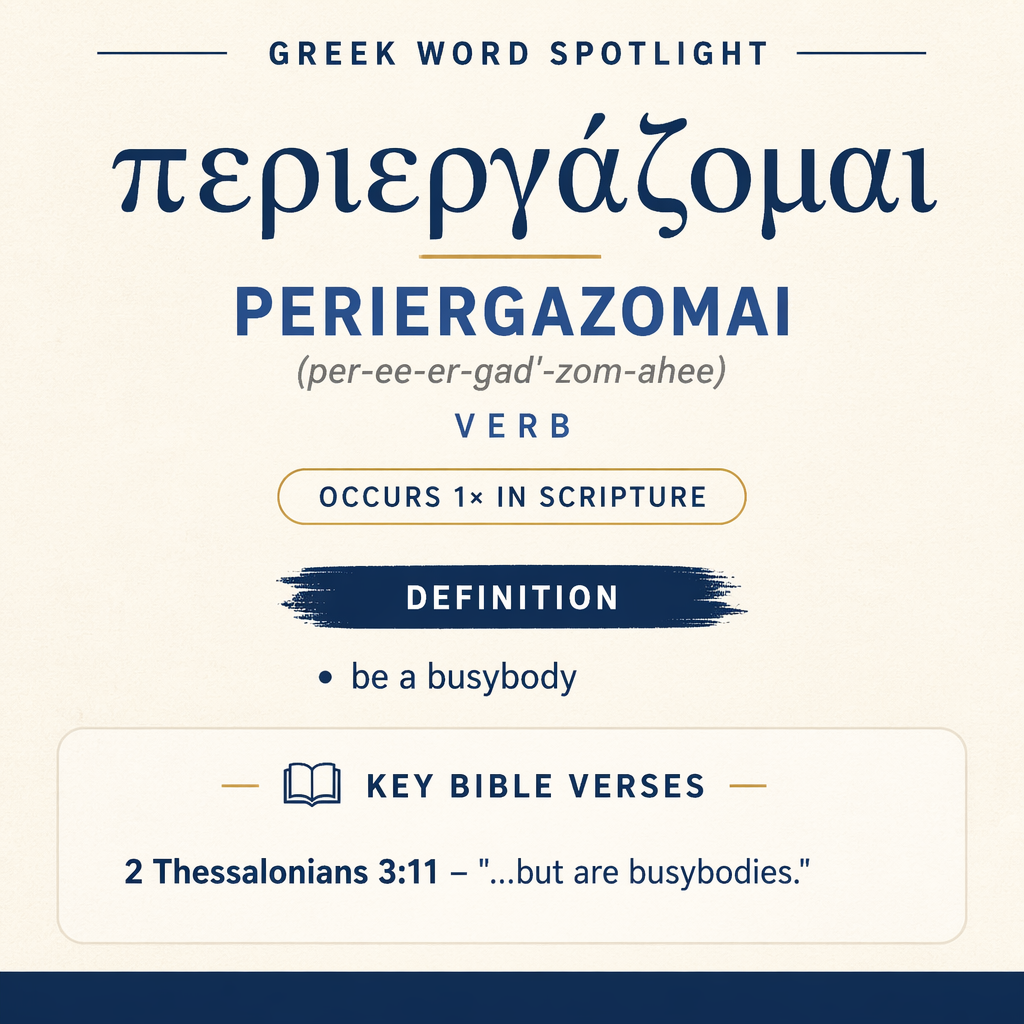
περιεργάζομαι (Periergazomai) means “be a busybody” and appears once in Scripture, in 2 Thessalonians 3:11.
Scripture Occurrence
This verb occurs 1 time in Scripture. Its occurrence is in 2 Thessalonians 3:11.
Learn More →Verse Context
In 2 Thessalonians 3:11, it describes some who don’t work at all, but are busybodies.
Learn More →περιεργάζομαι means “be a busybody,” and it appears once in the New Testament, in Paul’s instruction to the Thessalonian church. In its single attestation it names a pattern of behavior contrasted with honest work and orderly conduct.
Root and Related Words
Periergazomai (περιεργάζομαι) is formed from peri (περί), “about” (Strong’s G4012), and ergazomai (ἐργάζομαι), “to work” (Strong’s G2038). The combined shape of the word places the idea of “about/around” alongside the verb for working, yielding a term that, in its New Testament use, labels a kind of activity that is not straightforward labor.

Occurrences
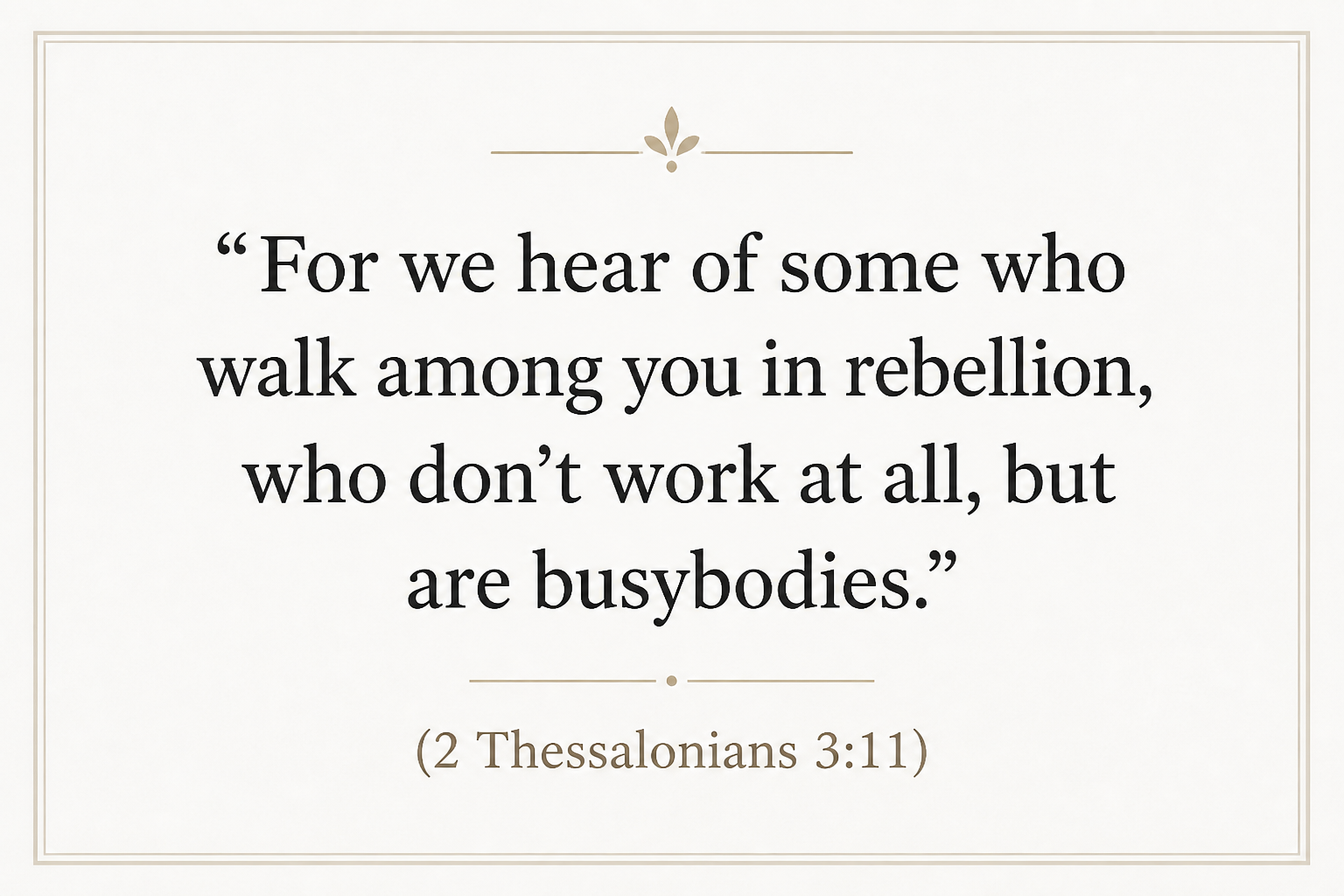
“For we hear of some who walk among you in rebellion, who don’t work at all, but are busybodies.” (2 Thessalonians 3:11)
Here periergazomai characterizes certain people by setting them in a three-part description. First, they “walk among you in rebellion,” a relational and communal context: their conduct is not private but visible “among” the church. Second, they “don’t work at all,” a blunt denial of productive labor; the line does not merely say they work poorly or less, but that they are inactive with respect to work. Third, in place of working, they “are busybodies,” which periergazomai supplies as the alternative activity filling that vacuum. The force of the clause lies in the contrast: the term marks a kind of busyness that exists alongside, and even instead of, the work they refuse to do.
The sentence begins, “For we hear of some…,” framing the behavior as a known report within the community and giving the description a corrective purpose. Within that correction, periergazomai functions as a diagnostic label. It does not stand alone as a general insult; it is tied to two surrounding realities stated in the verse: a disorderly way of “walk[ing] among you,” and a refusal to “work at all.” The word therefore contributes to Paul’s portrayal of a disruptive presence: active enough to be noticed and to affect others, yet not engaged in the labor that would mark a settled, obedient life in the congregation.
Sense and Usage
In its lone New Testament occurrence, periergazomai names “busybody” behavior as a distinct kind of activity—busy, but misdirected. The verse sets up an implicit moral and communal contrast between legitimate work and illegitimate busyness. Because “don’t work at all” and “are busybodies” are placed side by side, the term belongs to the realm of actions that can look like occupation while remaining a refusal of real work. The language suggests motion and involvement (“walk among you”), but the busyness is cast as part of the rebellion rather than as service.
The immediate context within the verse gives the word its contours. It is associated with “rebellion,” meaning it is not merely an eccentric personality trait but a form of conduct that resists the expected order of the community. It is also paired with idleness regarding work (“don’t work at all”), which implies that this “busyness” is not the productive kind that meets responsibilities. Taken together, the term points to a pattern: people can be active in a way that consumes attention and stirs activity while still failing to do the work that should occupy them.
Periergazomai also carries a social dimension in this sentence. The phrase “walk among you” locates the conduct in ongoing interaction with others, and the label “busybodies” naturally fits behavior that involves oneself in matters around one’s neighbors. Within this single use, the word is not defined by an abstract dictionary explanation but by its placement in the sentence: it is what some are doing while not working, and it is part of the disorder that Paul has “hear[d]” is present. The term therefore functions as a pastoral categorization, naming a recognizable, troubling posture in communal life.
Imagery
The picture evoked by 2 Thessalonians 3:11 is of people moving “among” the believers—present, active, and involved—yet characterized by a refusal to “work at all.” In that setting, periergazomai paints a kind of restless motion: energy spent in the community without the grounding of labor, an activity that becomes part of “rebellion” rather than a contribution to the church’s wellbeing.
Sources: Lexical data from Strong’s Exhaustive Concordance and the Translators Brief Lexicon of Extended Strongs for Greek (STEPBible, CC BY). Occurrence data from the Translators Amalgamated Greek New Testament (STEPBible, CC BY). Scripture quotations from the World English Bible (public domain).




