
Exploring the Meaning of Perge in Greek
Πέργη (Perge) means Perga and appears three times in Acts (13:13–14; 14:25).
Acts References
It occurs three times in Scripture: Acts 13:13, Acts 13:14, and Acts 14:25.
Learn More →Narrative Context
In Acts, Paul and his company came to Perga in Pamphylia, passed on from Perga, and later spoke the word in Perga.
Learn More →Πέργη (Perge), “Perga,” is a place-name occurring in Acts in the travel narrative of Paul and his companions. In these passages it marks a point of arrival, departure, and ministry activity within the sequence of locations named.

Root and Related Words
Perge is related to Πέργαμος (Pergamos), “Pergamum” (Strong’s G4010).
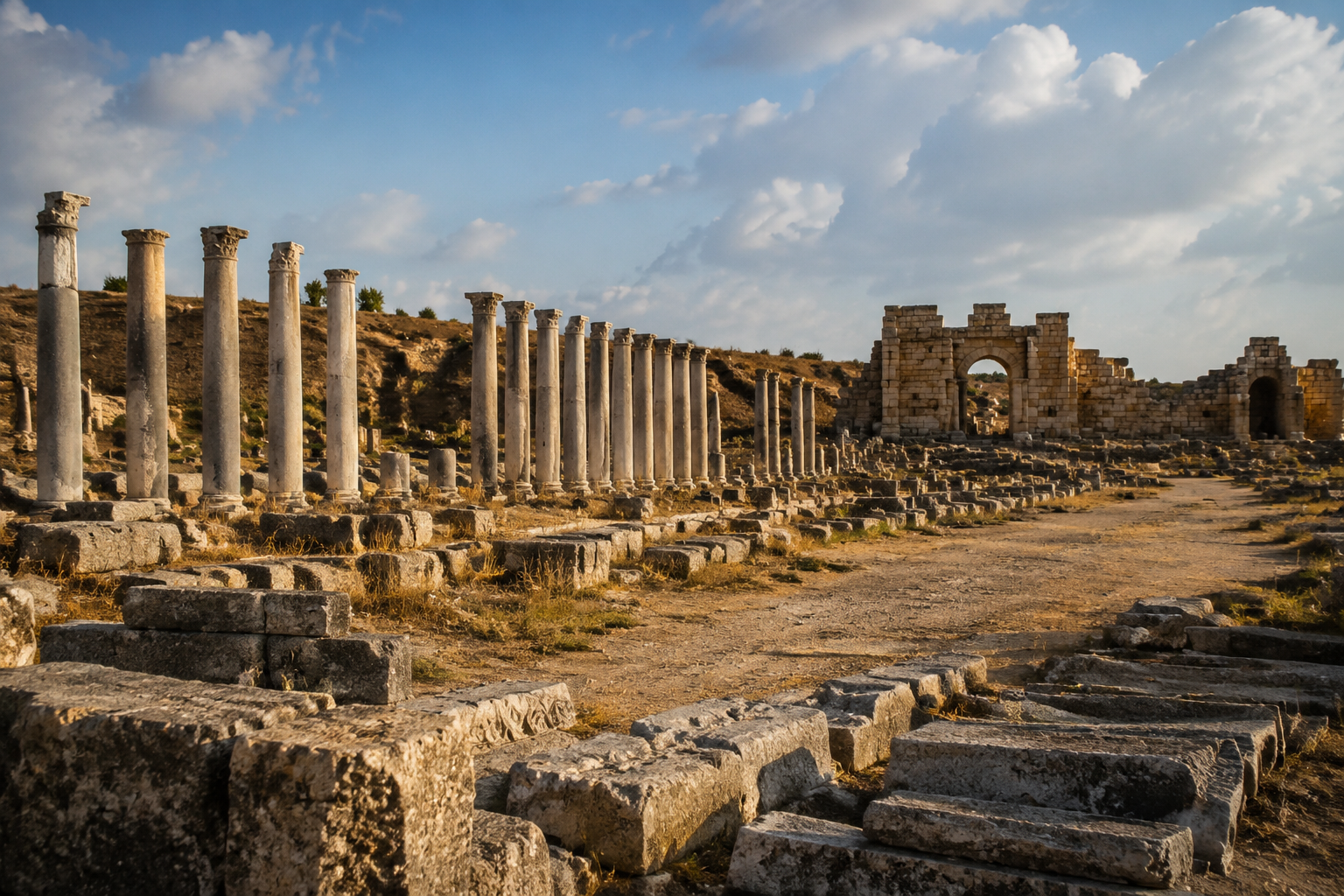
Occurrences
“Now Paul and his company set sail from Paphos, and came to Perga in Pamphylia. John departed from them and returned to Jerusalem.” (Acts 13:13)
Here Perga functions as a concrete destination reached by sea travel: Paul and his company “set sail” and “came to Perga in Pamphylia.” The wording places Perga within a wider regional description (“in Pamphylia”), locating it on the itinerary with enough precision to situate the reader geographically inside the story. Within the same sentence, the narrative connects the arrival at Perga with a change in the group’s composition: “John departed from them and returned to Jerusalem.” Perga therefore stands as the setting at which a separation takes place, not through a description of the city itself, but by anchoring a relational and directional shift—one person turning back toward Jerusalem while the rest continue onward.
“But they, passing on from Perga, came to Antioch of Pisidia. They went into the synagogue on the Sabbath day, and sat down.” (Acts 13:14)
In this verse Perga appears in a transitional phrase—“passing on from Perga”—that highlights movement away from the location rather than arrival into it. The narrative rhythm is quick: from Perga they “came to Antioch of Pisidia,” and from that arrival the next action follows immediately: “They went into the synagogue on the Sabbath day, and sat down.” Perga’s role is to mark the starting point of the next leg of travel, serving as a hinge between one location and the next. Because the verse supplies no additional action at Perga itself, the place-name works almost like a waypoint in the itinerary, allowing the reader to track continuity: the same group that had arrived in the prior scene now continues, with Antioch of Pisidia presented as the next significant setting for public activity.
“When they had spoken the word in Perga, they went down to Attalia.” (Acts 14:25)
Perga is presented here not only as a point on a route but as a setting for verbal proclamation: “they had spoken the word in Perga.” The expression gives Perga a ministry association within the travel account, contrasting with the earlier mentions that emphasize arrival and departure. The sentence also conveys directional movement immediately afterward: “they went down to Attalia.” Perga thus sits between speaking and traveling—first a completed act (“had spoken”), then a change of location (“went down”). Even without further detail about the audience or circumstances, the verse ties Perga to a purposeful stop, not merely passing through but engaging in speech there before continuing.
Sense and Usage
Across these passages, “Perga” functions as a stable geographical anchor in a narrative that is otherwise characterized by motion: setting sail, coming, passing on, speaking, and going down. The name is used in straightforward locative constructions that connect actions to a map-like sequence of places. In Acts 13:13, the phrasing “came to Perga in Pamphylia” situates Perga within a broader region, giving the place-name a clarifying role within the travel log. In Acts 13:14, Perga is not the focus of the action but the point of departure—language that treats the location as already known within the flow of the narrative, a place left behind as the group advances to Antioch of Pisidia. In Acts 14:25, Perga appears again, now explicitly linked with the act of “spoken the word,” so the place-name carries not only directional significance but also a remembered association with what the travelers did there.
The repeated use of Perga in close proximity to other locations (“Paphos,” “Jerusalem,” “Antioch of Pisidia,” “Attalia”) shows how a place-name can serve multiple narrative functions without changing its reference: it can mark a destination reached, a starting point departed, and a site in which a key activity occurs. The surrounding verbs define the role Perga plays at each moment. “Came to” frames it as arrival; “passing on from” frames it as departure; “spoken the word in” frames it as the sphere where speech occurs; “went down to” frames it as a point above the next destination in the sequence. In this way, Perga’s sense as a place is constant, while its usage shifts with the storyline’s needs: locating a separation (John’s departure), indicating continued progress (the move to Antioch of Pisidia), and indicating purposeful engagement before moving on (speaking the word prior to going down to Attalia).
Imagery in Acts
The imagery attached to Perga in these verses is the imagery of travel and transitions. It appears at the end of a sea journey (“set sail … and came to Perga”), at the beginning of an overland movement (“passing on from Perga”), and as a pause in which speech is completed before descent to another location (“had spoken the word in Perga, they went down to Attalia”). Without describing its streets or landmarks, Acts uses the name Perga to place the reader at a real stop on a real route, where decisions are made, movement continues, and proclamation happens in the midst of ongoing travel.
Sources: Lexical data from Strong’s Exhaustive Concordance and the Translators Brief Lexicon of Extended Strongs for Greek (STEPBible, CC BY). Occurrence data from the Translators Amalgamated Greek New Testament (STEPBible, CC BY). Scripture quotations from the World English Bible (public domain).




