
Exploring the Meaning of Pera in Greek
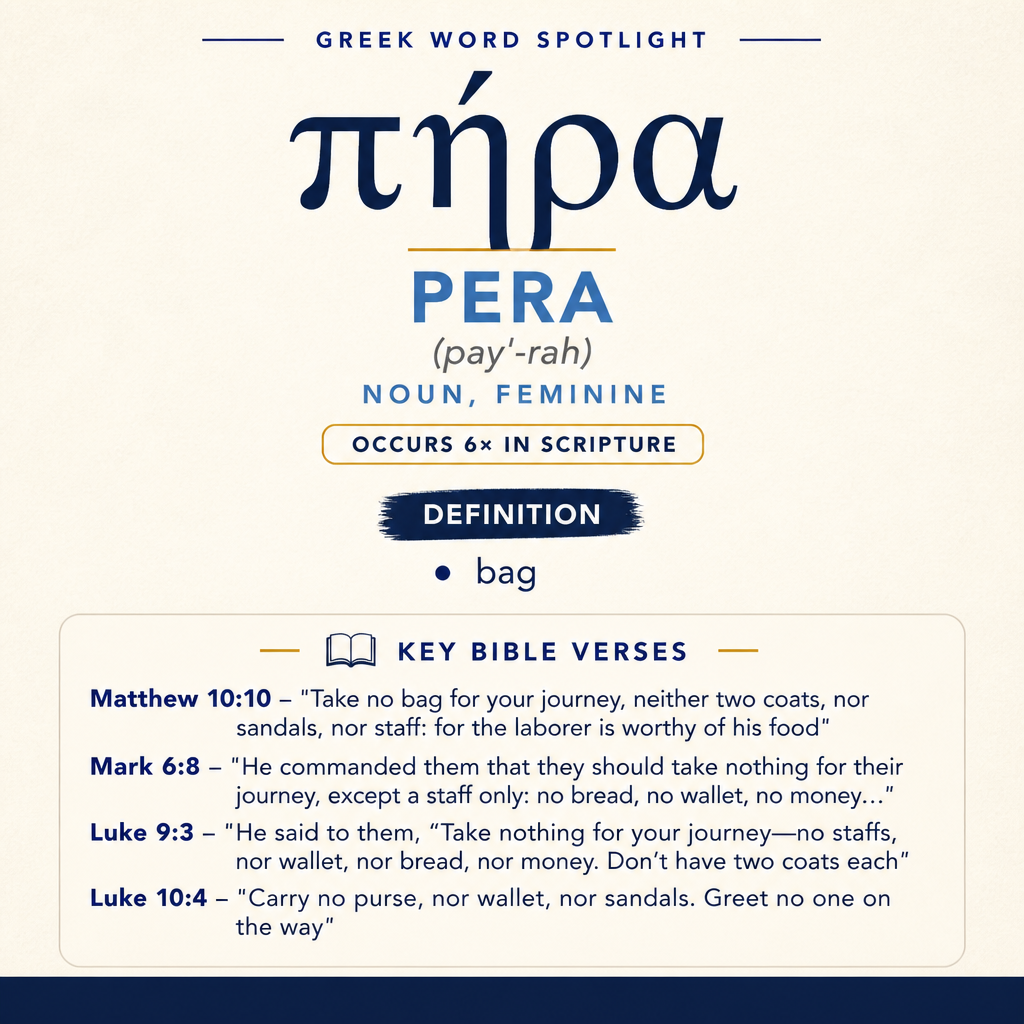
πήρα means “bag” and appears six times in the Gospels (Matthew 10:10; Mark 6:8; Luke 9:3; 10:4; 22:35–36).
Gospel Occurrences
It occurs 6 times in Scripture. All six occurrences are in Matthew, Mark, and Luke.
Learn More →Travel Instructions
In Matthew 10:10 and Luke 9:3–10:4, disciples are told to take no bag/wallet for their journey. In Luke 22:35–36, Jesus recalls being sent without it and then instructs taking it.
Learn More →πήρα means “bag” and appears in Jesus’ instructions about what to take—or not take—on a journey. In these passages the bag functions as a concrete travel item set alongside other provisions, so its presence or absence helps frame the kind of dependence and readiness expected of the traveler.
Occurrences
“Take no bag for your journey, neither two coats, nor sandals, nor staff: for the laborer is worthy of his food.” (Matthew 10:10)
Here the “bag” is named first among items the disciples are told not to take “for your journey.” The word contributes to a list of ordinary travel gear—extra clothing (“two coats”), footwear (“sandals”), and support for the road (“staff”). In that cluster, the bag represents a basic means of carrying supplies, and the prohibition makes the journey intentionally unencumbered. The closing reason, “for the laborer is worthy of his food,” sets the lack of a bag within a framework of provision: the travelers are not to pack as though they must secure and transport all necessities themselves.
“He commanded them that they should take nothing for their journey, except a staff only: no bread, no wallet, no money in their purse,” (Mark 6:8)
Mark’s version places the bag within a broader prohibition: “take nothing for their journey,” with a single exception (“except a staff only”). The bag appears as “wallet” in this verse and is paired with consumables and cash: “no bread… no money.” The bag is not treated as a neutral container but as part of a travel kit that would normally support self-sufficiency on the road—carrying food and funds. The command strips the travelers down to what can be held without such a container, intensifying the sense of going out with minimal material backing.
“He said to them, “Take nothing for your journey—no staffs, nor wallet, nor bread, nor money. Don’t have two coats each.” (Luke 9:3)
In Luke 9, the bag (“wallet”) is again embedded in a set of ordinary provisions: walking support (“staffs”), food (“bread”), and money. The line “Take nothing for your journey” is immediately unpacked in practical terms, and the bag is one of the concrete ways a traveler would ordinarily prepare. Luke’s inclusion of “Don’t have two coats each” brings the bag into a scene of reduced baggage overall: not only is a carrying bag excluded, even spare clothing is excluded. The bag thus helps define the journey as one undertaken without stored resources and without the usual means of transporting them.
“Carry no purse, nor wallet, nor sandals. Greet no one on the way.” (Luke 10:4)
In Luke 10, the prohibition is phrased as “Carry no…,” foregrounding the physical act of bearing travel items. The bag (“wallet”) sits between “purse” and “sandals,” bridging money-storage and basic travel wear. By coupling the instruction with “Greet no one on the way,” the verse ties the absence of a bag to urgency and focus: the travelers are not to be delayed, and they are not to move as people prepared to manage and transport their own supplies. The bag, as an object that would normally be carried, underlines the practical simplicity of the mission: fewer items to handle, fewer resources to manage.
“He said to them, “When I sent you out without purse, wallet, and sandals, did you lack anything?” They said, “Nothing.”” (Luke 22:35)
This retrospective question makes the bag part of a remembered sending: “without purse, wallet, and sandals.” The bag is no longer only a command in the moment but a marker of the earlier conditions of travel. Jesus’ question, “did you lack anything?” invites an assessment of outcomes under that minimalist equipment list. The reply, “Nothing,” places the missing bag within a testimony of sufficiency. The word thereby helps define what “without” looked like in practice—no carrying bag alongside no money-container and no spare footwear—and it anchors the claim that the earlier mission did not result in unmet needs.
“Then he said to them, “But now, whoever has a purse, let him take it, and likewise a wallet. Whoever has none, let him sell his cloak, and buy a sword.” (Luke 22:36)
Luke 22:36 sets the bag within a sharp contrast: “But now… let him take it.” The bag (“wallet”) is explicitly reinstated as appropriate equipment, parallel to “purse.” The instruction recognizes two situations: those who already “has” such an item should “take it,” and those who “has none” should make costly provision (“sell his cloak”) to acquire another item (“buy a sword”). Within that frame, the bag functions as standard travel gear that can and should be carried under the changed circumstances. The verse does not describe the bag’s contents, but by pairing it with “purse” it treats it as part of what a prepared traveler brings along.

Sense and Usage
Across these passages πήρα (“bag”) consistently denotes a practical object associated with travel. The word’s sense is shaped less by description of its materials or design than by how it is positioned among other necessities: clothing, footwear, staff, bread, money, and purse. In Matthew 10:10 the bag is one item in a list of things not to take “for your journey,” and that setting makes the bag stand for the ordinary means of transporting provisions. Mark 6:8 and Luke 9:3 press the same point by coordinating the bag with “bread” and “money,” items a traveler would normally carry; the bag belongs to a bundle of self-provisioning tools that are deliberately set aside.
Luke 10:4 shows that the bag can be spoken of primarily as something to be “carried,” and its collocation with purse and sandals gives it a place at the intersection of financial readiness and basic travel readiness. In Luke 22:35–36 the bag becomes a hinge term for comparison between two stages. First, it marks the earlier sending as one conducted “without” such equipment, which is then interpreted in terms of experienced sufficiency (“Nothing”). Second, it is explicitly permitted and even expected in a new situation (“whoever has… let him take it, and likewise a wallet”). This contrast does not change what the bag is; it changes what carrying a bag signifies in that moment. In one stage, the absence of a bag is integral to the mission’s manner of travel. In another stage, having and taking a bag is treated as appropriate preparedness.
Because the bag repeatedly appears in lists rather than in isolation, its usage is best read in its company: it is one of the ordinary items by which a traveler organizes and transports what is needed. When prohibited, it supports a pattern of going out with minimal personal provisions. When allowed, it supports a pattern of taking up ordinary travel resources in response to altered conditions. In both cases, the bag serves as a concrete, easily understood piece of travel equipment that helps the instruction land in everyday terms.
Imagery
The repeated mention of a bag among staffs, coats, sandals, bread, and money gives these sayings a plain road-side texture: the listener can picture what it means to set out with or without the usual kit. In Luke 22 the imagery becomes especially vivid because the bag is part of a before-and-after comparison—an earlier journey remembered as lacking nothing despite traveling without it, and a later moment where taking it is directly enjoined. The bag thus functions as a small, tangible object through which the sayings sketch two different postures on the road: traveling unburdened, and traveling equipped.
Sources: Lexical data from Strong’s Exhaustive Concordance and the Translators Brief Lexicon of Extended Strongs for Greek (STEPBible, CC BY). Occurrence data from the Translators Amalgamated Greek New Testament (STEPBible, CC BY). Scripture quotations from the World English Bible (public domain).




