Exploring the Meaning of Parektos in Greek
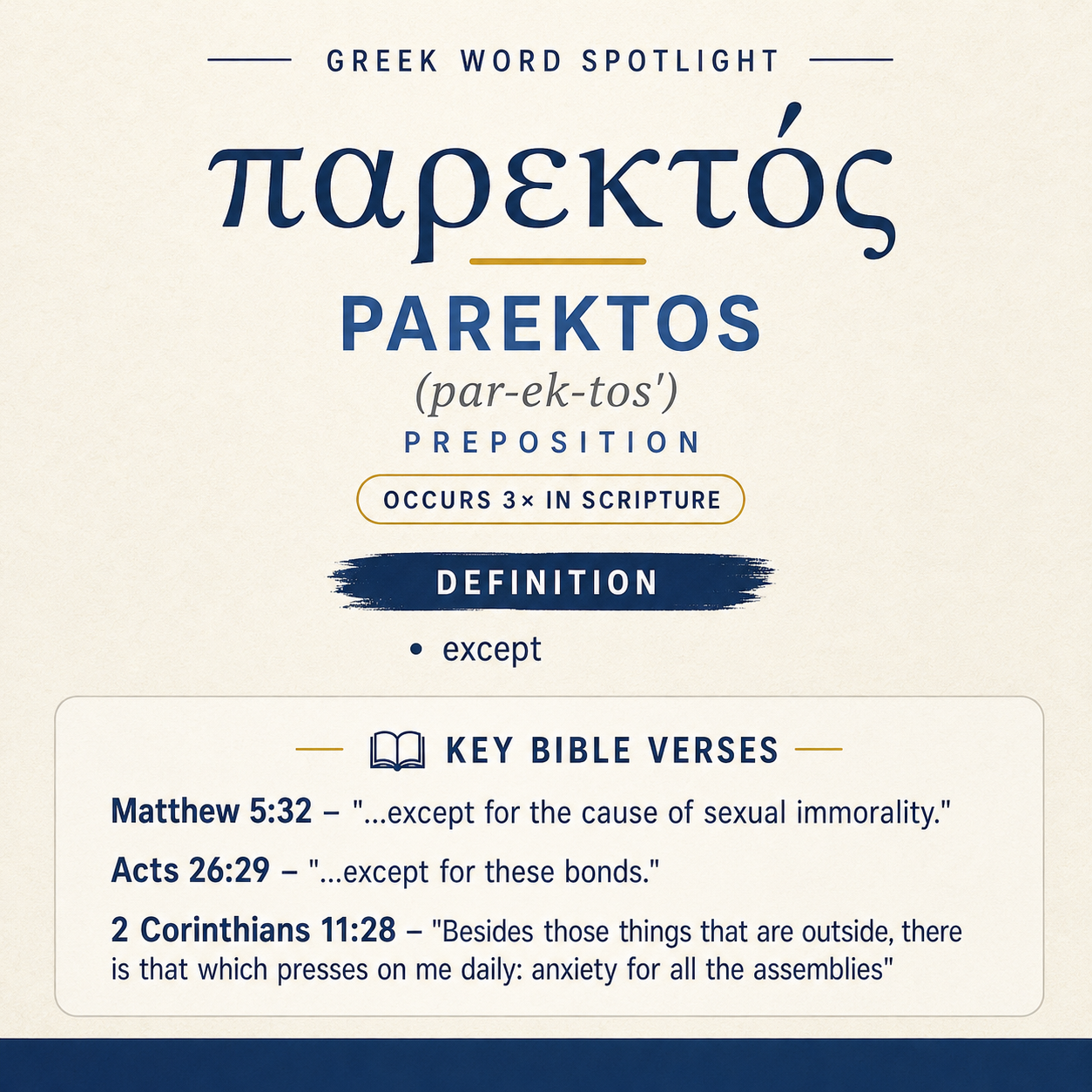
παρεκτός means “except” and appears three times in Scripture: Matthew 5:32, Acts 26:29, and 2 Corinthians 11:28.
Core Meaning
παρεκτός is defined as “except.” It marks an exclusion or exception in a statement.
Learn More →Gospel Example
In Matthew 5:32, it introduces an exception: “except for the cause of sexual immorality.” The word frames the stated condition.
Learn More →Other Occurrences
It also occurs in Acts 26:29 and 2 Corinthians 11:28. These three references account for all of its Scripture occurrences.
Learn More →παρεκτός (Parektos) marks an exception within a stated claim, delimiting what is included by naming what is excluded. In the New Testament it appears in Matthew 5:32, Acts 26:29, and 2 Corinthians 11:28, each time tightening the scope of what is being asserted.
Root and Related Words
Parektos corresponds to a form built from ἐκτός (ektos), “outside/except” (Strong’s G1622), and παρά (para), “from/with/beside” (Strong’s G3844). The combination yields a compact marker for setting something off to the side as the one stated exclusion from what otherwise holds.

Occurrences
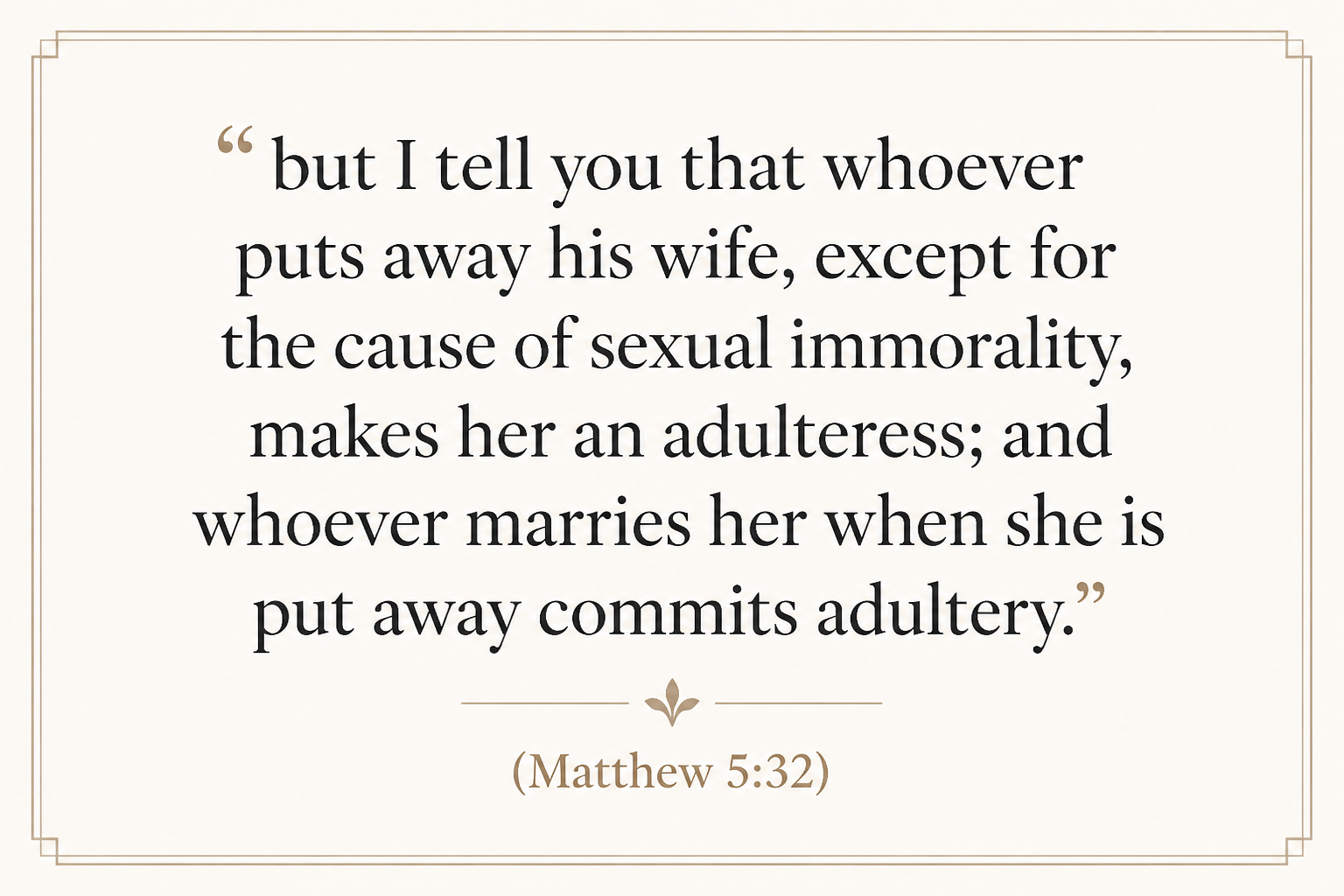
“but I tell you that whoever puts away his wife, except for the cause of sexual immorality, makes her an adulteress; and whoever marries her when she is put away commits adultery.” (Matthew 5:32)
Here parektos functions as a legal-style limiter inside a tightly framed conditional statement. The sentence lays down a general rule (“whoever puts away his wife … makes her an adulteress”) and then inserts an exception clause that narrows the reach of that rule (“except for the cause of sexual immorality”). The word does not add a separate command; it shapes the boundaries of the claim being made. As a result, the reader is forced to read the whole statement with precision: the general outcome described is presented as applying broadly, but not in the specified excluded circumstance.
Because the exception is embedded in the middle of the line, parektos also controls how the surrounding phrases connect: it binds the exclusion directly to the act of “put[ting] away his wife,” clarifying that the speaker’s point is not an unqualified pronouncement but one that has an explicit boundary. In this scene, parektos has the practical effect of distinguishing a general case from a single named case that stands outside it.
“Paul said, “I pray to God, that whether with little or with much, not only you, but also all that hear me today, might become such as I am, except for these bonds.” (Acts 26:29)
In Paul’s closing line to his hearers, parektos frames an exception not to a rule but to a wished-for identification. Paul expresses a prayer that his audience might “become such as I am,” and the exception immediately qualifies what kind of likeness he desires for them. The phrase “except for these bonds” sets one feature of his present situation outside the scope of the comparison. The word therefore keeps the wish from being misunderstood as a desire for others to share his imprisonment.
Within the rhetoric of the verse, the exception is pointed and concrete. Paul’s statement extends broadly (“not only you, but also all that hear me today”), and parektos provides the one boundary that prevents the wish from collapsing into mere sentimentality or into a call for others to copy his afflictions. The exclusion is expressed with a demonstrative immediacy (“these bonds”), and parektos turns that visible reality into the precise item withheld from the otherwise sweeping wish.
“Besides those things that are outside, there is that which presses on me daily: anxiety for all the assemblies.” (2 Corinthians 11:28)
In this verse parektos introduces an addition set alongside earlier burdens. The line contrasts “those things that are outside” with an inward, continuing pressure: “there is that which presses on me daily: anxiety for all the assemblies.” By placing “Besides those things that are outside” first, the sentence establishes one category and then moves to another that weighs on Paul “daily.” In this context, parektos functions to distinguish what lies outside from what continually bears upon him, setting up the shift from external matters to the persistent concern named in the verse.
The result is a structured accounting: one set of pressures is acknowledged as existing “outside,” yet Paul singles out an additional burden that is not simply occasional but recurrent. Parektos serves as the hinge that allows the sentence to move from one category to another without confusing them, so that the “anxiety for all the assemblies” stands out as its own pressing reality alongside the outside matters already mentioned.
Sense and Usage
Across these passages, parektos works as a boundary-setting term: it draws a clear line around what the speaker is affirming by naming what stands as the stated exception. In Matthew 5:32 it carves out a specific circumstance within a morally weighty claim, shaping how the audience must apply the statement. In Acts 26:29 it limits a desired likeness, preserving the core of Paul’s wish while excluding a particular feature of his current condition. In 2 Corinthians 11:28 it separates categories of concern, allowing an additional burden to be named as distinct from what has already been placed in view.
Although the surrounding contexts differ—an authoritative instruction, a personal appeal, and a description of ongoing pressures—parektos consistently performs the same discourse task: it prevents overextension. The word forces attention to scope: what is being said is not meant to be taken in an unlimited way, but with a specific exclusion in mind. That scope-control can be restrictive (limiting a general statement by excluding one case), protective (excluding “these bonds” from what others should share), or organizational (distinguishing one set of matters from another). In each setting, the word’s value is its precision: it turns broad language into carefully bounded language.
Imagery
The imagery surrounding parektos is the imagery of boundaries and singled-out items. Matthew 5:32 pictures an exception clause placed within a relational crisis, marking one stated case that stands apart. Acts 26:29 places the exception on something tangible—“these bonds”—so the exclusion is as visible as the chains themselves. 2 Corinthians 11:28 uses the language of pressures and categories (“outside” matters versus a daily pressing anxiety), and parektos creates the conceptual separation that lets the reader feel the weight of what is added to an already heavy load.
Sources: Lexical data from Strong’s Exhaustive Concordance and the Translators Brief Lexicon of Extended Strongs for Greek (STEPBible, CC BY). Occurrence data from the Translators Amalgamated Greek New Testament (STEPBible, CC BY). Scripture quotations from the World English Bible (public domain).