
Exploring the Meaning of Parateino in Greek
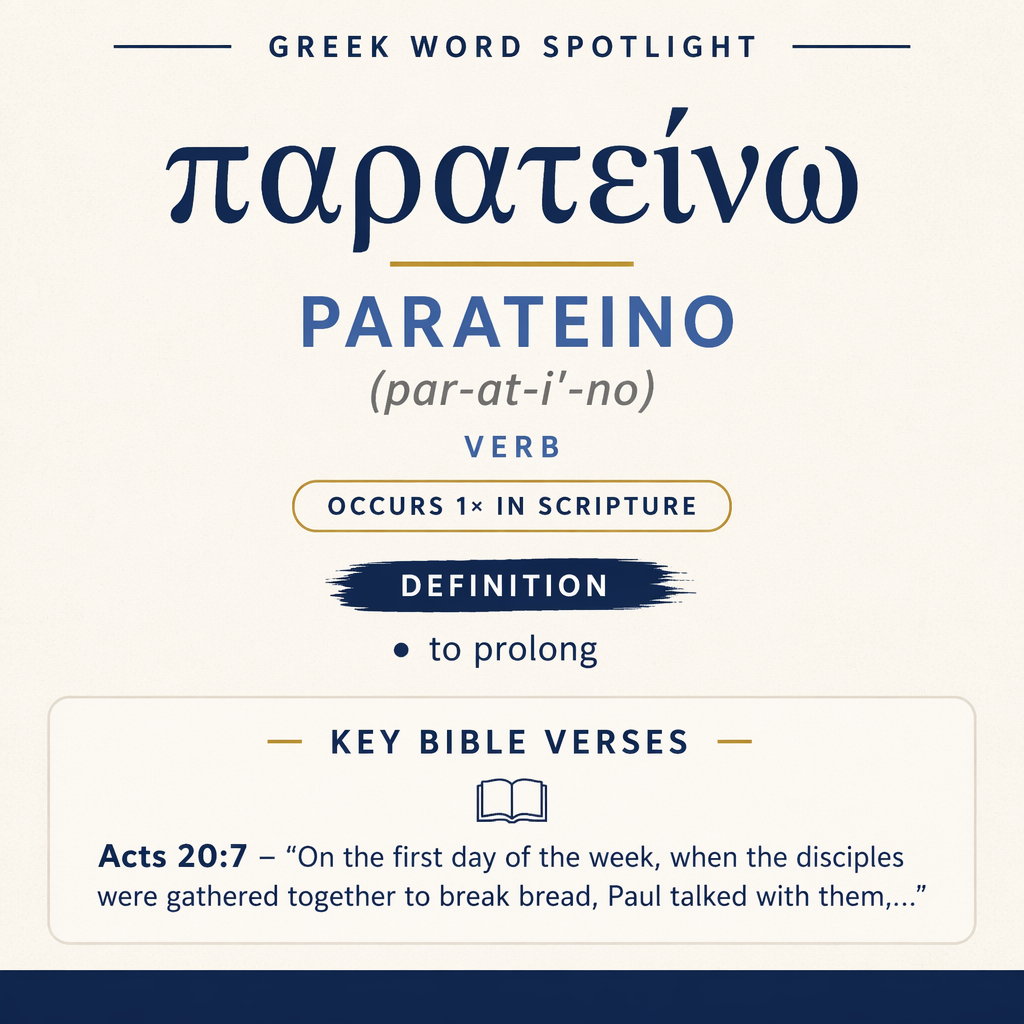
παρατείνω means “to prolong” and appears once in Scripture, in Acts 20:7.
Verse Context
In Acts 20:7, Paul talked with the gathered disciples, intending to prolong.
Learn More →παρατείνω means “to prolong.” It appears in the narrative of Paul’s final visit with the believers at Troas, where his public speaking stretches late into the night.
Root and Related Words
παρατείνω is connected with the preposition παρά (para), glossed “from/with/beside.” In this verb, the presence of παρά helps frame the action as something extended beyond an expected point in the flow of events.

Occurrences
“On the first day of the week, when the disciples were gathered together to break bread, Paul talked with them, intending to depart on the next day, and continued his speech until midnight.” (Acts 20:7)
In this scene the setting is already marked by purpose and time: “the first day of the week,” a gathering “to break bread,” and a clear travel plan—Paul is “intending to depart on the next day.” Against that schedule, παρατείνω characterizes how Paul’s address relates to the hours available. The statement “continued his speech until midnight” ties the action to a concrete endpoint and makes the length of the discourse part of the narrative emphasis. The word contributes the idea that the speaking is not brief or incidental; it is extended, carried forward as time advances, until a late-night boundary is reached.
The surrounding details in the verse show why this extension matters. The disciples’ gathering has a defined communal focus (“gathered together to break bread”), but Paul’s talk occupies substantial space within the meeting. The next-day departure places natural pressure on the moment: this is not an open-ended stay, but an imminent parting. Within that tension, παρατείνω presents the speech as deliberately lengthened rather than abruptly concluded. The narrative effect is to depict a meeting in which instruction or exhortation is allowed to run long because the opportunity is limited and the departure is near; the time reference “until midnight” makes that prolonging measurable and vivid.

Sense and Usage
As used here, “to prolong” functions as a temporal verb that measures an action not by its content but by its duration. The verse does not describe the subject matter of Paul’s speech, but it does highlight its length, and παρατείνω is the hinge that turns a simple report (“Paul talked with them”) into a scene marked by extended time. The prolonging is expressed with an explicit terminus (“until midnight”), so the sense is not merely “to continue” in a general way, but to continue in such a way that the passage of hours becomes a notable feature of the event.
The context gives the prolonging a pragmatic contour. A speaker might prolong a discourse for many reasons, but the verse frames the length in relation to the schedule: Paul “intending to depart on the next day.” In that framework, prolonging is the stretching of a present opportunity right up to a late hour. The disciples’ assembly is not portrayed as scattered or distracted; it is cohesive enough that an extended address is possible within the gathering. Thus the verb contributes a social and narrative reality: a community meeting that endures into the night, with the speaker drawing out the time available before leaving.
The presence of the related preposition παρά (“from/with/beside”) also suits the way the verse reads as a whole. The meeting occurs alongside ordinary temporal expectations—people gather on a day, share a meal, and anticipate tomorrow’s travel—yet the speech is prolonged beside those expectations, extending beyond what the impending departure might otherwise suggest. Without adding new meanings, the combination of the verb’s sense with the time marker (“until midnight”) makes the prolonging feel like an intentional extension beyond a natural stopping point.
Because this word is attested here in a narrative report, its force is concrete rather than abstract: it places the reader inside an evening that runs late. The prolonging is not an internal feeling of time but a publicly observable fact about the meeting—hours pass, and the speech remains in progress. In that way παρατείνω serves as a narrative tool that compresses many moments into one line while still conveying the weight of the time invested.
Implied Imagery
The single use of παρατείνω in Acts 20:7 carries the imagery of time being stretched across an evening gathering. The verse paints the movement from an ordinary meeting point—believers assembled for a shared act of fellowship—through the steady advance of night “until midnight,” with the prolonged speech spanning the interval and making the lateness itself part of the scene.
Sources: Lexical data from Strong’s Exhaustive Concordance and the Translators Brief Lexicon of Extended Strongs for Greek (STEPBible, CC BY). Occurrence data from the Translators Amalgamated Greek New Testament (STEPBible, CC BY). Scripture quotations from the World English Bible (public domain).




