
Exploring the Meaning of Paraptoma in Greek
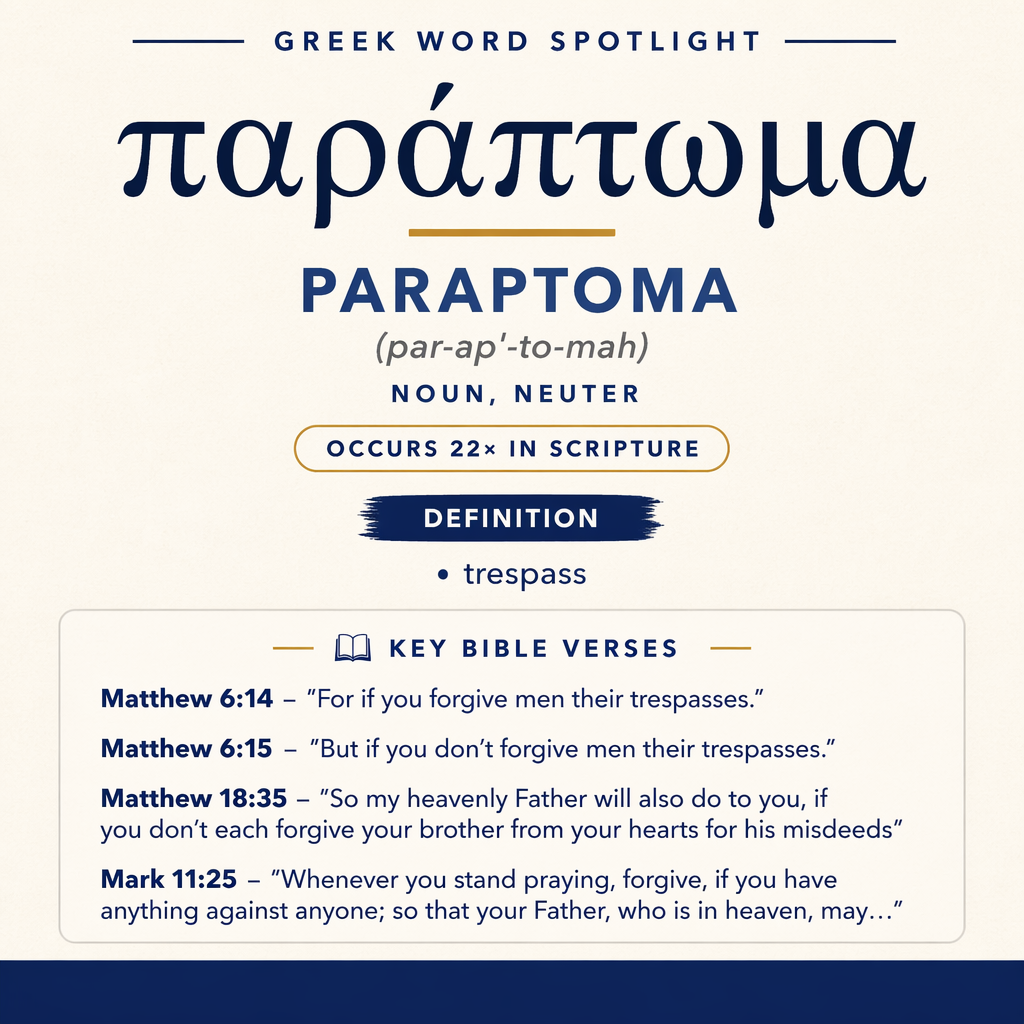
παράπτωμα means “trespass” and occurs 22 times in Scripture, including in Matthew, Mark, and Romans.
Gospel Context
In Matthew 6:14–15 and Mark 11:25–26, it appears in teaching about forgiving others’ trespasses.
Learn More →Romans Context
In Romans 4:25 and Romans 5:15–16, it is used in statements about trespass, judgment, and God’s free gift.
Learn More →παράπτωμα names a “trespass,” an act spoken of as something that can be forgiven, counted, and set in contrast with grace and justification. In the passages where it appears, it ranges from interpersonal wrongs requiring forgiveness to the representative trespass that brings condemnation and death, and the many trespasses answered by a justifying gift.
Occurrences
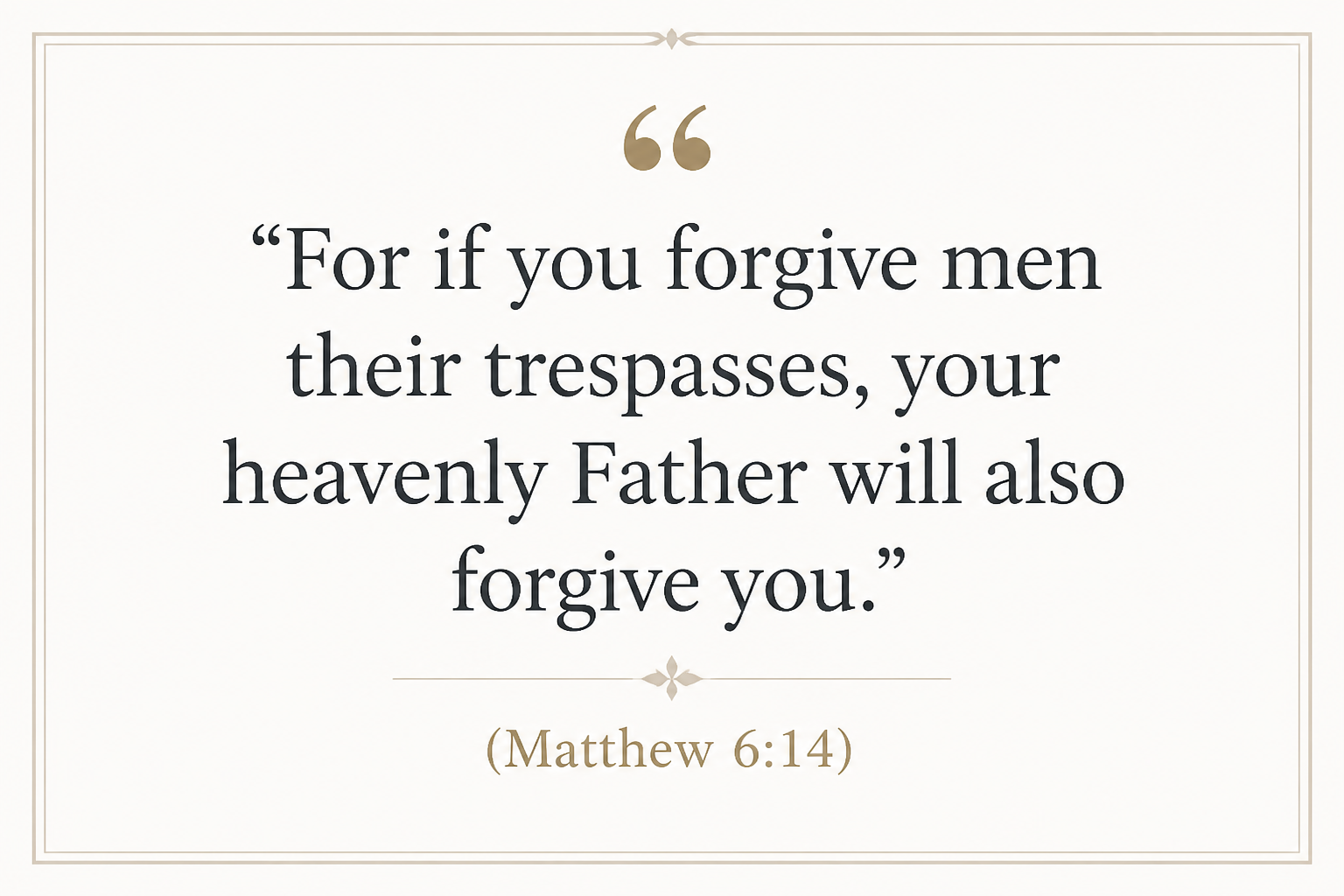
“For if you forgive men their trespasses, your heavenly Father will also forgive you.” (Matthew 6:14)
Here παράπτωμα is the concrete object of forgiveness between people (“men”) and the parallel object of God’s forgiveness (“your heavenly Father”). The sentence treats trespasses as personal wrongs that stand between persons until forgiveness removes them.
But if you don’t forgive men their trespasses, neither will your Father forgive your trespasses. (Matthew 6:15)
παράπτωμα is again framed as something held “against” a person until forgiveness is granted, now with the negative condition. The reciprocity is explicit: refusing to forgive others’ trespasses is matched by the Father’s refusal to forgive one’s own.
So my heavenly Father will also do to you, if you don’t each forgive your brother from your hearts for his misdeeds.” (Matthew 18:35)
In this warning, the word is set in the context of “each forgive your brother from your hearts,” locating trespass in the sphere of community relationships. The scene emphasizes the inwardness (“from your hearts”) expected in forgiving what is called “his misdeeds,” making the trespass a real wrong that demands more than formal release.
Whenever you stand praying, forgive, if you have anything against anyone; so that your Father, who is in heaven, may also forgive you your transgressions. (Mark 11:25)
παράπτωμα appears within prayer as the reason forgiveness is sought from God and extended to others. “If you have anything against anyone” places trespass in the realm of grievances; the instruction links a worship posture (“stand praying”) with an ethical posture (forgive), so that God’s forgiveness of trespasses is not treated as detached from human relationships.
But if you do not forgive, neither will your Father in heaven forgive your transgressions.” (Mark 11:26)
This repeats the conditional structure found in Matthew: unforgiveness blocks the Father’s forgiveness. Trespasses are pictured as real liabilities that remain in place when forgiveness is withheld.
who was delivered up for our trespasses, and was raised for our justification. (Romans 4:25)
παράπτωμα is placed alongside two decisive events: being “delivered up” and being “raised.” The trespasses are plural and owned collectively (“our”), and they are the stated reason connected to the “delivered up” clause, while “justification” stands in deliberate counterpoint in the second clause.
But the free gift isn’t like the trespass. For if by the trespass of the one the many died, much more did the grace of God, and the gift by the grace of the one man, Jesus Christ, abound to the many. (Romans 5:15)
παράπτωμα is contrasted with “the free gift,” and it is specified as “the trespass of the one,” an individual act with corporate consequence: “the many died.” The verse’s logic turns on the disproportion: one trespass yields death for many, but grace and gift “abound to the many,” treating trespass as the dark foil against which grace is described as overflowing.
The gift is not as through one who sinned; for the judgment came by one to condemnation, but the free gift came of many trespasses to justification. (Romans 5:16)
Here trespasses are explicitly “many,” and they form the backdrop against which the “free gift” operates “to justification.” The verse sets up a courtroom-like sequence: “judgment… to condemnation” is traced back to “one,” while “many trespasses” are met not with an equal measure of condemnation but with a gift that results in justification.
For if by the trespass of the one, death reigned through the one; so much more will those who receive the abundance of grace and of the gift of righteousness reign in life through the one, Jesus Christ. (Romans 5:17)
παράπτωμα is personified in its consequence: through the trespass, “death reigned.” The trespass is again singular and tied to “the one,” and its effect is dominion (“reigned”). The verse then counters that reign with another reign: those who “receive” grace and righteousness will “reign in life,” using the trespass as the catalyst that introduced death’s rule.
So then as through one trespass, all men were condemned; even so through one act of righteousness, all men were justified to life. (Romans 5:18)
παράπτωμα stands as the single act that serves as the avenue (“through”) to universal condemnation: “all men were condemned.” The parallelism makes trespass the representative doorway into condemnation, matched by “one act of righteousness” as the doorway into “justified to life.”
The law came in that the trespass might abound; but where sin abounded, grace abounded more exceedingly; (Romans 5:20)
Trespass is depicted as something that can “abound,” increasing in scope or frequency in relation to “the law.” Yet the verse immediately sets trespass within a larger comparison of abundance: “grace abounded more exceedingly.” The word therefore participates in a measurement metaphor—trespass multiplied, but grace surpassed it.
I ask then, did they stumble that they might fall? May it never be! But by their fall salvation has come to the Gentiles, to provoke them to jealousy. (Romans 11:11)
In this line of argument, παράπτωμα is expressed in the imagery of misstep and collapse: “stumble” and “fall.” The trespass is not treated as the final purpose (“May it never be!”); rather, “by their fall” becomes the circumstance in which “salvation has come to the Gentiles,” showing trespass functioning as a pivotal turning point in the unfolding of salvation and response.

Sense and Usage
Across these passages, παράπτωμα consistently names wrongdoing in a way that highlights its relational and judicial weight. In the sayings of Jesus (Matthew 6:14–15; 18:35; Mark 11:25–26), a trespass is the sort of wrong that one person commits against another, leaving a genuine debt of grievance (“anything against anyone”) that must be released by forgiveness. The emphasis falls not on defining the wrong but on what is done with it: it can be forgiven by people, and it can be forgiven by the Father; it can also remain unforgiven, with serious consequences. Matthew 18:35 presses beyond outward reconciliation to the inner stance: forgiveness is to be extended “from your hearts,” so a trespass is not merely a procedural offense but something that tests sincerity and mercy in the community.
Paul’s uses in Romans widen the frame without changing the basic idea of trespass as culpable wrongdoing. Romans 4:25 speaks of “our trespasses” as a collective reality addressed by decisive divine action, and pairs trespasses with “justification” to show that wrongdoing and legal standing before God are in view together. Romans 5 uses the word with careful counting and contrast: “the trespass of the one,” “many trespasses,” and the effects that follow—“condemnation,” death’s “reign,” and the universal scope (“the many,” “all men”). In this context, trespass is not presented as an isolated misdeed but as an act with cascading consequences, measured against the “free gift,” “grace,” and “the gift of righteousness.” The logic repeatedly intensifies the comparison: trespass produces death and condemnation; grace produces justification and life, and it does so in an abounding way that overtakes the spread of trespass (Romans 5:20).
Romans 11:11 shows that the word can also be framed in the metaphor of a misstep—“stumble… fall”—without softening its seriousness. Even when treated as a “fall,” trespass remains a real failure, yet it is discussed within a purpose-laden argument in which God brings salvation to others “by their fall,” introducing a dynamic where the reality of trespass and the advance of salvation are spoken of in the same breath.
Imagery
These passages attach vivid movement and measurement to trespass. It can be “against” someone as a felt grievance (Mark 11:25), it can be held or released through forgiveness (Matthew 6:14–15), and it can be multiplied—made to “abound” (Romans 5:20). It can also be pictured as a loss of footing, a “stumble” and “fall” (Romans 11:11), and as a doorway “through” which condemnation enters (Romans 5:18). Set beside these images, the counter-images are striking: grace “abound[s]” beyond trespass, and life “reign[s]” where death once reigned (Romans 5:15–17).
Sources: Lexical data from Strong’s Exhaustive Concordance and the Translators Brief Lexicon of Extended Strongs for Greek (STEPBible, CC BY). Occurrence data from the Translators Amalgamated Greek New Testament (STEPBible, CC BY). Scripture quotations from the World English Bible (public domain).




