
Exploring the Meaning of Paraluo in Greek
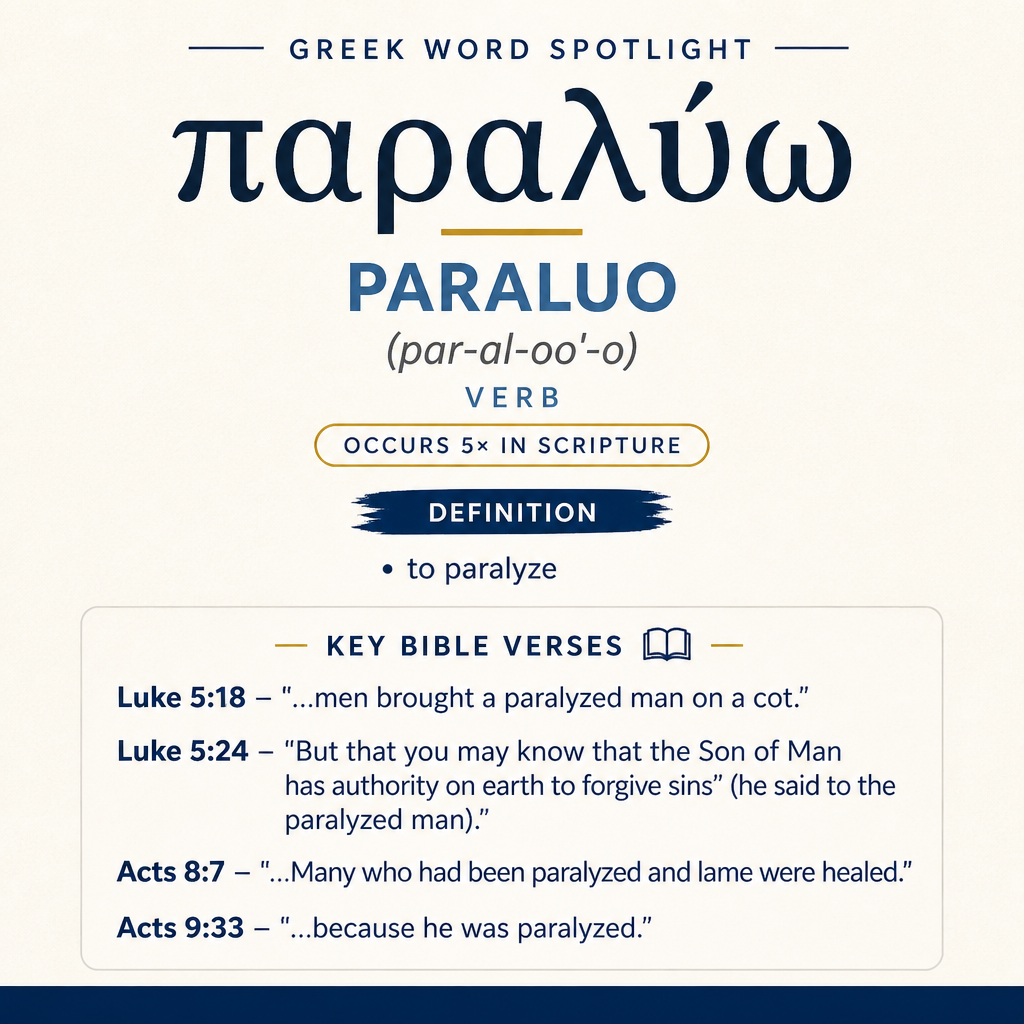
παραλύω means “to paralyze” and occurs five times in Scripture in Luke 5:18, Luke 5:24, Acts 8:7, Acts 9:33, and Hebrews 12:12.
Core Meaning
παραλύω means “to paralyze.” It describes the condition of a person who is paralyzed.
Learn More →Gospel Context
In Luke 5:18 a paralyzed man is brought on a cot to Jesus. In Luke 5:24 Jesus speaks to the paralyzed man while declaring His authority to forgive sins.
Learn More →Other Occurrences
In Acts 9:33, Aeneas is described as paralyzed and bedridden for eight years. The word also appears in Acts 8:7 and Hebrews 12:12.
Learn More →παραλύω means “to paralyze,” a verb used for bodily disablement in healing narratives and once in an exhortation that pictures weakened limbs. It appears in Luke, Acts, and Hebrews in contexts where paralysis marks helplessness and becomes a focal point for restoration or renewed strength.
Root and Related Words
παραλύω is formed with παρά (para), “from/with/beside” (Strong’s G3844), and λύω (lyo), “to loose” (Strong’s G3089). The compound shape suits contexts where a person’s normal bodily function is impeded and then, in scenes of healing, released into movement again.

Occurrences
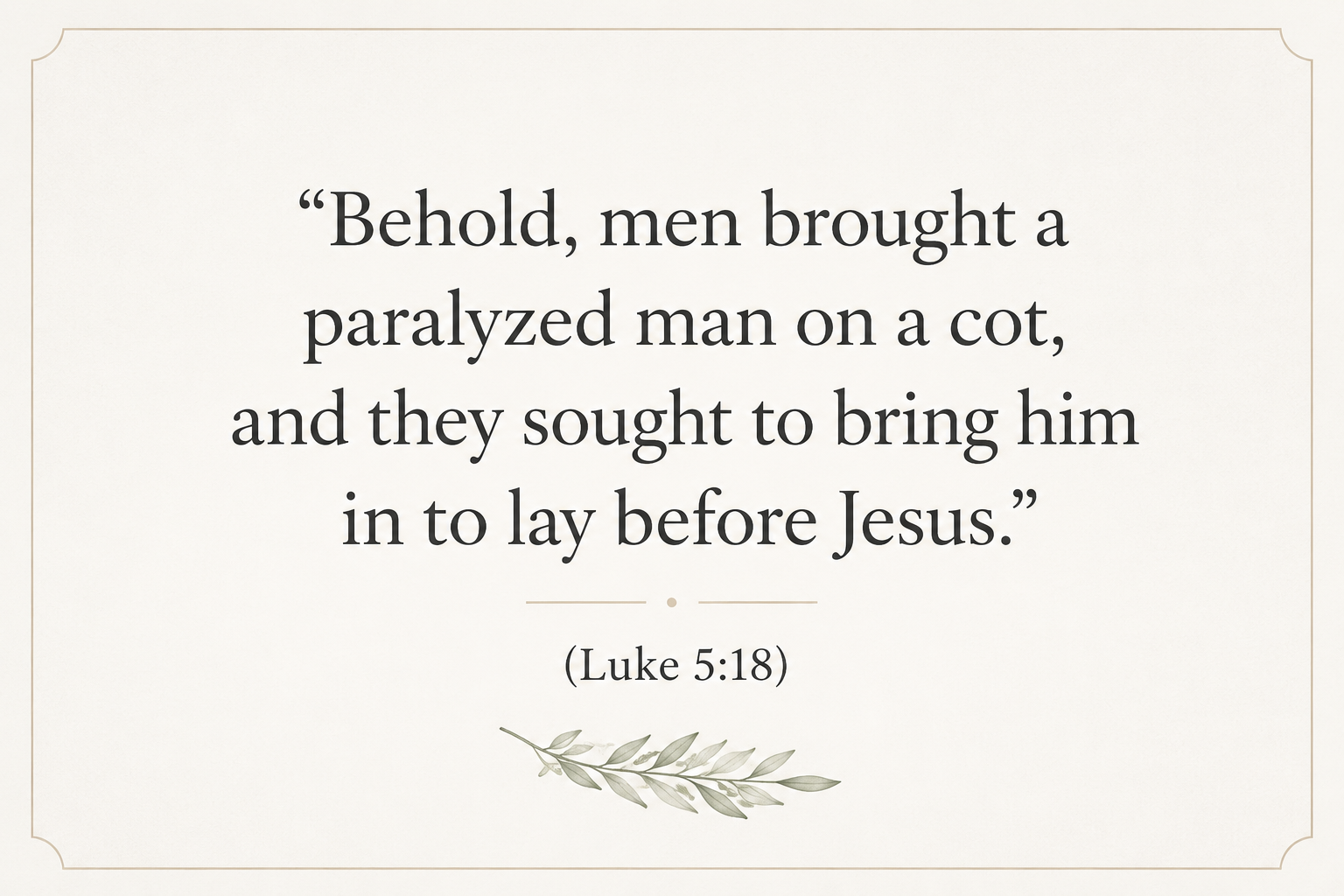
“Behold, men brought a paralyzed man on a cot, and they sought to bring him in to lay before Jesus.” (Luke 5:18)
Here the verb identifies the man by his condition: he is “a paralyzed man,” carried rather than walking. The detail “on a cot” and the group effort—“men brought”—frame paralysis as a state that confines him to a stretcher and makes access to Jesus dependent on others’ help. In the scene’s action, παραλύω functions as the reason for the journey and the urgency behind “they sought to bring him in.”
“But that you may know that the Son of Man has authority on earth to forgive sins” (he said to the paralyzed man), “I tell you, arise, take up your cot, and go to your house.” (Luke 5:24)
In this saying, παραλύω marks the direct recipient of a command that reverses his prior immobility. The address “to the paralyzed man” keeps the condition in view even as Jesus issues three concrete imperatives: “arise,” “take up your cot,” and “go to your house.” Within the verse’s own flow, the paralyzed condition provides the visible backdrop for demonstrating “authority on earth to forgive sins.” The command assumes that the man, formerly defined by being carried on a cot, will now be able to stand, lift what once carried him, and depart under his own power.
“For unclean spirits came out of many of those who had them. They came out, crying with a loud voice. Many who had been paralyzed and lame were healed.” (Acts 8:7)
παραλύω appears in a plural description—“Many who had been paralyzed and lame”—embedded in a summary of deliverance and healing. The verse pairs the expulsion of “unclean spirits” (with audible cries) and the recovery of those with physical impairment. Within this summary, paralysis is one of the highlighted afflictions that yields to healing; it functions as evidence that the ministry described brings tangible change to bodies as well as release from spirits. The phrase “had been paralyzed” presents the condition as a prior state, and “were healed” signals that the state does not remain.
“There he found a certain man named Aeneas, who had been bedridden for eight years, because he was paralyzed.” (Acts 9:33)
In this narrative note, παραλύω explains prolonged confinement: Aeneas “had been bedridden for eight years, because he was paralyzed.” The verb gives the reason for the duration and severity of his situation; “bedridden” is not incidental but grounded in paralysis. The time marker “for eight years” intensifies what paralysis has meant in his life—extended dependence and restricted movement—so that his condition is not momentary weakness but an entrenched disability.
“Therefore lift up the hands that hang down and the feeble knees,” (Hebrews 12:12)
Although the wording here is exhortative rather than a healing report, παραλύω stands behind the picture of limbs made ineffective. The verse speaks of “hands that hang down” and “feeble knees,” portraying a bodily posture of drooping and weakness. In this setting, the verb’s idea of paralysis supplies vivid imagery for discouragement or exhaustion: hands and knees are described as if their normal strength and steadiness have been impaired, and the command calls for a deliberate reversal—“lift up”—as one would rouse a body from slackness to readiness.
Sense and Usage
Across these passages, παραλύω consistently marks a disabling condition that limits ordinary movement and strength. In Luke 5, the condition is concrete and visible: the man is transported “on a cot,” and the command sequence (“arise… take up… go”) draws a straight line from paralysis to restored mobility and independence. The verb therefore does more than label a diagnosis; it sets up a before-and-after contrast inside the narrative’s action, where the former inability to walk is implicitly overturned by standing and carrying.
Acts uses παραλύω in two complementary ways. Acts 8:7 presents it in a broad sweep—“Many who had been paralyzed… were healed”—so the term contributes to the scale and variety of afflictions being addressed. Acts 9:33 narrows from a crowd summary to an individual case, and the verb accounts for a sustained, eight-year pattern of being “bedridden.” Together these uses show the word fitting both public reports of widespread healing and personal descriptions of long-term disability.
Hebrews 12:12 extends the word’s reach into figurative exhortation by adopting the body-language of impaired limbs—hands that droop, knees that fail. The imagery depends on the recognizable effects associated with paralysis: sagging, instability, and reduced capacity to act. In that way, παραλύω supports a moral appeal through physical metaphor without changing its basic sense; the author calls for a posture that looks like recovery from impairment, expressed in the simple, bodily directive to “lift up.”
Imagery
The passages collectively frame paralysis as confinement and loss of agency—being carried on a cot (Luke 5:18), being “bedridden” for years (Acts 9:33), and limbs that “hang down” (Hebrews 12:12). Against that backdrop, the word also carries the imagery of reversal: the paralyzed man is commanded to rise and walk home (Luke 5:24), and those once paralyzed are counted among “many” who “were healed” (Acts 8:7). The verb thus evokes both the stillness of disability and the expectation of renewed movement in contexts where restoration is in view.
Sources: Lexical data from Strong’s Exhaustive Concordance and the Translators Brief Lexicon of Extended Strongs for Greek (STEPBible, CC BY). Occurrence data from the Translators Amalgamated Greek New Testament (STEPBible, CC BY). Scripture quotations from the World English Bible (public domain).




