Exploring the Meaning of Palaios in Greek
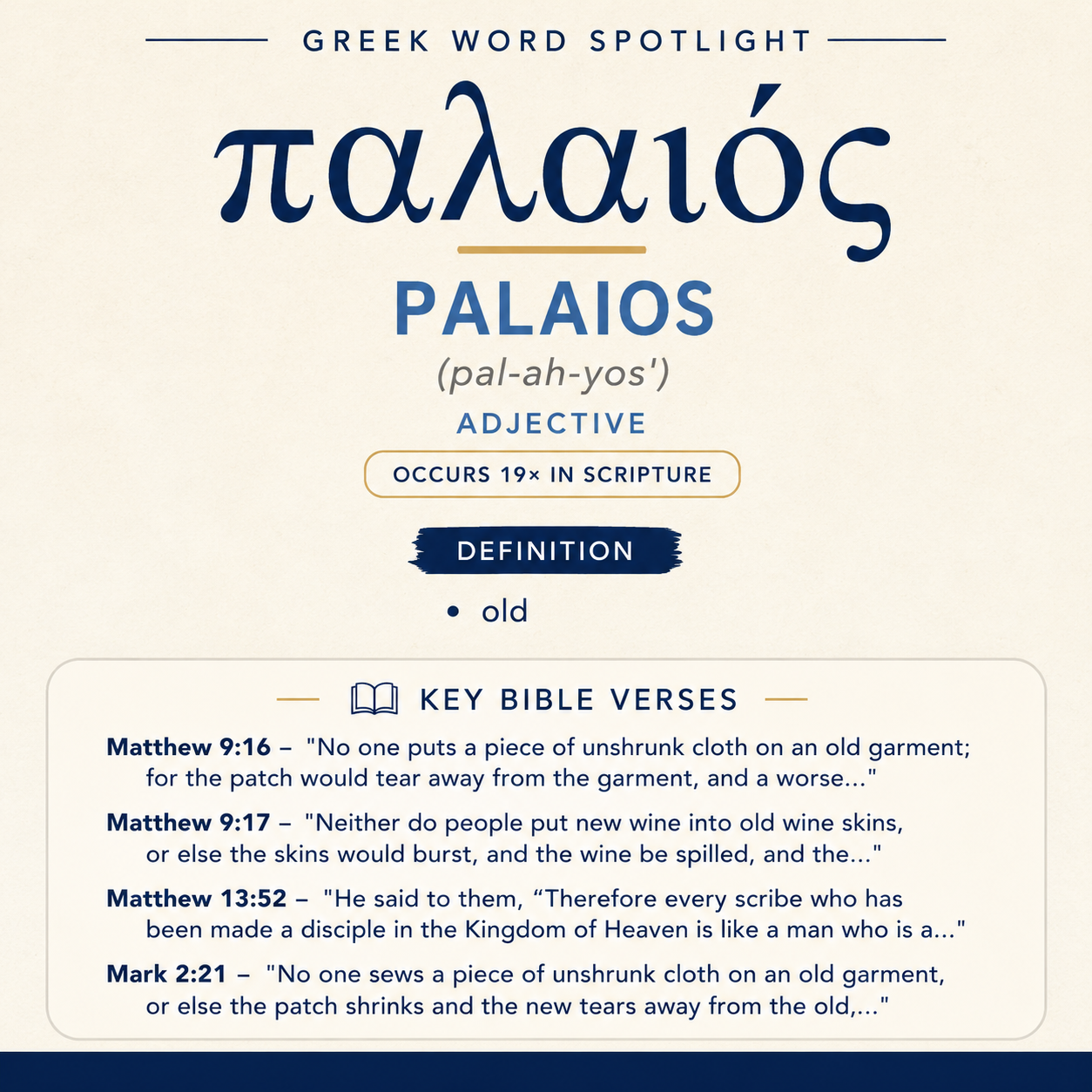
παλαιός means “old” and occurs 19 times in Scripture, including Matthew 9:16–17, Matthew 13:52, Mark 2:21–22, and Luke 5:36–39.
Core Meaning
παλαιός is defined as “old.” In the listed passages it describes garments, wineskins, and wine.
Learn More →Gospel Examples
In Matthew 9:16–17, Mark 2:21–22, and Luke 5:36–37, it contrasts an old garment or old wineskins with something new. Luke 5:39 uses it of old wine described as “better.”
Learn More →Matthew 13:52
Matthew 13:52 includes παλαιός in a saying about a scribe made a disciple in the Kingdom of Heaven. This is one of the listed Gospel occurrences.
Learn More →παλαιός describes what is “old,” and it is used in sayings about garments and wineskins, a proverb about wine, and in apostolic teaching about a person, yeast, and a covenant. Across these settings, the adjective marks what belongs to an earlier state that is either contrasted with something new or evaluated for its continuing hold and familiarity.
Occurrences
“No one puts a piece of unshrunk cloth on an old garment; for the patch would tear away from the garment, and a worse hole is made.” (Matthew 9:16)
Here παλαιός qualifies the “garment” as old, setting up the practical mismatch the saying depends on. The garment’s “old” condition is not merely descriptive; it explains why attaching “a piece of unshrunk cloth” results in damage: the patch “would tear away,” producing “a worse hole.” The adjective thus anchors the illustration in the everyday fragility of what has already been worn and weakened.
“Neither do people put new wine into old wine skins, or else the skins would burst, and the wine be spilled, and the skins ruined. No, they put new wine into fresh wine skins, and both are preserved.” (Matthew 9:17)
In this parallel image, παλαιός describes wineskins as old, and the contrast is sharpened by the explicit alternative “fresh wine skins.” The “old” skins are portrayed as unable to bear the pressure implied by “new wine”: they “would burst,” leading to loss (“wine be spilled”) and destruction (“skins ruined”). The adjective helps locate the problem in the condition of what is old when confronted with what is new.
“He said to them, “Therefore every scribe who has been made a disciple in the Kingdom of Heaven is like a man who is a householder, who brings out of his treasure new and old things.”” (Matthew 13:52)
παλαιός appears as part of a paired description: “new and old things.” The householder’s “treasure” contains both, and he “brings out” both. “Old” here contributes to the sense of variety and range within what is stored and available, without being cast as defective; it stands alongside “new” as something worth bringing out from the same treasury.
“No one sews a piece of unshrunk cloth on an old garment, or else the patch shrinks and the new tears away from the old, and a worse hole is made.” (Mark 2:21)
This version intensifies the interaction by describing the patch’s behavior: “the patch shrinks.” παλαιός again marks the garment as old, and the damage is pictured relationally—“the new tears away from the old.” The adjective helps establish a contrast between “the new” and “the old” that becomes visible in the tearing and the “worse hole.”
“No one puts new wine into old wineskins, or else the new wine will burst the skins, and the wine pours out, and the skins will be destroyed; but they put new wine into fresh wineskins.” (Mark 2:22)
παλαιός qualifies the wineskins, and the outcome is expressed with forceful verbs: the wine “will burst the skins,” “pours out,” and the skins “will be destroyed.” “Old” is therefore tied to a vulnerability that is exposed by “new wine.” The closing corrective—putting new wine into “fresh wineskins”—depends on the old/fresh contrast that παλαιός helps frame.
“He also told a parable to them. “No one puts a piece from a new garment on an old garment, or else he will tear the new, and also the piece from the new will not match the old.” (Luke 5:36)
In Luke’s form, παλαιός marks the recipient garment as old, and the consequences are described in terms of both damage and incongruity. The attempt “will tear the new,” and even if the piece is taken, it “will not match the old.” “Old” here contributes to the sense that a prior state has a settled character—one that resists being made to fit by attaching something new.
“No one puts new wine into old wine skins, or else the new wine will burst the skins, and it will be spilled, and the skins will be destroyed.” (Luke 5:37)
παλαιός again describes wineskins as old, and Luke repeats the same chain of loss: bursting, spilling, and destruction. The adjective functions as the key condition that makes the disaster predictable. The “old” container is portrayed as unfit for the demands placed on it by “new wine.”
“No man having drunk old wine immediately desires new, for he says, ‘The old is better.’ ” (Luke 5:39)
Here παλαιός describes wine that has already been drunk and is preferred. The proverb’s logic hinges on immediate preference: the one who has drunk “old wine” “immediately desires” no “new,” because of the judgment, “The old is better.” “Old” contributes not weakness but attraction and perceived superiority, showing that the adjective can carry positive valuation depending on context.
“knowing this, that our old man was crucified with him, that the body of sin might be done away with, so that we would no longer be in bondage to sin.” (Romans 6:6)
παλαιός modifies “man,” placing “our old man” in a decisive past action: it “was crucified with him.” The adjective helps distinguish a former identity or state from what follows the crucifixion described. The purpose clauses (“that the body of sin might be done away with,” “so that we would no longer be in bondage to sin”) show how “old” is linked to an existence characterized by bondage, now targeted for removal.
“Purge out the old yeast, that you may be a new lump, even as you are unleavened. For indeed Christ, our Passover, has been sacrificed in our place.” (1 Corinthians 5:7)
In this exhortation, παλαιός qualifies “yeast” as old and makes it the object of decisive action: “Purge out.” The aim is transformation described as “a new lump,” paired with the community’s stated condition, “you are unleavened.” “Old” thus marks what must be removed in order for “new” to characterize the whole.
“Therefore let’s keep the feast, not with old yeast, neither with the yeast of malice and wickedness, but with the unleavened bread of sincerity and truth.” (1 Corinthians 5:8)
παλαιός again modifies “yeast,” and the contrast is expanded: the feast is not to be kept “with old yeast,” nor with “the yeast of malice and wickedness,” but with “unleavened bread of sincerity and truth.” “Old” here is placed on the negative side of the contrastive instruction, reinforcing that what is old is unsuitable for the kind of keeping-the-feast described.
“But their minds were hardened, for until this very day at the reading of the old covenant the same veil remains, because in Christ it passes away.” (2 Corinthians 3:14)
In this passage παλαιός qualifies “covenant” as old, and the adjective participates in an argument about ongoing perception: “their minds were hardened,” and “the same veil remains” at the covenant’s “reading.” “Old covenant” is associated with a continuing veil in this description, and the clause “because in Christ it passes away” portrays the veil’s removal in connection with Christ, while still speaking of the covenant being read as “old.”

Sense and Usage
Across these texts, παλαιός marks something as belonging to an earlier condition that becomes significant when set against “new” or “fresh.” In the garment and wineskin sayings (Matthew 9:16–17; Mark 2:21–22; Luke 5:36–37), “old” describes what has a settled, existing condition that cannot simply absorb a new addition without damage. The focus is not nostalgia but the realistic consequences of mixing what is new with what is already old: tearing, bursting, spilling, and destruction are the repeated outcomes. The adjective therefore helps carry the argument by making the contrast tangible and the result foreseeable.
Luke 5:39 shows another side: “old wine” is preferred, and “old” becomes the basis of a comparative evaluation—“The old is better.” In this setting, “old” is tied to satisfaction and preference that resists immediate change. The adjective supports the proverb’s observation about desire and judgment rather than material failure.
In the letters, παλαιός moves from household objects to moral and covenantal categories, still functioning as a marker of what belongs to a former state. “Our old man” in Romans 6:6 is something that can be spoken of as put to death with Christ, with the stated aim of liberation from “bondage to sin.” “Old yeast” in 1 Corinthians 5:7–8 is something to be purged and excluded from keeping the feast, set against being “a new lump” and against “sincerity and truth.” Finally, “the old covenant” in 2 Corinthians 3:14 appears in a scene of public reading where a “veil” remains for hardened minds, and the statement that in Christ “it passes away” treats the old/new distinction as bearing on how Scripture is encountered and understood.
Imagery
The recurring imagery of παλαιός is concrete: worn fabric, strained skins, and yeast working through dough. These pictures give “old” a physical weight—something already formed, already conditioned, and therefore not neutral when something new is introduced. At the same time, “new and old things” (Matthew 13:52) and the preference for “old wine” (Luke 5:39) show that “old” can also signal valued store and familiar goodness. In the apostolic uses, the same adjective brings that earlier state into focus so it can be removed (“old yeast”), decisively ended (“our old man was crucified”), or read within a larger change in perception (“the old covenant” and the passing away of the veil in Christ).
Sources: Lexical data from Strong’s Exhaustive Concordance and the Translators Brief Lexicon of Extended Strongs for Greek (STEPBible, CC BY). Occurrence data from the Translators Amalgamated Greek New Testament (STEPBible, CC BY). Scripture quotations from the World English Bible (public domain).