
Exploring the Meaning of Palaioo in Greek
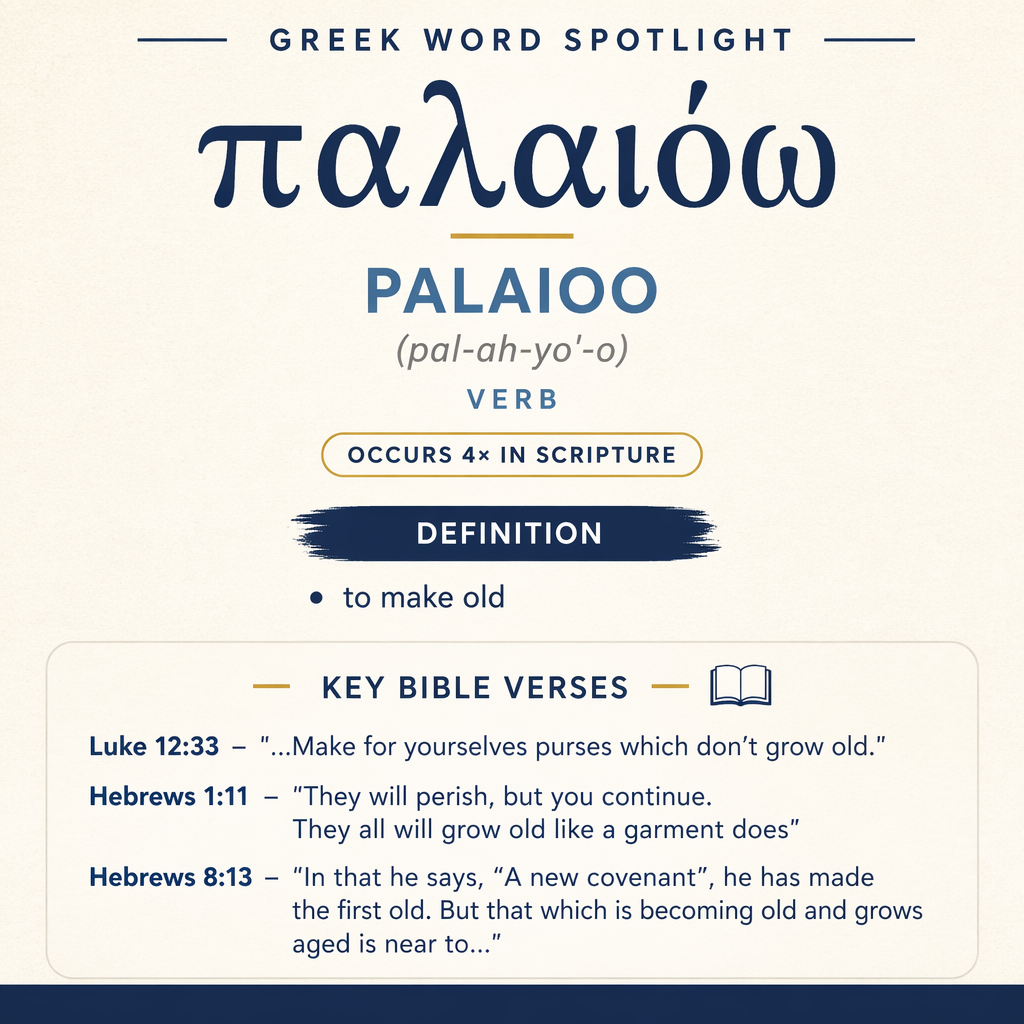
παλαιόω means “to make old” and occurs four times in Scripture, including Luke 12:33 and Hebrews 1:11; 8:13.
Core Meaning
παλαιόω is defined as “to make old.” In Hebrews 8:13 it is used of making the first covenant old.
Learn More →Where It Appears
This verb occurs 4 times in Scripture. Listed occurrences include Luke 12:33; Hebrews 1:11; Hebrews 8:13.
Learn More →Text Examples
In Luke 12:33 it appears in “purses which don’t grow old.” In Hebrews 1:11 it describes things that “will grow old like a garment.”
Learn More →παλαιόω means “to make old.” It appears in Jesus’ instruction about durable heavenly treasure (Luke 12:33) and in Hebrews in two images of aging: creation like a garment (Hebrews 1:11) and the first covenant rendered old in light of “a new covenant” (Hebrews 8:13).
Root and Related Words
παλαιόω derives from palaios (παλαιός), “old” (Strong’s G3820). The verb expresses the action or effect corresponding to that adjective.

Occurrences
“Sell that which you have, and give gifts to the needy. Make for yourselves purses which don’t grow old, a treasure in the heavens that doesn’t fail, where no thief approaches, neither moth destroys.” (Luke 12:33)
Here the idea of becoming old is placed in contrast with what “doesn’t fail.” The command to “make for yourselves purses which don’t grow old” ties παλαιόω to the vulnerability and decay that can affect ordinary containers of wealth. The verse itself supplies the practical threats: “no thief approaches, neither moth destroys” in the location of the “treasure in the heavens.” Against those threats, “don’t grow old” describes purses not subject to the wearing-out that makes possessions insecure or ineffective. In this scene, aging is not merely a calendar marker; it is the process by which something becomes less able to serve its purpose, and the point is to seek a kind of treasure-storage that is not exposed to that process.
“They will perish, but you continue. They all will grow old like a garment does.” (Hebrews 1:11)
In Hebrews 1:11, παλαιόω is used for a broad “they all,” set alongside “They will perish,” and opposed to “but you continue.” The aging described is likened to what happens to “a garment.” The comparison gives the verb a tangible shape: cloth that has been used and worn becomes old, and that visible oldness stands as an image for the created order’s changeability. The line does not leave the aging as a neutral fact; it is part of a contrast in which what “grows old” belongs with what “will perish,” while the one addressed “continue[s].” Thus in this occurrence the word helps present oldness as the mark of what is not enduring, even when the image is as everyday as clothing.
“In that he says, “A new covenant”, he has made the first old. But that which is becoming old and grows aged is near to vanishing away.” (Hebrews 8:13)
This occurrence places παλαιόω within covenant language: the statement “A new covenant” has the effect that “he has made the first old.” The verb expresses a decisive result—what was “the first” is rendered old in relation to what is explicitly called “new.” The verse then expands the idea with two parallel descriptions: “becoming old” and “grows aged,” and it attaches an outcome: it “is near to vanishing away.” In this context, making old is not about physical materials wearing down, but about an arrangement being treated as belonging to what is prior, what is superseded. The movement of the sentence is important: naming the covenant as new establishes an oldness for the former covenant, and oldness is portrayed as a condition that stands on the verge of disappearance.
Sense and Usage
Across these passages, “to make old” functions as a way of describing the shift from reliability and endurance to the state associated with decline. Luke 12:33 uses the idea negatively—“purses which don’t grow old”—so that the desired treasure-storage is described by exemption from aging. Oldness here is the ordinary fate of possessions in a world where thieves and moths are real dangers; the command’s logic assumes that what becomes old becomes vulnerable, and so the listener is directed toward what “doesn’t fail.”
Hebrews employs the verb in two distinct but related frames. In Hebrews 1:11, oldness is cosmic in scope (“they all”) yet illustrated by something simple (“like a garment”). The verb contributes to a contrast in permanence: what grows old is on the perishable side of the comparison, while the one addressed is marked by continuing. In Hebrews 8:13, oldness is juridical and relational rather than material: one covenant is “made…old” by the declaration of another as “new.” The verse’s wording shows oldness as both a status (“has made the first old”) and an ongoing process (“becoming old and grows aged”), and it links that process to an approaching end (“near to vanishing away”).
Taken together, these uses show that παλαιόω can speak of aging as (1) an unwanted condition avoided by what is secure, (2) a property of created things that are not permanent, and (3) a designation placed upon what has been surpassed when something new is introduced. In each setting, the verb carries a directional force: it points from usefulness and standing toward the state described as “old,” and each passage attaches consequences—exposure to loss, association with perishing, or proximity to vanishing away.
Imagery
The passages cluster around two everyday images that make the idea concrete: purses and garments. A purse that “grow[s] old” evokes something worn and less dependable for holding treasure; a garment that “grow[s] old” evokes visible wear that anticipates being set aside. Hebrews 8:13 draws on the same intuitive sense of oldness—what is old belongs to what is earlier—and applies it to covenant language: the “first” is treated as old when the “new covenant” is spoken, and the oldness is pictured as moving toward disappearance.
Sources: Lexical data from Strong’s Exhaustive Concordance and the Translators Brief Lexicon of Extended Strongs for Greek (STEPBible, CC BY). Occurrence data from the Translators Amalgamated Greek New Testament (STEPBible, CC BY). Scripture quotations from the World English Bible (public domain).




