Exploring the Meaning of Paizo in Greek
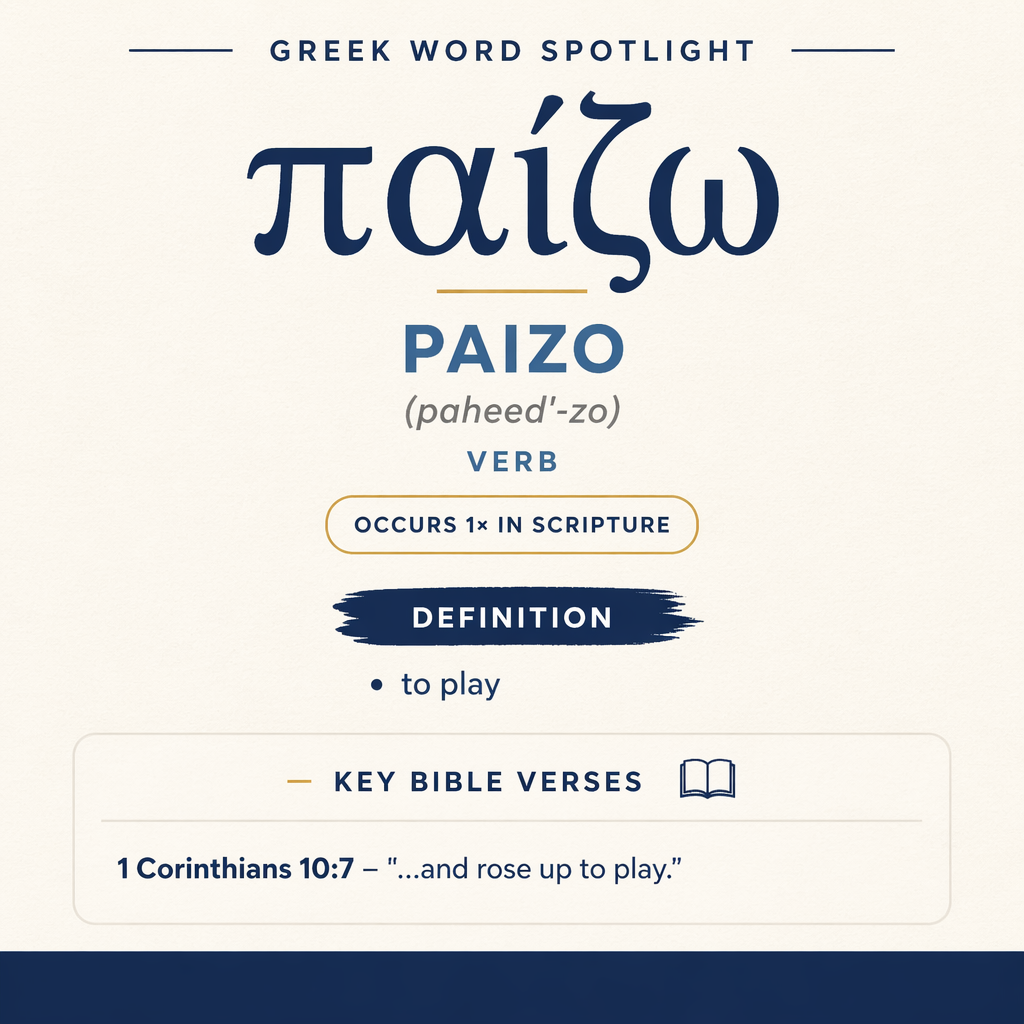
παίζω means “to play” and appears once in Scripture in 1 Corinthians 10:7.
Biblical Occurrence
This verb occurs 1 time in Scripture. It appears in 1 Corinthians 10:7.
Learn More →Verse Context
In 1 Corinthians 10:7, the people “sat down to eat and drink, and rose up to play.”
Learn More →παίζω means “to play,” and it appears once in the New Testament, in Paul’s warning against idolatry in 1 Corinthians 10:7. In that citation, the verb is part of a remembered sequence of actions that begins with eating and drinking and ends with rising “to play.”
Root and Related Words
παίζω is related to pais (παῖς), “child” (Strong’s G3816). The relationship situates the verb within the sphere of child-associated activity, presenting “play” as a recognizable kind of human action rather than a technical or specialized term.

Occurrences
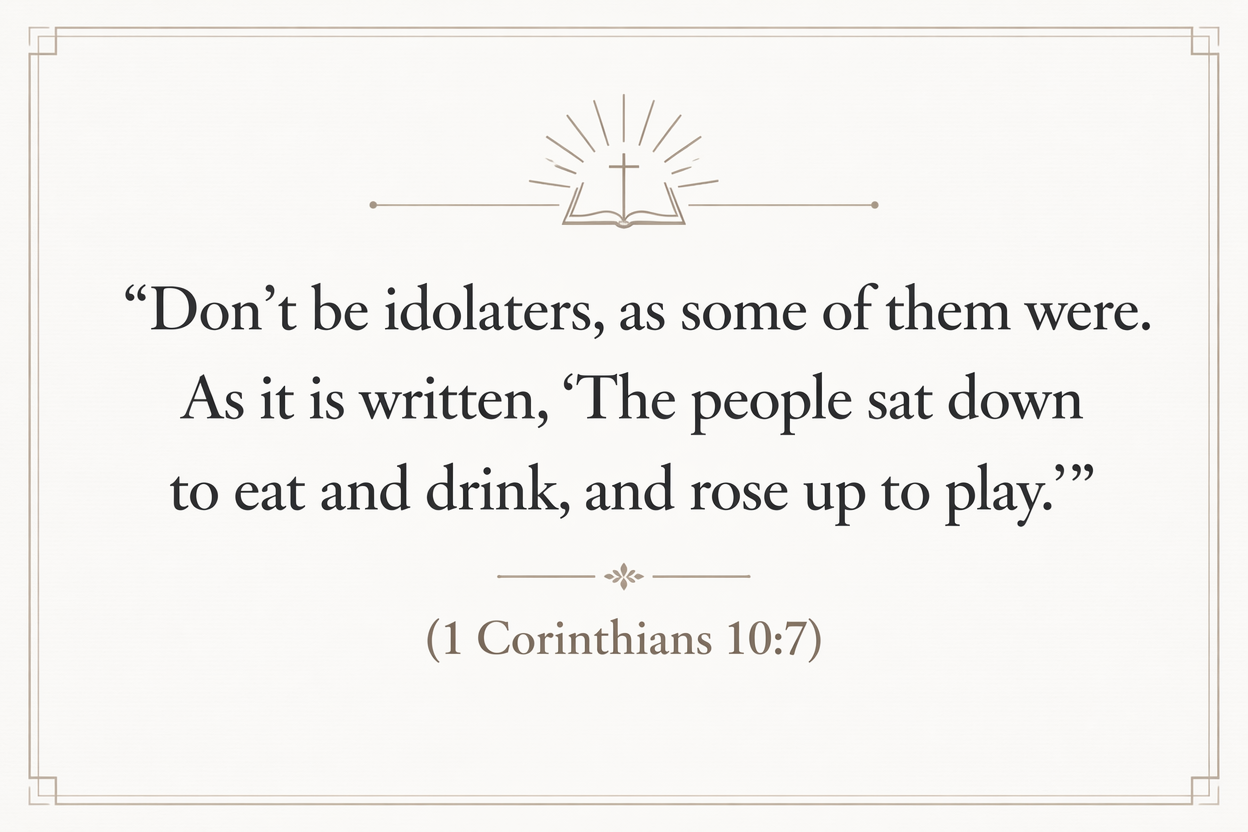
“Don’t be idolaters, as some of them were. As it is written, ‘The people sat down to eat and drink, and rose up to play.’” (1 Corinthians 10:7)
In this passage, παίζω supplies the final movement in a short narrative chain: the people “sat down” for eating and drinking, and then “rose up” for playing. The sequencing matters. The first two activities are stationary and table-centered (“sat down,” “eat and drink”), while the third introduces a change of posture and energy (“rose up”) followed by an action characterized as “play.” Within Paul’s admonition, the verb is not presented as neutral description detached from moral context; it is embedded in a cautionary frame: “Don’t be idolaters.” The verb therefore functions as part of the portrayal of a community at ease—fed, refreshed, and then turning to a further activity that, in this warning, belongs to the remembered pattern of idolatry.
The citation formula “As it is written” also shapes how the verb is heard. Paul is not merely reporting that some people played; he is invoking a written account as a moral example, and the quoted clause is the remembered wording that crystallizes the behavior. In that role, παίζω carries a representative weight: it stands as the culminating action that completes the picture of the people’s trajectory from consumption (“eat and drink”) to a social, outward activity (“rose up to play”). Because the instruction is framed negatively (“Don’t be idolaters”), “play” is not isolated as a harmless pastime in this context but is presented as an ingredient within an idolatrous episode, the kind of thing that can characterize a people who have already positioned themselves wrongly in worship.
Sense and Usage
The single attested use of παίζω sets “play” in a communal scene rather than in private recreation. The subject is “the people,” and the activity follows a shared meal: “The people sat down to eat and drink, and rose up to play.” The verb thus depicts play as something a crowd can do together, an activity compatible with public movement (“rose up”) and likely observable as a group action. It is “play” as an event that can follow feasting—something done after being satisfied with food and drink, when the group shifts from sitting to standing and from consumption to activity.
Paul’s way of deploying the quoted line also shows that “play” can be morally freighted by its setting. The basic action remains “to play,” but its force in this context is shaped by the surrounding evaluative language. The command “Don’t be idolaters” frames the quotation as a cautionary snapshot of behavior associated with idolatry. That does not redefine the verb into a different action; instead, it places the action of playing within an example that is meant to warn. In other words, the sense is stable (“play”), while the discourse function is admonitory: a remembered community, satisfied and celebratory, turns toward “play” in a way that belongs to a broader pattern Paul rejects.
The structure of the quoted clause adds nuance to how “play” functions semantically. The line does not say merely that the people played; it marks a transition: they “rose up” in order “to play.” This infinitival purpose-like relationship (rising with the aim of playing) presents play as the goal of their getting up. It is an activity that motivates action and rearranges the group’s posture. Within the short scene, “play” is not incidental background but the outcome that completes the three-part description. As the final verb, παίζω stands as the memorable endpoint of the sequence, the action that the quotation leaves ringing in the reader’s ear.
The association with pais (παῖς), “child,” helps explain why “play” can be a vivid, accessible descriptor in a moral warning. It draws on an everyday category of human behavior, something recognizable without technical explanation. In 1 Corinthians 10:7, that ordinariness becomes part of the rhetorical effect: the warning does not require esoteric vocabulary. Instead, the remembered pattern is described in plain actions—sitting, eating, drinking, rising, playing—so that the reader can picture a whole social scene and feel how readily a group can move from ordinary enjoyment to behavior that, in this context, is held up as an idolatrous example.
Imagery
The imagery of παίζω in 1 Corinthians 10:7 is kinetic and communal: a people who have been seated at food and drink stand up and transition into “play.” The verb contributes the scene’s shift from table to activity, from stillness to movement, and—because the citation is set within a warning—casts that movement as part of a remembered pattern that Paul holds before his readers as something to avoid.
Sources: Lexical data from Strong’s Exhaustive Concordance and the Translators Brief Lexicon of Extended Strongs for Greek (STEPBible, CC BY). Occurrence data from the Translators Amalgamated Greek New Testament (STEPBible, CC BY). Scripture quotations from the World English Bible (public domain).