
Exploring the Meaning of Paideia in Greek
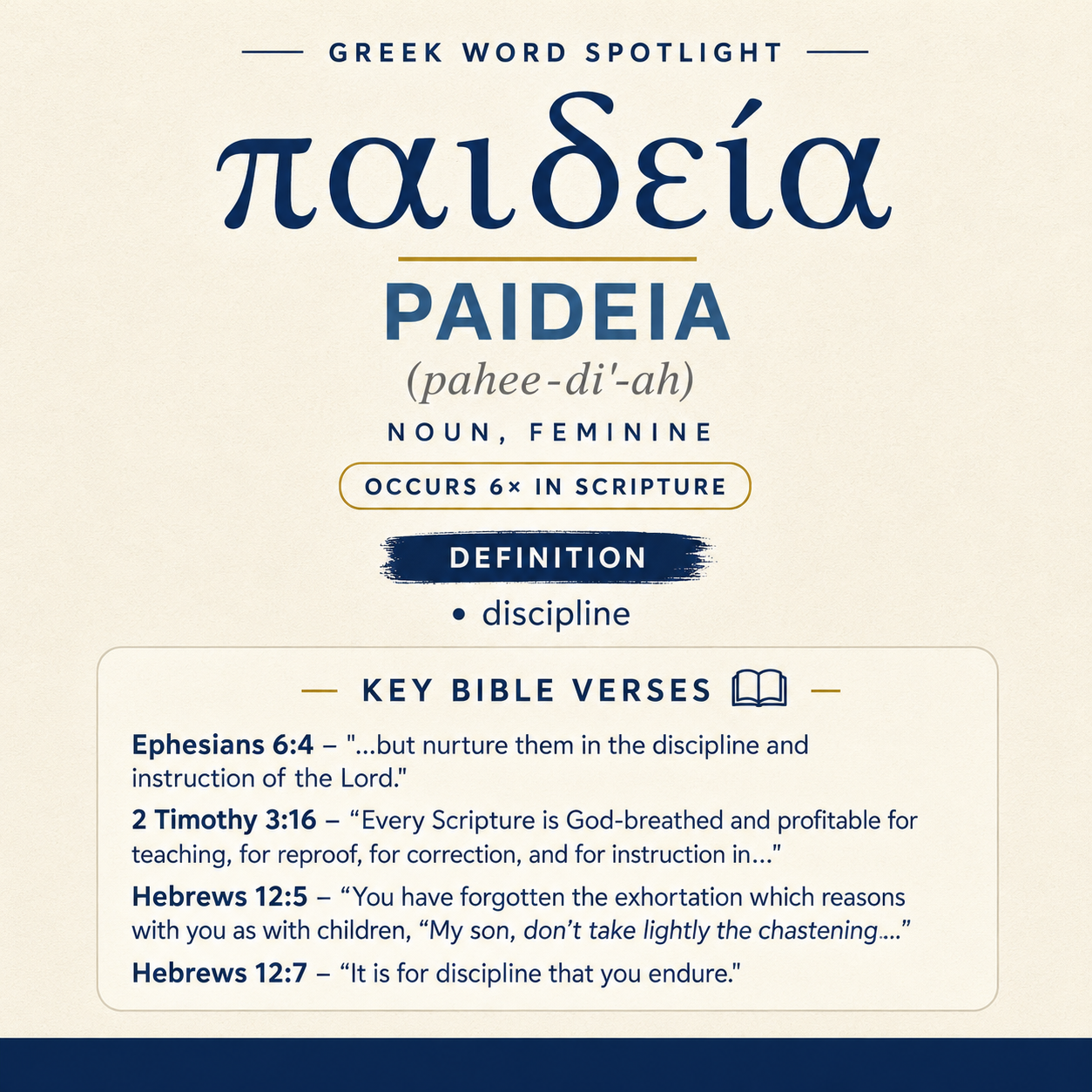
παιδεία means “discipline” and occurs six times in Scripture: Ephesians 6:4; 2 Timothy 3:16; and Hebrews 12:5, 7, 8, 11.
Core Meaning
παιδεία is defined as “discipline.” In these passages, it is linked with training, correction, and chastening.
Learn More →Where It Appears
It occurs in Ephesians 6:4 in the call to nurture children in the Lord’s discipline and instruction. It appears again in 2 Timothy 3:16 and four times in Hebrews 12 (5, 7, 8, 11).
Learn More →Hebrews 12 Focus
Hebrews 12 presents discipline as something to be endured as God deals with His people as children. It also contrasts being without discipline with being illegitimate, and notes its later peaceful fruit of righteousness.
Learn More →παιδεία (Paideia) means “discipline.” In the passages where it appears, it is framed through parent–child language, Scripture’s formative role, and endurance under God’s training toward righteous outcomes.
Occurrences
Ephesians 6:4: “You fathers, don’t provoke your children to wrath, but nurture them in the discipline and instruction of the Lord.”
Here παιδεία is set inside the ordinary household relationship of “fathers” and “children,” and it is presented as something a parent is to supply positively (“nurture them in the discipline”). The verse contrasts two ways of relating to children: one that stirs anger (“provoke … to wrath”) and one that forms them. Within that contrast, παιδεία marks a constructive, shaping approach rather than a reaction-producing one. The pairing with “instruction of the Lord” places this discipline within the sphere of the Lord’s own direction: the father’s nurture is not merely personal preference or impulse, but discipline joined to instruction that belongs to the Lord.
2 Timothy 3:16: “Every Scripture is God-breathed and profitable for teaching, for reproof, for correction, and for instruction in righteousness,”
In this statement about Scripture’s usefulness, παιδεία appears in a list of effects (“teaching … reproof … correction … instruction in righteousness”). Discipline is therefore portrayed as something Scripture provides: it is “profitable for” forming people in a righteous direction. The verse’s structure is practical and evaluative—Scripture is described in terms of what it accomplishes—so παιδεία is not an abstract ideal but an outcome Scripture produces in the life of the community. Its placement alongside “reproof” and “correction” also situates it in contexts where wrongs are identified and set right, as part of a process that aims at “righteousness.”
Hebrews 12:5: “You have forgotten the exhortation which reasons with you as with children, “My son, don’t take lightly the chastening of the Lord, nor faint when you are reproved by him;”
This verse explicitly addresses the hearers “as with children” and uses direct speech (“My son”). παιδεία is linked with the Lord’s action toward his people (“of the Lord”) and paired with being “reproved by him.” The admonition gives two wrong responses to avoid: treating the Lord’s discipline as insignificant (“don’t take lightly”) and collapsing under it (“nor faint”). In this setting, discipline is not treated as random hardship; it is interpreted as the Lord’s purposeful engagement with his children, and the hearers are urged to adopt an attitude of seriousness and perseverance when that discipline includes reproof.
Hebrews 12:7: “It is for discipline that you endure. God deals with you as with children, for what son is there whom his father doesn’t discipline?”
Here παιδεία is the stated reason for endurance: the audience is enduring “for discipline.” The verse explains this endurance by a family analogy: God’s manner of dealing is like a father’s dealings with a son. Discipline is treated as a defining feature of genuine fatherly relation—“what son is there whom his father doesn’t discipline?”—and the rhetorical question assumes discipline is normal, expected, and characteristic of a true parent-child bond. In this argument, παιδεία gives meaning to endurance by locating it within God’s fatherly dealings rather than outside them.
Hebrews 12:8: “But if you are without discipline, of which all have been made partakers, then you are illegitimate, and not children.”
This verse sharpens the claim by presenting the alternative: being “without discipline.” Discipline is described as something shared (“all have been made partakers”), so it is not depicted as a rare experience for a select few but as a common participation among those addressed. The consequence of lacking discipline is severe in relational terms: “illegitimate, and not children.” Within the logic of the passage, παιδεία functions as a marker of belonging in the family relationship; its presence signals true sonship, while its absence signals the opposite. The verse thus ties discipline to identity and status within the family framework the author has been using.
Hebrews 12:11: “All chastening seems for the present to be not joyous but grievous; yet afterward it yields the peaceful fruit of righteousness to those who have been trained by it.”
In this reflection on experience, παιδεία is recognized as difficult in the moment: it “seems for the present to be not joyous but grievous.” The verse then provides a time contrast (“for the present” versus “afterward”) and an outcome: it “yields the peaceful fruit of righteousness.” Discipline is also described as something that trains (“to those who have been trained by it”), emphasizing a formative process that produces a settled result (“peaceful fruit”). This portrayal gives emotional realism—grief now—while insisting on a constructive end. Discipline is not characterized by immediate pleasure but by later fruit, and those who undergo it are pictured as recipients of training that leads to righteousness characterized by peace.
Sense and Usage
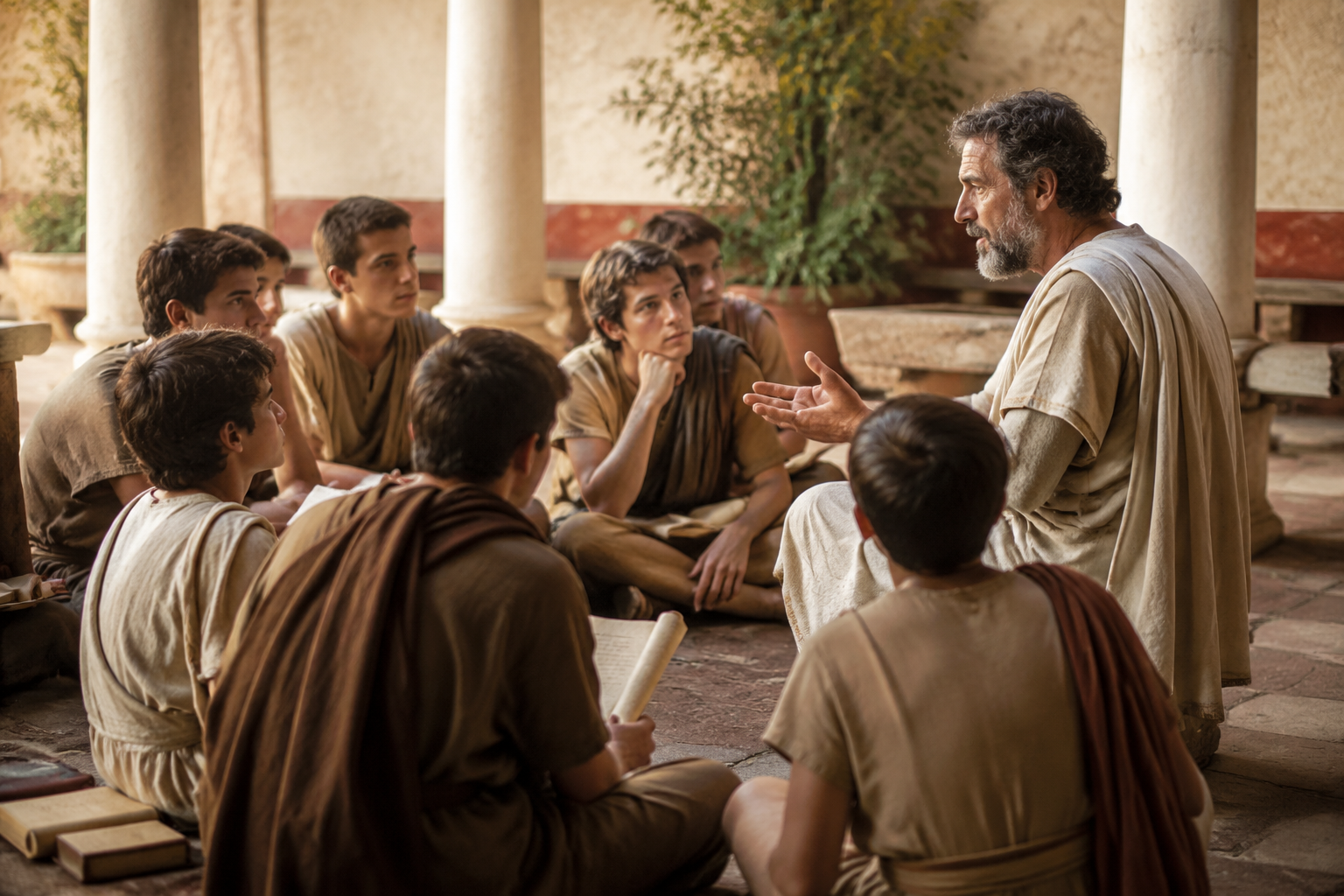
Across these passages, παιδεία consistently belongs to a framework of formation within relationships and over time. Ephesians places it in the parental task of nurturing children, where discipline is the constructive alternative to provoking anger. The verse does not frame discipline as venting frustration or enforcing dominance; it is embedded in “nurture” and paired with “instruction of the Lord,” suggesting a deliberate, steady shaping that corresponds to the Lord’s own instruction. In that household setting, discipline functions as a means of care: it is something a father gives as part of raising a child, and it stands in contrast to behavior that drives a child toward wrath.
2 Timothy broadens the setting from the household to the formative influence of Scripture. Discipline is one of the things Scripture is “profitable for,” and it is specifically discipline “in righteousness.” The surrounding terms (“reproof” and “correction”) indicate that discipline is at home in contexts where errors are confronted and right paths are restored. Yet the aim is not mere fault-finding; the stated destination is righteousness. In this verse, παιδεία belongs to the category of constructive, purposeful formation that Scripture supplies to people and communities.
Hebrews 12, where most occurrences cluster, ties discipline closely to endurance, identity, and outcome. The repeated parent-child language (“as with children,” “My son,” “son,” “father,” “children”) makes discipline intelligible as a family reality: it is what a father does with and for a son. On this logic, discipline is not an interruption of relationship but an expression of it. The exhortations in Hebrews 12:5 deal directly with the hearers’ inner posture toward discipline: they must neither dismiss it (“don’t take lightly”) nor be undone by it (“nor faint”). That twofold warning implies discipline can be misread in opposite ways—either trivialized or treated as crushing—and the passage seeks a steadier response consistent with being addressed as children.
Hebrews 12:7 makes endurance central: “It is for discipline that you endure.” Discipline is thus not only a momentary correction; it is something that can require sustained perseverance. Endurance is given meaning by discipline’s purpose and by the relational explanation that follows (“God deals with you as with children”). The rhetorical question about sons and fathers presents discipline as a normal expectation, not a strange exception. Hebrews 12:8 then pushes the point by turning discipline into a sign of legitimate sonship. Participation in discipline is described as widespread (“all have been made partakers”), and absence of discipline is connected to being “illegitimate, and not children.” Discipline in this sequence is intertwined with belonging: it is presented as evidence of being treated as a child within the relationship the author assumes between God and his people.
Finally, Hebrews 12:11 supplies a realistic description of discipline’s felt character and its hoped-for result. Discipline is acknowledged as painful—“not joyous but grievous”—which prevents an overly tidy portrayal. Yet the verse also insists discipline is productive: it “yields” fruit. The metaphor of fruit marks discipline as something that takes time and culminates in a harvest. The fruit is described as “peaceful” and as belonging to “righteousness,” and it comes to “those who have been trained by it.” In this way, discipline is not only corrective but educative in the broad sense of training: it forms a person so that righteousness becomes a settled, peace-producing outcome. In Hebrews, the recurring family language, the call to endurance, and the promised fruit work together to present discipline as a shaping process that belongs to God’s way of dealing with his children.
Imagery and Themes
The dominant imagery carried by παιδεία in these passages is familial and agricultural. The family picture is explicit: fathers and children in Ephesians, and God dealing “as with children” in Hebrews. Discipline is therefore not treated as an impersonal mechanism but as something administered within recognized bonds of care and belonging. Hebrews complements that with the growth-image of “fruit,” portraying discipline as a process whose value is measured not by immediate comfort but by later harvest—“the peaceful fruit of righteousness.” Together these images hold two truths in tension: discipline can be “grievous” now, yet it is oriented toward nurture and training that yields a mature outcome.
Sources: Lexical data from Strong’s Exhaustive Concordance and the Translators Brief Lexicon of Extended Strongs for Greek (STEPBible, CC BY). Occurrence data from the Translators Amalgamated Greek New Testament (STEPBible, CC BY). Scripture quotations from the World English Bible (public domain).





