
Exploring the Meaning of Olothreutes in Greek
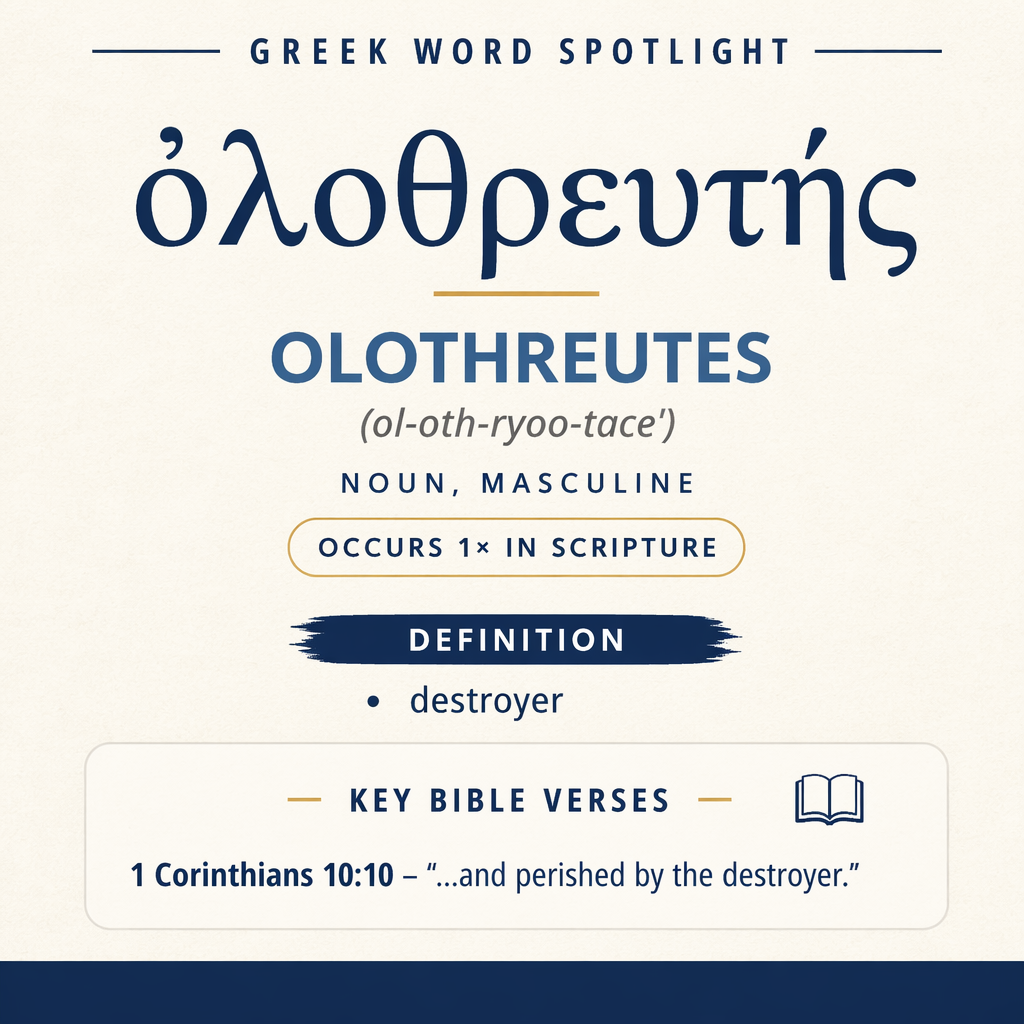
ὀλοθρευτής means “destroyer” and appears once in Scripture, in 1 Corinthians 10:10.
Biblical Occurrence
The word occurs 1 time in Scripture. Its single occurrence is in 1 Corinthians 10:10.
Learn More →ὀλοθρευτής means “destroyer” and appears once in the New Testament, in Paul’s warning against grumbling in 1 Corinthians 10:10. In that single context it names the agent by which certain grumblers “perished,” sharpening the seriousness of the conduct being condemned.
Root and Related Words
ὀλοθρευτής (Olothreutes) is related to the verb ὀλοθρεύω (olothreuo), “to destroy” (Strong’s G3645). The noun form designates a “destroyer” in line with that verbal idea of destroying.

Occurrences
“Don’t grumble, as some of them also grumbled, and perished by the destroyer.” (1 Corinthians 10:10)
In this warning, ὀλοθρευτής identifies the instrument or agent associated with the perishing that follows grumbling. The sentence is built with a straightforward moral progression: an action (“grumble”), the example of “some of them,” and the outcome (“perished”), capped by the phrase “by the destroyer,” which concentrates attention on the cause of death. By naming a destroyer rather than leaving the outcome as an impersonal consequence, the line gives the perishing a directed, active character: the end of the grumblers is not portrayed as a vague fading away but as an ending brought about “by” someone or something called “the destroyer.”

The presence of the article (“the destroyer”) makes the noun feel definite within the discourse: Paul is not introducing an abstract category (“a destroyer”) but invoking a recognized figure in the moral imagination of the community he addresses. Within the verse’s tight parallelism—“Don’t grumble… as some of them also grumbled”—the term λειτουργεί as the weight-bearing final element. It is the last word of the warning’s causal chain and therefore the rhetorical punch: what seems like a spoken complaint is placed in line with fatal consequence.
The verse also sets the destroyer in contrast with the grumblers. The grumblers are characterized by speech, discontent, and contagious behavior (“some of them also grumbled”), while the destroyer is characterized by effect: destruction resulting in perishing. The word thus functions as a stark noun of agency. It makes the outcome concrete and personal in grammatical form, even though the text does not describe the destroyer’s appearance or method. The emphasis falls on the reality of the outcome and the seriousness of the behavior that preceded it.
Sense and Usage
With its single New Testament use, ὀλοθρευτής is a concentrated term: it contributes a definite agent-title that frames “perished” as the result of destructive action. The sense “destroyer” in this context is not a neutral label for an opponent; it is a name for the force that brings about death in response to wrongdoing. The immediate co-text supplies the term’s practical contour: it is connected to perishing, and it is connected specifically to the sin of grumbling. That linkage matters for the way the word is heard. Paul’s warning does not treat grumbling as a minor social irritant; by attaching it to perishing “by the destroyer,” he positions it among behaviors with severe, even terminal consequences.
The word’s contribution is also disciplinary and communal. “Don’t grumble” is addressed to a group, and the example “some of them also grumbled” presumes a shared story-world that the audience can recognize. Within that shared frame, “the destroyer” operates as a boundary-marker: it is the named consequence that stands at the far end of a path the community must not take. The term therefore functions not only descriptively (naming who or what destroyed) but admonishingly: it furnishes the warning with a concrete endpoint that makes the prohibition urgent.
Because ὀλοθρευτής is used with the preposition “by,” it is grammatically positioned as the agent connected with the perishing of the grumblers. The noun does not merely describe destruction as an abstract event; it depicts destruction as something enacted. This aligns with the moral logic of the verse: an act of grumbling is met by an act of destroying. The word, then, brings a symmetry of agency into the sentence: human agency in sin is met by the destroyer’s agency in judgment. The result is a compressed but vivid causal picture, with “the destroyer” functioning as the decisive actor at the end of the chain.
Imagery
The imagery carried by ὀλοθρευτής in 1 Corinthians 10:10 is spare but severe. Nothing is narrated about how the destroyer works; the power of the line lies in its stark pairing of “perished” with “the destroyer.” The word evokes the presence of a destroying agent who brings an end, and it does so in a context where the precipitating sin is verbal discontent—grumbling that may seem ordinary until it is set beside the destroyer’s deadly result.
Sources: Lexical data from Strong’s Exhaustive Concordance and the Translators Brief Lexicon of Extended Strongs for Greek (STEPBible, CC BY). Occurrence data from the Translators Amalgamated Greek New Testament (STEPBible, CC BY). Scripture quotations from the World English Bible (public domain).





