
Exploring the Meaning of Ololuzo in Greek
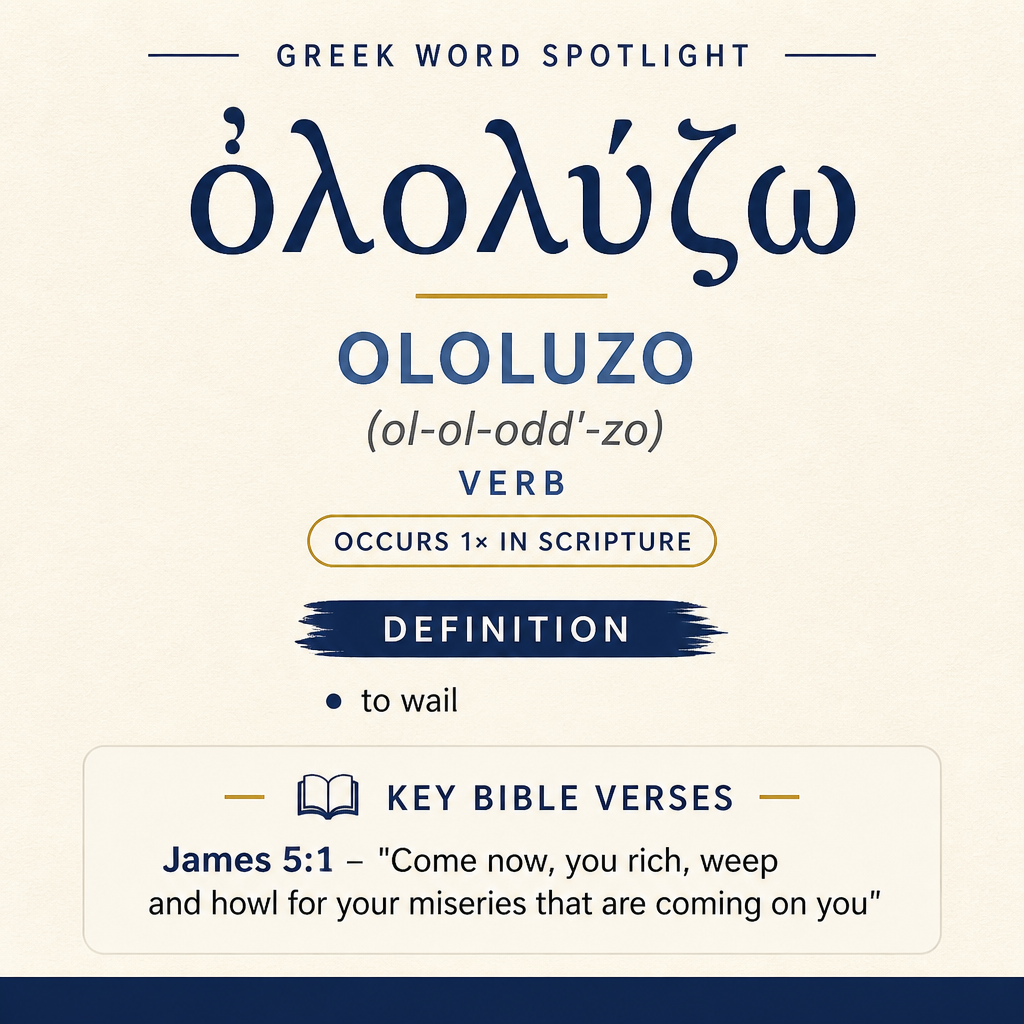
ὀλολύζω means “to wail” and appears once in Scripture, in James 5:1.
Scripture Occurrence
This verb occurs 1 time in Scripture. Its single occurrence is in James 5:1.
Learn More →James 5:1 Usage
In James 5:1 it is used in the call to “weep and howl.” The address is to the rich regarding miseries coming upon them.
Learn More →ὀλολύζω means “to wail” and is used once in the Greek New Testament, in James 5:1. In that verse it stands beside other verbs of lament to portray an intense response to impending hardship.
Occurrences
“Come now, you rich, weep and howl for your miseries that are coming on you.” (James 5:1)
In James 5:1, ὀλολύζω appears in a direct address: “Come now, you rich.” The line is constructed as a summons followed by two imperatives of grief: “weep and howl.” Within the sentence, “howl” functions as the stronger, more piercing element alongside “weep,” pressing beyond private sorrow into an audible outcry. The wailing is not presented as a vague emotional state but as an action commanded in view of a specific cause: “your miseries that are coming on you.”

The verse sets the time frame with a forward look—miseries “are coming”—so the wailing is prompted by anticipated distress. The word therefore contributes a sense of urgent lament appropriate to the seriousness of what is approaching. Because the command is directed to “you rich,” it reads as a public warning and confrontation rather than a quiet internal reaction; the instruction to wail fits the rhetorical posture of calling a group to acknowledge looming suffering.
The pairing “weep and howl” also shapes how ὀλολύζω is heard: it is not a neutral cry, but lamentation. “Weep” supplies the ordinary language of tears; “howl” adds the voice of anguish. Together they form a compressed picture of grief that is both visible (weeping) and audible (wailing). In the immediate context of this single sentence, wailing is the fitting expression for “miseries” that are not hypothetical but on their way.

Sense and Usage
As used in James 5:1, ὀλολύζω names a form of lament that is outward and voiced. The definition “to wail” places the emphasis on sound—an expression that can be heard—rather than on inward feeling alone. In ordinary communication, “wail” evokes a heightened register of distress: it is what someone does when suffering is great, sudden, or unavoidable. James employs that register to sharpen the warning: the rich are not merely told to feel regret but to respond with the kind of cry that matches calamity.
The verse’s structure gives ὀλολύζω a specific rhetorical function. The opening command “Come now” draws attention and signals urgency. The second-person address (“you rich”) identifies the audience with directness. Then the two imperatives—“weep and howl”—supply the demanded response. In that chain of imperatives, wailing is not spontaneous; it is commanded. That choice intensifies the confrontation: the speaker speaks as one who can call for a public acknowledgment of coming misery, and the audience is told to adopt the posture of mourners before the misery arrives.
James also anchors the wailing in an object: “for your miseries that are coming on you.” The prepositional phrase “for your miseries” ties the audible lament to a reason, so the wailing is not treated as empty noise but as a reaction to real hardship. The last clause, “that are coming on you,” adds inevitability and direction. The miseries are pictured as approaching and landing upon them; wailing is matched to the sense of being overtaken. Thus ὀλολύζω carries the weight of impending judgment-like trouble without needing to specify the content of the miseries in this verse; the emotional and vocal register is enough to convey how severe they will be.
The collocation with “weep” is also important for semantic force. English can distinguish between crying with tears and crying out with the voice; the verse includes both. The presence of “weep” keeps the scene within the category of lament rather than anger, celebration, or mere shouting. “Howl” then moves lament into its most intense audible form. In this pairing, ὀλολύζω suggests a grief that breaks normal composure. It is the cry that corresponds to “miseries,” not to minor losses.
Because James 5:1 is the only occurrence here, the sense of ὀλολύζω must be read through the single frame the verse provides: a prophetic-sounding warning that compels an audible response. Even within one sentence, the term’s usage is clear: it is the language of lament at the brink of suffering. The command form gives it a performative dimension—wailing as an enacted acknowledgment. It is not merely descriptive (“they wailed”) but directive (“howl”), which portrays wailing as the appropriate posture for those addressed.
The immediacy of the line also shapes the word’s feel. James does not say “you will howl” but commands “weep and howl.” The present urgency presses the reaction into the current moment even though the “miseries” are future. In this way ὀλολύζω serves as a verbal shock: the verse calls for the sound of lament now because the approach of misery is certain enough to warrant it. The result is a compressed scene where the future casts its shadow into the present, and wailing is the sound demanded by that shadow.
Imagery
James 5:1 evokes the soundscape of lament. The verse does not describe tears in detail or specify the miseries, but it does place “howl” on the lips of those being warned, making the audible cry part of the picture. The reader is left with a stark contrast: those addressed as “rich” are summoned to the posture of mourners, and the commanded wailing becomes the fitting sound for “miseries that are coming on you.”
Sources: Lexical data from Strong’s Exhaustive Concordance and the Translators Brief Lexicon of Extended Strongs for Greek (STEPBible, CC BY). Occurrence data from the Translators Amalgamated Greek New Testament (STEPBible, CC BY). Scripture quotations from the World English Bible (public domain).





