Exploring the Meaning of Oikeios in Greek
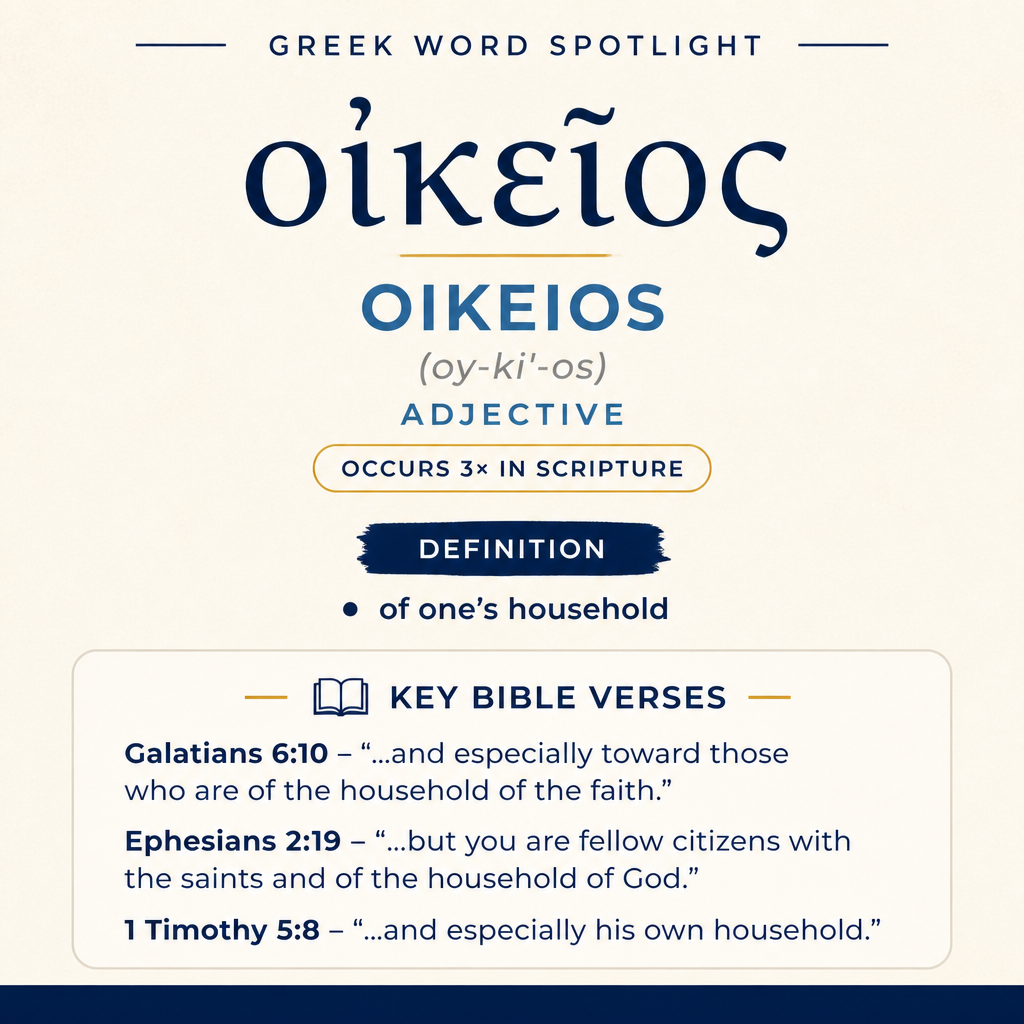
οἰκεῖος means “of one’s household” and appears in Galatians 6:10, Ephesians 2:19, and 1 Timothy 5:8.
Core Meaning
οἰκεῖος is defined as “of one’s household.” It points to those who belong to a household.
Learn More →Scripture Occurrences
It occurs 3 times in Scripture. The references are Galatians 6:10, Ephesians 2:19, and 1 Timothy 5:8.
Learn More →Contextual Use
In Galatians 6:10 it modifies those “of the household” who receive special good. In Ephesians 2:19 and 1 Timothy 5:8 it identifies belonging and responsibility within a household.
Learn More →οἰκεῖος describes what belongs to one’s household. It appears in three New Testament passages that speak about the boundaries of responsibility and belonging in relation to faith, God, and one’s own dependents.
Root and Related Words
οἰκεῖος is derived from oikos (οἶκος), “house: home” (Strong’s G3624). That connection frames the adjective in terms of household life: those who are “in the house” and those who are treated as such.

Occurrences
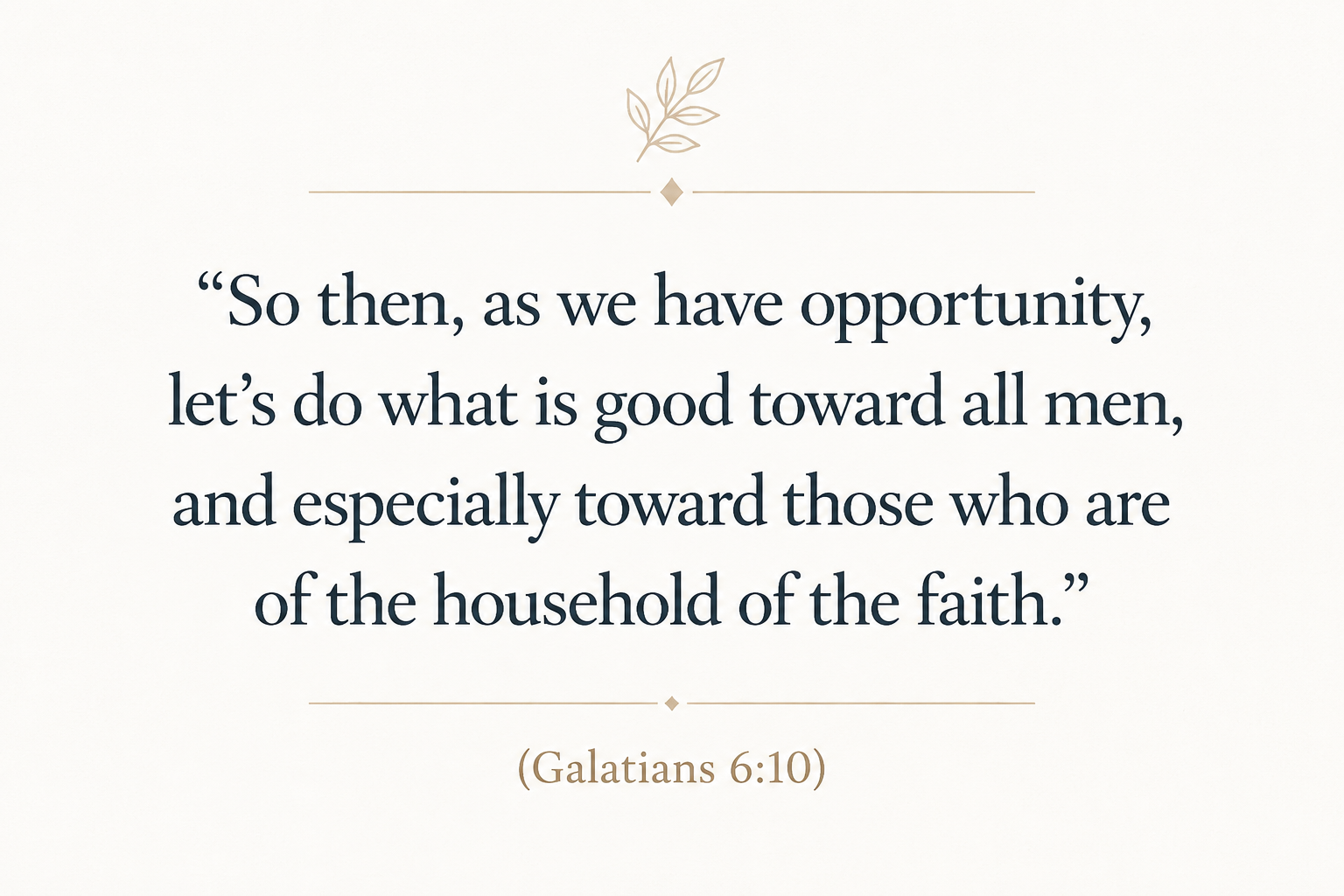
“So then, as we have opportunity, let’s do what is good toward all men, and especially toward those who are of the household of the faith.” (Galatians 6:10)
Here οἰκεῖος marks out a particular circle within the wider field of benevolence. The sentence opens outward—“do what is good toward all men”—and then narrows with “especially.” The household idea shapes that narrowing: some are described as belonging to a household characterized by “the faith.” In this setting, οἰκεῖος does not replace doing good to “all men”; it supplies the category that justifies a special focus. The phrase “of the household of the faith” presents faith as something that can define a household, so that those who belong to it receive a distinct kind of attention within the broader mandate to do good whenever there is “opportunity.”
“So then you are no longer strangers and foreigners, but you are fellow citizens with the saints and of the household of God,” (Ephesians 2:19)
In this verse οἰκεῖος works alongside two other belonging-terms to describe a change of status. The negative side is exclusion: “strangers and foreigners.” The positive side is layered inclusion: first “fellow citizens with the saints,” and then “of the household of God.” The household image adds an intimate, domestic register to the civic register of citizenship. The transition from being outsiders to being insiders is expressed not only as entry into a people (“fellow citizens”) but as placement within a household that is God’s. Within the verse’s own contrasts, οἰκεῖος names the opposite of estrangement: membership that implies nearness, recognized place, and inclusion within God’s own sphere of belonging.
“But if anyone doesn’t provide for his own, and especially his own household, he has denied the faith, and is worse than an unbeliever.” (1 Timothy 5:8)
Here οἰκεῖος identifies the most immediate circle of obligation within “his own.” The line again uses “especially” to heighten focus: providing “for his own” is sharpened to providing “especially [for] his own household.” The word therefore functions as a practical designation for those who fall under one’s household responsibility, and the verse attaches moral seriousness to that responsibility. Failure to provide is not treated as a minor lapse; it is framed as denial of faith and compared unfavorably even with the stance of “an unbeliever.” In this scene, οἰκεῖος anchors the discussion in concrete duty: the household is the place where claims of faith are tested by sustained care for those nearest at hand.
Sense and Usage
Across these three passages, οἰκεῖος consistently draws a boundary around a household, but the household is specified in different ways. In Galatians 6:10, the household is defined by “the faith,” and the word helps express a prioritization within a universal posture of doing good. In Ephesians 2:19, the household is “of God,” and the word participates in a strong before-and-after contrast: outsiders become insiders, not merely in a political sense but in a domestic sense. In 1 Timothy 5:8, the household is one’s “own,” and the word directs attention to immediate dependents as the primary arena for provision.
These uses together show that οἰκεῖος can frame belonging at more than one level without changing its household character. It can describe affiliation that is communal and faith-marked (“the household of the faith”), identity that is relational to God (“the household of God”), and responsibility that is personal and familial (“his own household”). The adjective’s household orientation gives each context a particular texture: it makes “faith” and “God” speak in domestic terms of belonging, and it makes moral exhortation speak in terms of duty to one’s nearest household circle. Even where the immediate topic differs—doing good broadly, redefining status, requiring provision—the word supplies a stable picture of who counts as one’s household and therefore who receives special recognition in care, identity, or obligation.
Household Imagery
In these verses the household is more than a metaphor for organization; it is a way of picturing nearness and responsibility. Galatians 6:10 and 1 Timothy 5:8 each use “especially” to highlight a household-centered priority within a wider field—toward “all men” in the one, and toward “his own” in the other—so that household belonging becomes the reason for focused action. Ephesians 2:19 presents the household as a marker of changed standing: those once defined by distance (“strangers and foreigners”) are now placed within God’s own household, a shift that expresses welcome and settled inclusion.
Sources: Lexical data from Strong’s Exhaustive Concordance and the Translators Brief Lexicon of Extended Strongs for Greek (STEPBible, CC BY). Occurrence data from the Translators Amalgamated Greek New Testament (STEPBible, CC BY). Scripture quotations from the World English Bible (public domain).