
Exploring the Meaning of Oiketes in Greek
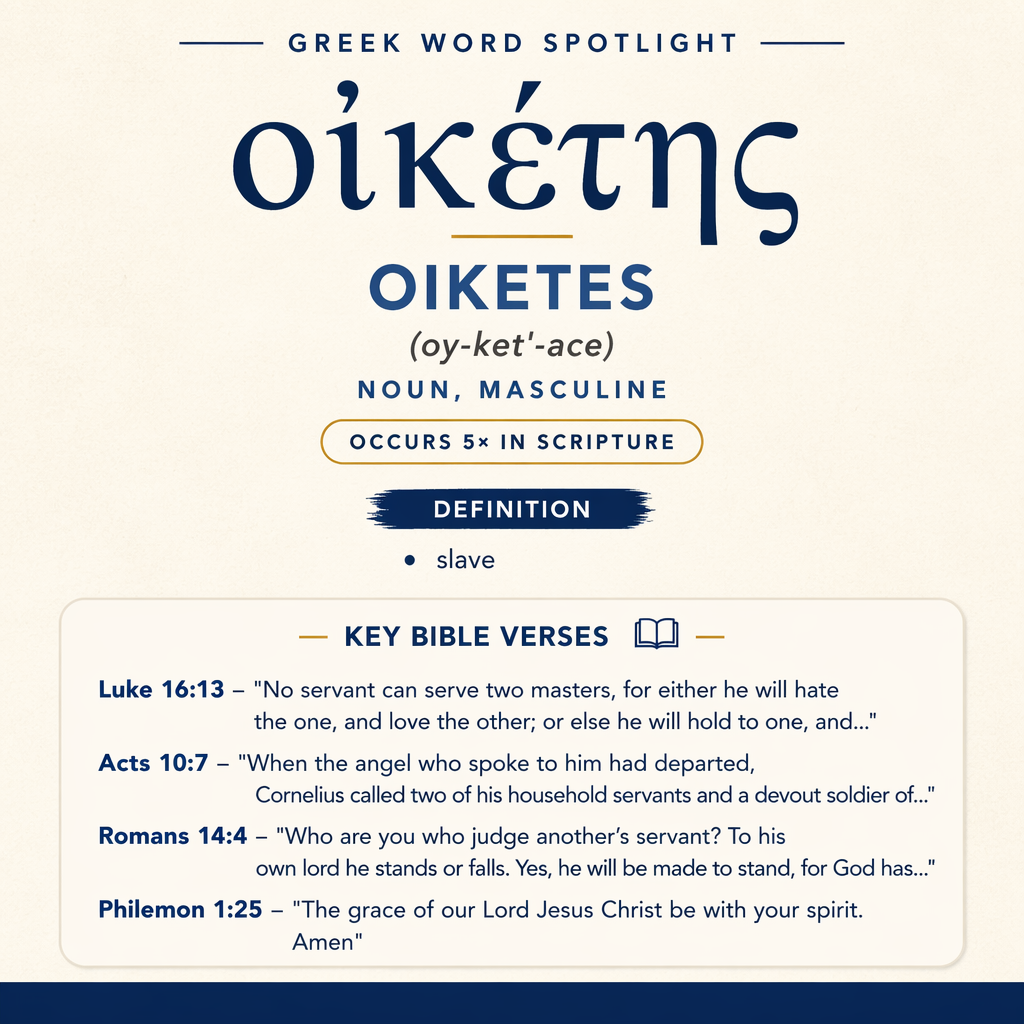
οἰκέτης (Oiketes) means “slave” and appears five times in Scripture: Luke 16:13; Acts 10:7; Romans 14:4; Philemon 1:25; 1 Peter 2:18.
Core Meaning
οἰκέτης means “slave.” In the listed passages it is rendered as “servant” or “household servant.”
Learn More →Scripture Occurrences
This word occurs 5 times in Scripture. The references are Luke 16:13; Acts 10:7; Romans 14:4; Philemon 1:25; and 1 Peter 2:18.
Learn More →Context Snapshots
In Luke 16:13 it appears in a statement about serving masters. In 1 Peter 2:18 it addresses servants submitting to masters with respect.
Learn More →οἰκέτης appears in a small cluster of New Testament passages where a “slave” is set in relation to a master, a household, or a lord whose authority defines the slave’s standing. The word’s uses range from Jesus’ moral teaching to narrative description and direct exhortation.
Root and Related Words
οἰκέτης derives from oikeo (οἰκέω), “to dwell” (Strong’s G3611). The connection in form highlights how the word naturally fits settings described in terms of a dwelling or household sphere, even when the immediate context broadens from domestic space to questions of loyalty and accountability.
Occurrences
Luke 16:13: “No servant can serve two masters, for either he will hate the one, and love the other; or else he will hold to one, and despise the other. You aren’t able to serve God and Mammon.”
Here οἰκέτης frames an everyday relationship of control and obligation to make a point about exclusive allegiance. The “slave” is pictured as unable to divide service between “two masters,” and the verse presses the relational consequences: “hate” versus “love,” “hold to” versus “despise.” The term contributes the social reality that service is not a casual arrangement but a binding one; the slave’s life is claimed by a master in a way that makes double service impossible. The closing line (“You aren’t able to serve God and Mammon”) turns the household image into a moral contrast between rival claimants.
Acts 10:7: “When the angel who spoke to him had departed, Cornelius called two of his household servants and a devout soldier of those who waited on him continually.”
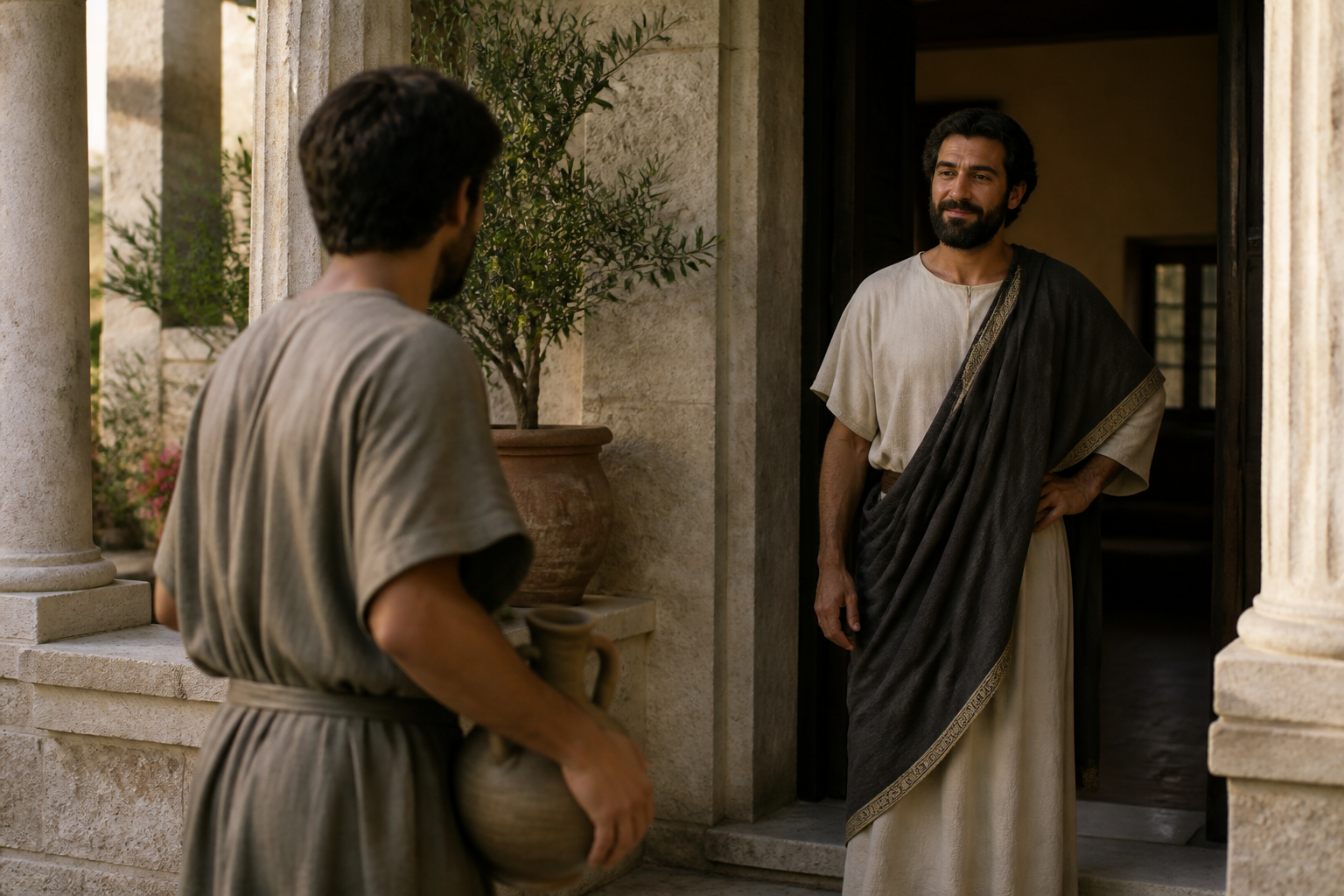
In Acts, οἰκέτης is anchored explicitly within a household setting: “two of his household servants.” The word helps specify Cornelius’ immediate circle of personnel available for dispatch after the angel’s departure. The phrase “household servants” places them inside his domestic establishment, while the broader description—alongside “a devout soldier of those who waited on him continually”—shows a structured environment of service and readiness. οἰκέτης contributes the idea of persons whose role is defined by belonging to the household and responding to their master’s summons.
Romans 14:4: “Who are you who judge another’s servant? To his own lord he stands or falls. Yes, he will be made to stand, for God has power to make him stand.”
Paul uses οἰκέτης to argue that judgment over someone else’s “slave” is a category mistake: the slave answers to “his own lord.” The term marks a relationship of accountability that is not transferable to outside observers. The imagery of “stands or falls” depicts the slave’s state as evaluated within the master–slave bond; it is the lord to whom he is responsible. The final assurance (“God has power to make him stand”) draws the relational picture upward: the decisive power that stabilizes the slave’s standing belongs to God. οἰκέτης therefore functions to sharpen the boundary between human judgment and the rightful authority of the one who is truly “lord” over the slave.
Philemon 1:25: “The grace of our Lord Jesus Christ be with your spirit. Amen.”
In this closing blessing, οἰκέτης is not visible in the English verse as quoted, yet the verse’s own wording still supplies the controlling relational frame that commonly surrounds the term in its other occurrences: “our Lord Jesus Christ.” The title “Lord” supplies the language of lordship that elsewhere sets the “slave” in relation to a master. Within this benediction, the focus falls on grace proceeding from the “Lord Jesus Christ” and being “with your spirit,” a pairing that keeps attention on the authority and beneficence of the Lord rather than on the status or claims of human masters.
1 Peter 2:18: “Servants, be in subjection to your masters with all respect: not only to the good and gentle, but also to the wicked.”
In Peter, οἰκέτης addresses slaves directly and places their daily posture under the heading of “subjection” and “respect.” The term is tied to concrete power asymmetry: slaves have “masters,” and those masters may be “good and gentle” or “wicked.” By naming both kinds, the verse treats slavery as a lived condition that can involve widely different moral character in those holding authority. οἰκέτης contributes an audience designation—people whose social position entails submission in a master’s household or sphere of control—and the exhortation targets their conduct within that established relationship.
Sense and Usage
Across these passages, οἰκέτης (“slave”) consistently places a person within a defined structure of authority in which another is “master” or “lord.” Luke 16:13 uses the slave’s situation to make the sharpest point: a slave is not free to distribute service across competing masters, and the language of love, hate, attachment, and contempt portrays divided service as relationally incoherent. Romans 14:4 uses the same basic relationship to protect community life from presumptuous judgment; because the slave belongs to a particular lord, outsiders do not possess the standing to issue decisive verdicts on that slave’s condition (“stands or falls”). Acts 10:7 grounds the word in household operations, where the slave is part of the master’s working environment and can be summoned immediately for action. 1 Peter 2:18 addresses the realities of obligation within that structure—subjection to masters—and does so without limiting the instruction only to favorable circumstances, since masters may be “wicked.”
Two recurring relational poles organize the word’s force: (1) the master’s claim on the slave, and (2) the slave’s responsibility within that claim. In Luke, that responsibility is framed as undivided service; in Romans, as accountability to the rightful lord rather than to spectators; in Acts, as readiness within a household; and in Peter, as comportment under authority marked by “respect.” Even where the verse is a benediction (Philemon 1:25), the language of “our Lord Jesus Christ” keeps the theme of lordship in view, providing a theological horizon for how lordship is spoken of in Christian discourse.
Because οἰκέτης is used in both teaching and direct address, it can function either as a vivid illustration (Luke; Romans) or as a direct label for a social group (Acts; 1 Peter). In every case, the word draws attention to a relationship that is not merely occupational but defined by belonging and authority: a slave’s service and standing are interpreted through the master–slave bond named in the immediate context.
Imagery
The passages that use οἰκέτης regularly evoke the space and dynamics of a household: masters, servants, and the daily reality of being “in subjection.” Luke 16:13 and Romans 14:4 extend that familiar picture into moral and communal reasoning—exclusive service and proper boundaries of judgment—while Acts 10:7 and 1 Peter 2:18 keep the term close to the practical world of “household servants” and the varied character of “masters.”
Sources: Lexical data from Strong’s Exhaustive Concordance and the Translators Brief Lexicon of Extended Strongs for Greek (STEPBible, CC BY). Occurrence data from the Translators Amalgamated Greek New Testament (STEPBible, CC BY). Scripture quotations from the World English Bible (public domain).




