Discovering the Meaning of ‘Oben in Hebrew
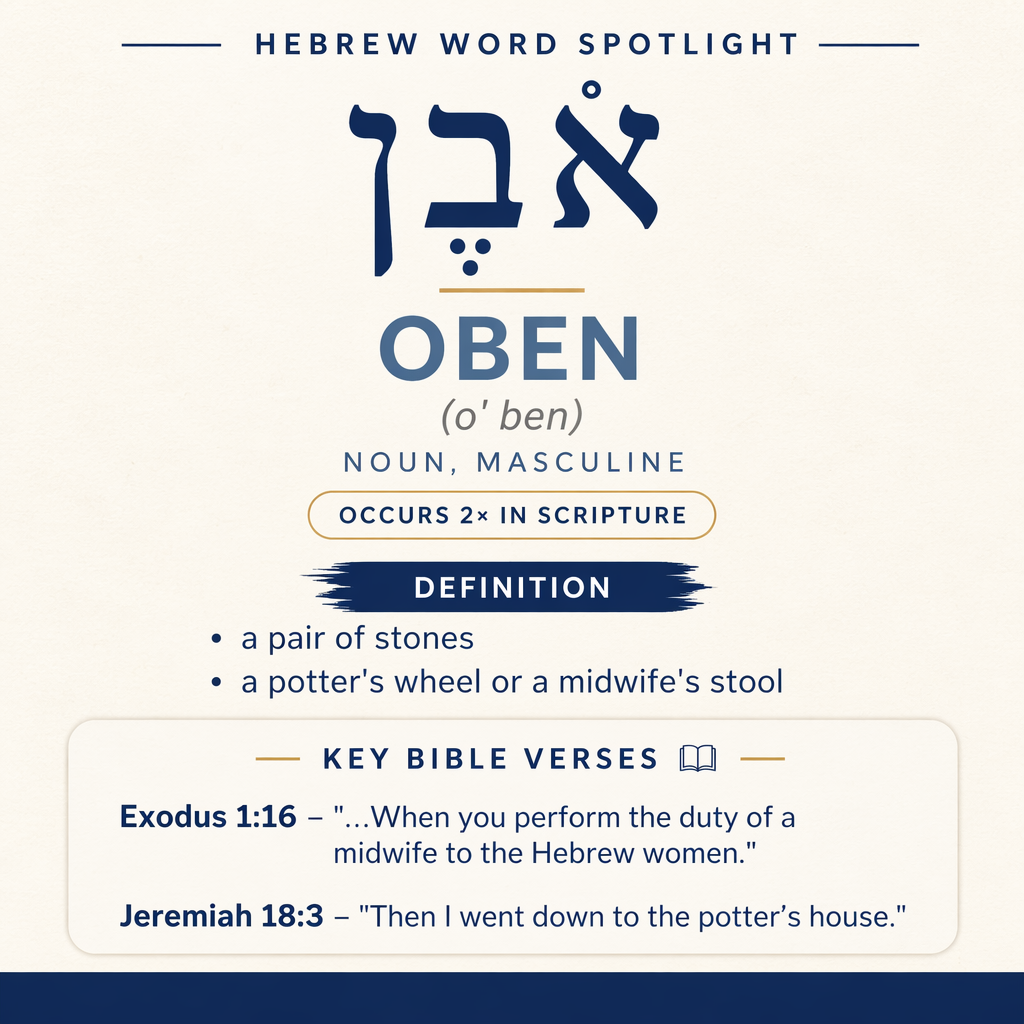
אֹבֶן means a pair of stones—used for a potter’s wheel or a midwife’s stool—and appears in Exodus 1:16 and Jeremiah 18:3.
Core Meaning
אֹבֶן refers to a pair of stones. It can denote a potter’s wheel or a midwife’s stool.
Learn More →Exodus Context
In Exodus 1:16, it names the birth stool seen by the midwife during delivery. The word is used in instructions about assisting Hebrew women.
Learn More →Jeremiah Context
In Jeremiah 18:3, it describes the wheels used by the potter. The scene takes place in the potter’s house while he is making something.
Learn More →אֹבֶן (oben) refers to “a pair of stones,” used concretely for either a potter’s wheel or a midwife’s stool. Scripture uses it in two distinct scenes: royal instruction about childbirth in Egypt and an observed act of pottery-making.
Occurrences
“and he said, “When you perform the duty of a midwife to the Hebrew women, and see them on the birth stool, if it is a son, then you shall kill him; but if it is a daughter, then she shall live.”” (Exodus 1:16)
Here אֹבֶן appears within an order addressed to those “perform[ing] the duty of a midwife.” The wording situates the term at the precise moment when the infant’s sex can be recognized: the instruction turns on what is “see[n]” when the mother is “on the birth stool.” In the scene’s logic, the stool is not incidental furniture but a practical point of observation and decision. The command is framed as conditional (“if it is a son … but if it is a daughter”), and the mention of the birth stool anchors those conditions to a specific setting of labor, where the midwife is expected to be present and able to act immediately.
The term’s concrete reference supports the verse’s stark procedural tone. The speaker is not describing childbirth in general; he is specifying the moment and place at which an act is to be carried out. By naming the birth stool, the verse gives the instruction a mechanical clarity: a designated place in the birthing process becomes the occasion for the morally weighty decision the command demands. Thus אֹבֶן contributes to the verse’s chilling realism by attaching the policy to a tangible apparatus of delivery.
“Then I went down to the potter’s house, and behold, he was making something on the wheels.” (Jeremiah 18:3)
In Jeremiah 18:3 the word occurs in a craft scene narrated in the first person: “I went down to the potter’s house.” The decisive detail is what the observer sees—“behold, he was making something on the wheels.” Here אֹבֶן names the implement by which the potter forms his work. The verse does not dwell on the object’s construction, but it presents it as the defining feature of the activity: the potter is “making something,” and that making is characterized by being done “on the wheels.”
The term’s basic sense “a pair of stones” fits the plural feel of “wheels” in this translation and helps the reader visualize a workstation built around a rotating pair. In this setting, אֹבֶן serves as the stable, recurring tool of a potter’s labor—the fixed apparatus at the center of repeated shaping. The verse’s simple, observational style (“behold”) relies on such a concrete implement: it invites attention to process, not merely to the final product.

Sense and Usage
The two attestations present אֹבֶן as an everyday object defined by its function in skilled, bodily work. The definition “a pair of stones” stands behind both uses: whether in childbirth or in pottery, the term points to a two-stone apparatus that supports a task requiring steadiness, positioning, and close attention. In Exodus the object belongs to the midwife’s sphere; in Jeremiah it belongs to the artisan’s shop. In both, it is part of a structured practice, not an improvised aid.
These passages show that the word’s semantic range includes two distinct, context-driven applications: (1) a stool associated with delivery (“birth stool”) and (2) a wheel system used for forming clay (“the wheels”). The link between them is not the action performed but the kind of object: a paired-stone arrangement that makes a process possible. The word does not describe the persons involved (midwife, mother, potter) and does not name the product (child, vessel); it marks the equipment that mediates the work.
Because אֹבֶן can denote either implement, context determines which specific referent is intended. In Exodus the surrounding vocabulary—“perform the duty of a midwife,” “Hebrew women,” and the outcome of “son” versus “daughter”—demands the childbirth sense. In Jeremiah the setting—“the potter’s house” and the act of “making something”—calls for the craft sense. Each occurrence places the term in a sentence that is already strongly oriented toward a particular domain of human labor; the object named by אֹבֶן therefore functions as a domain marker. It signals, in a single concrete noun, the scene’s practical world: delivery-room procedure in one text, workshop technique in the other.
The term’s concreteness also shapes how each verse communicates. Exodus 1:16 embeds אֹבֶן in an instruction meant to be carried out, and the tool-name contributes to the instruction’s grim specificity: it identifies an expected moment in the birth process when the midwife is to “see” and then act. Jeremiah 18:3 embeds אֹבֶן in an eyewitness description, and the tool-name contributes to the vividness of what is observed: the making occurs “on the wheels,” placing the viewer’s attention on the method of formation rather than on any finished object. In both cases the word functions as a hinge between a human agent and a consequential outcome—life-and-death policy in Exodus, and purposeful shaping work in Jeremiah—by naming the physical apparatus that stands between intention and result.
Imagery
Across these two scenes, אֹבֶן carries imagery of formative moments—one of human birth and one of crafted making—without shifting into abstraction. Exodus 1:16 places the word at the threshold where a new life is first identified “on the birth stool,” making the object an unadorned witness to a commanded decision. Jeremiah 18:3 places it at the center of a potter’s activity, where “he was making something on the wheels,” and the object becomes the quiet center of a shaping process. In both, the “pair of stones” suggests steadiness and structure: a fixed piece of equipment around which decisive work takes place.
Sources: Lexical data from Strong’s Exhaustive Concordance and the Open Scriptures Hebrew Lexicon. Occurrence data from the Westminster Leningrad Codex with STEPBible reference data (CC BY). Scripture quotations from the World English Bible (public domain).