Exploring the Meaning of Nomotheteo in Greek
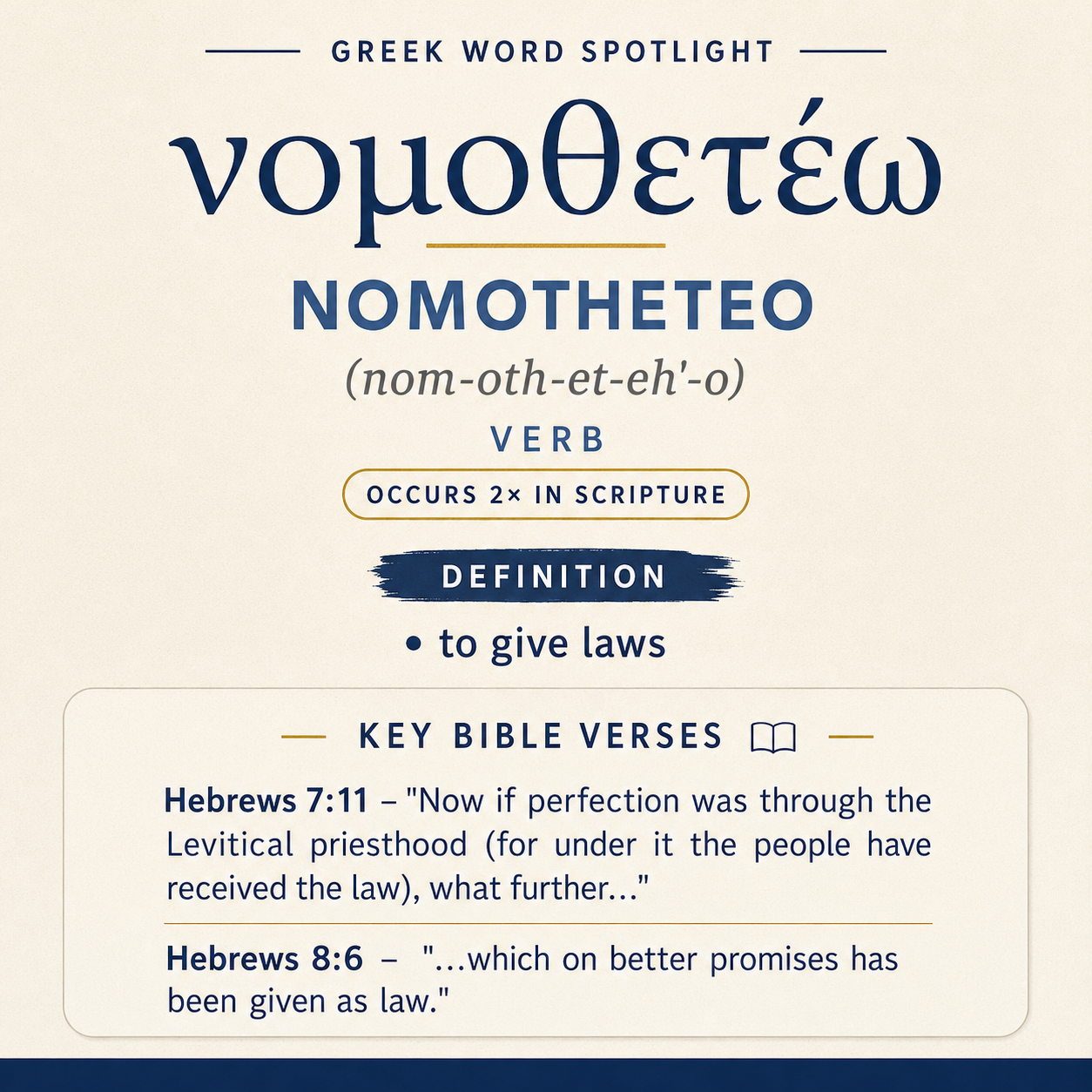
νομοθετέω means “to give laws” and occurs twice in Scripture, in Hebrews 7:11 and Hebrews 8:6.
Scripture Occurrences
This verb occurs 2 times in Scripture. The references are Hebrews 7:11 and Hebrews 8:6.
Learn More →Hebrews Context
In Hebrews 7:11 it appears in a statement about the people having received the law. In Hebrews 8:6 it occurs within a discussion of a better covenant.
Learn More →νομοθετέω means “to give laws.” In the New Testament it appears in Hebrews, where it is used to describe the giving of law in connection with the Levitical priesthood and, later, the establishment of a better covenant.
Root and Related Words
νομοθετέω is related to nomothetes (νομοθέτης), “lawgiver” (Strong’s G3550). The related noun points to the personal agent who gives law, while the verb expresses the act itself—law being given or established as law.

Occurrences
“Now if perfection was through the Levitical priesthood (for under it the people have received the law), what further need was there for another priest to arise after the order of Melchizedek, and not be called after the order of Aaron?” (Hebrews 7:11)
In Hebrews 7:11, νομοθετέω is embedded in a parenthetical remark explaining the setting in which the argument is being made: “under it the people have received the law.” The act of giving laws is presented as something that took place “under” the Levitical priesthood, so that the priesthood and the giving of law are treated together as a single framework for Israel’s life. The sentence then uses that framework to raise a question of “further need”: if “perfection was through the Levitical priesthood” in the context where the people were given law, why would there be any need for “another priest” of a different order? The verb therefore does more than describe that laws exist; it sets up the idea of a formally constituted order in which law was granted to the people, and that order is the background against which a change in priesthood would be significant.
The surrounding phrasing highlights the public and communal dimension of this lawgiving: it is “the people” who “have received the law.” This is not portrayed as a private instruction to a few, but as the establishment of an authoritative structure under which the community lives. In that scene, νομοθετέω contributes the notion of a decisive act by which law was handed over and received, forming a basis for the writer’s probing question about priestly succession and the “order” by which a priest is “called.”
“But now he has obtained a more excellent ministry, by so much as he is also the mediator of a better covenant, which on better promises has been given as law.” (Hebrews 8:6)
In Hebrews 8:6, νομοθετέω appears in a different, forward-looking frame. The verse contrasts “now” with what came before: “he has obtained a more excellent ministry,” and this superiority is linked to his being “the mediator of a better covenant.” Within that description, the clause “which on better promises has been given as law” uses the verb to describe the covenant’s status as something established with binding authority. Here the focus is not the older priesthood under which law was received, but a “better covenant” whose foundation is “better promises,” and which has itself been “given as law.”

In this scene, the act of giving laws is associated with mediation and covenant. The wording makes the covenant the direct object of the lawgiving action: the covenant “has been given as law.” That presentation places the covenant’s arrangement in the category of something formally enacted, not merely offered as advice or aspiration. The expression “on better promises” also ties the lawgiving act to the covenant’s basis: the lawgiving corresponds to the quality and content of the promises that undergird it. Thus νομοθετέω contributes the idea that this “better covenant” is not only promised but authoritatively established.
Sense and Usage
Across these two uses in Hebrews, νομοθετέω consistently denotes the decisive act by which law is given and thereby becomes the controlling framework for a people’s life. In Hebrews 7:11, it characterizes the historical setting of the Levitical priesthood: law was given “under it,” and the people “have received” that law. The verb therefore supports an argument that treats lawgiving and priestly order as linked realities: the giving of law is not a detached legal event but something that belongs to a particular priestly arrangement, the “Levitical priesthood,” and is significant enough to function as a premise in reasoning about “perfection” and “need.”
In Hebrews 8:6, the same act of lawgiving is applied to the “better covenant.” The covenant is not only described as better; it is presented as having been granted with legal force—“given as law.” In this way the verb serves as a bridge between covenant language (“mediator,” “covenant,” “promises”) and legal language (a thing “given as law”). The writer’s choice of this verb in both contexts allows the reader to see continuity in the category—both settings involve law being given—while also sustaining the contrast that Hebrews draws: the earlier lawgiving is located “under” the Levitical priesthood, while the later lawgiving is attached to a “more excellent ministry” and “better promises.”
The two occurrences also show that the act of giving laws can be described from different angles. In Hebrews 7:11, the emphasis falls on the recipients (“the people have received the law”) and the administrative sphere (“under” the Levitical priesthood). In Hebrews 8:6, the emphasis falls on what is enacted (“a better covenant”) and what grounds it (“better promises”). The verb is flexible enough to cover both: it can frame lawgiving as something experienced by a people within an established order, and it can frame lawgiving as something that formally establishes a covenantal arrangement.
Imagery in Hebrews
Hebrews uses νομοθετέω to evoke the picture of law arriving as an authoritative grant that shapes communal life. In Hebrews 7:11, the imagery is that of a people living “under” a priesthood while receiving law, as though the priestly order provides the setting in which law is handed over and acknowledged. In Hebrews 8:6, the imagery shifts to covenant being enacted “as law,” so that promises are not merely spoken but set into place with binding force within a mediated covenantal relationship.
Sources: Lexical data from Strong’s Exhaustive Concordance and the Translators Brief Lexicon of Extended Strongs for Greek (STEPBible, CC BY). Occurrence data from the Translators Amalgamated Greek New Testament (STEPBible, CC BY). Scripture quotations from the World English Bible (public domain).