Exploring the Meaning of Noema in Greek
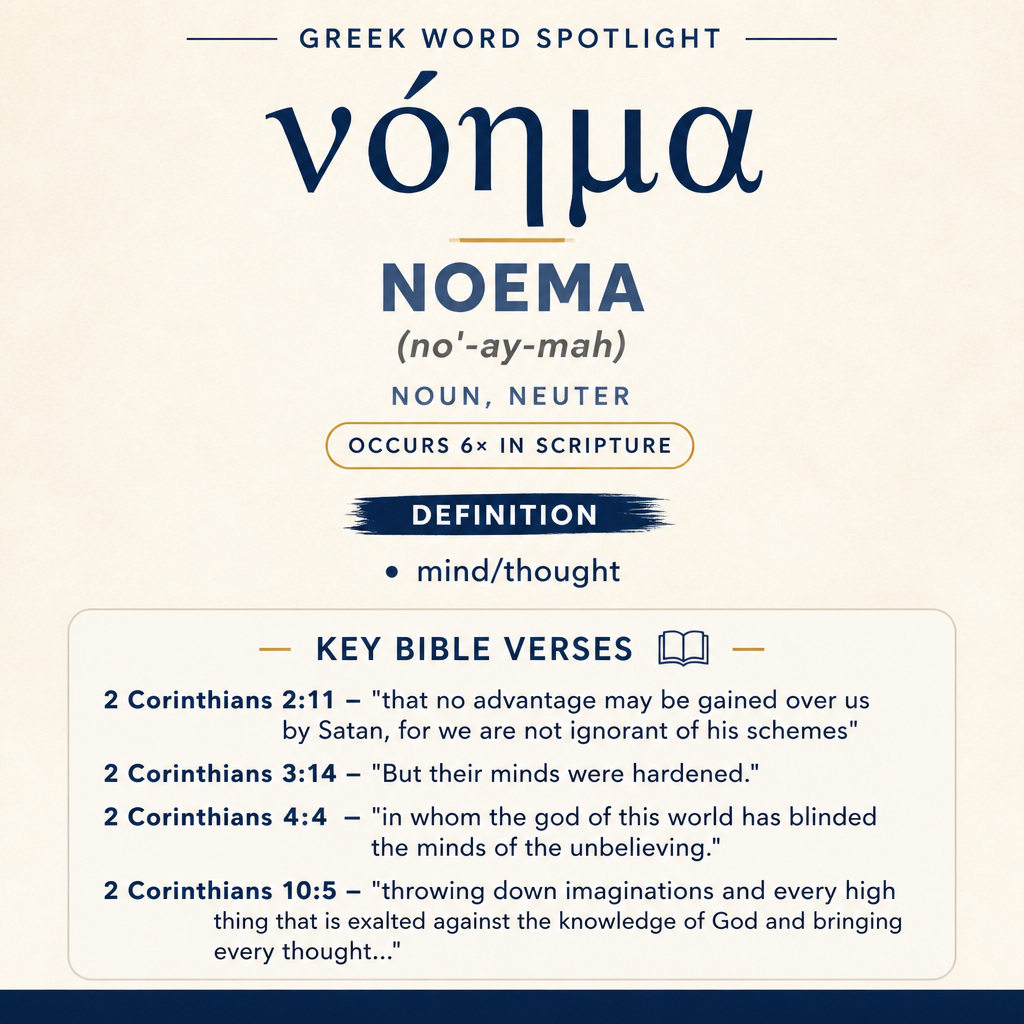
νόημα (Noema) means mind/thought and appears six times in Scripture: five in 2 Corinthians and once in Philippians.
Pauline Occurrences
It occurs in 2 Corinthians 2:11; 3:14; 4:4; 10:5; 11:3 and Philippians 4:7.
Learn More →Usage In Context
In 2 Corinthians it can describe Satan’s schemes, hardened or blinded minds, imaginations, and thoughts. In Philippians 4:7, God’s peace guards hearts and thoughts in Christ Jesus.
Learn More →Noema denotes the mind or a thought, and it appears in a cluster of Pauline contexts where inner cognition is acted upon—hardened, blinded, guarded, corrupted, or taken captive. The passages present it both as the seat of perception and as the arena where conflict over understanding and allegiance is fought.
Occurrences
“that no advantage may be gained over us by Satan, for we are not ignorant of his schemes.” (2 Corinthians 2:11)
Here noema is expressed through the line “we are not ignorant,” placing mental awareness over against “schemes.” The verse frames cognition as a point of vulnerability: to be mentally unaware is to leave room for “advantage” to be gained. Noema contributes the idea that what happens in the mind—knowing or not knowing—directly affects whether one is outmaneuvered.
“But their minds were hardened, for until this very day at the reading of the old covenant the same veil remains, because in Christ it passes away.” (2 Corinthians 3:14)
Noema here is the “minds” that “were hardened,” a condition described alongside the “veil” that “remains” at “the reading of the old covenant.” The imagery connects inner mental condition with the experience of reading: the veil is not merely external but corresponds to a hardened mental state. Noema, in this scene, marks the interior faculty that can become resistant, rendering one’s engagement with what is read constrained until the veil “passes away.”
“in whom the god of this world has blinded the minds of the unbelieving, that the light of the Good News of the glory of Christ, who is the image of God, should not dawn on them.” (2 Corinthians 4:4)
In this sentence noema is the target of an action: the “minds of the unbelieving” are “blinded.” The result is framed in visual terms—“light,” “glory,” and “should not dawn”—suggesting that the mind is the place where dawning illumination would occur. Noema therefore carries the sense of the mind as the locus of perceiving or recognizing; blinding it prevents the “light of the Good News” from coming into view for the person described.
“throwing down imaginations and every high thing that is exalted against the knowledge of God and bringing every thought into captivity to the obedience of Christ,” (2 Corinthians 10:5)
Here noema appears as “every thought” that is “brought…into captivity.” The verse portrays a sequence of mental conflict: “imaginations” are thrown down, “every high thing” opposed to “the knowledge of God” is confronted, and then thoughts themselves are seized and redirected “to the obedience of Christ.” Noema contributes the idea that thoughts are not neutral; they can be aligned against knowledge or brought under obedience. The language of captivity pictures thoughts as entities that can be taken hold of and placed under a new authority.
“But I am afraid that somehow, as the serpent deceived Eve in his craftiness, so your minds might be corrupted from the simplicity that is in Christ.” (2 Corinthians 11:3)
Noema is again “minds,” now placed under threat: they “might be corrupted.” The comparison to deception “in…craftiness” makes the mind the susceptible point where corruption would take root, and the direction of corruption is specified: “from the simplicity that is in Christ.” Noema thus functions as the inner orientation that can be pulled away from a characterized “simplicity,” not by open force but through deceptive influence.
“And the peace of God, which surpasses all understanding, will guard your hearts and your thoughts in Christ Jesus.” (Philippians 4:7)
In Philippians noema is rendered “your thoughts,” paired with “your hearts,” and both are the objects of a protective action: they “will” be “guard[ed].” The guarding comes from “the peace of God,” described as surpassing “all understanding.” Noema here highlights the active life of the mind—thoughts that move and can be protected. The verse presents a positive counterpart to hardening, blinding, or corruption: thoughts are not only vulnerable; they can also be kept secure “in Christ Jesus.”

Sense and Usage
Across these occurrences, noema consistently names the interior life where perception, comprehension, and mental direction occur. The contexts do not treat the mind or thought as a detached capacity; noema is portrayed as something that can be affected—hardened (2 Corinthians 3:14), blinded (2 Corinthians 4:4), corrupted (2 Corinthians 11:3), guarded (Philippians 4:7)—and therefore as a decisive site of spiritual and moral consequence.
The passages also present noema at two closely related scales. At the collective or enduring level, noema is “minds” as a condition or state: hardened minds correspond to a “veil” remaining at the “reading of the old covenant” (2 Corinthians 3:14), and blinded minds prevent the “light” from dawning (2 Corinthians 4:4). At the more granular level, noema is “every thought” (2 Corinthians 10:5), treated as particular mental contents that can be confronted and brought under a defined obedience. This pairing shows how noema can refer both to the mind as an overall faculty or disposition and to its concrete outputs as thoughts.
Several passages place noema in proximity to language of knowledge and understanding, clarifying what is at stake when the mind is impacted. In 2 Corinthians 2:11, the concern is not being “ignorant,” because ignorance opens space for “advantage” to be gained through “schemes.” In 2 Corinthians 10:5, opposition is framed as what is “exalted against the knowledge of God,” and mental content is drawn into “obedience of Christ.” In Philippians 4:7, “understanding” is surpassed by divine “peace,” and that peace functions as a guard over the interior life. In each case, noema participates in the movement between awareness and vulnerability: the mind knows or is kept from knowing; thoughts submit or resist; inner peace guards the mind rather than leaving it exposed.
The verbs and images paired with noema give it a vivid profile in these texts. “Schemes” (2 Corinthians 2:11) presuppose planning and strategy, so mental alertness is framed as defense. “Hardened” and “veil” (2 Corinthians 3:14) cast the mind as something that can become unresponsive and obscured in its reading and recognition. “Blinded” and “light…should not dawn” (2 Corinthians 4:4) speak in sensory metaphors, presenting the mind as the place where illumination is received. “Captivity” and “obedience” (2 Corinthians 10:5) bring in the language of control and allegiance, suggesting that thoughts can be governed. “Corrupted…from the simplicity that is in Christ” (2 Corinthians 11:3) presents the mind as capable of being diverted from a straightforward orientation. “Guard” (Philippians 4:7) rounds out the pattern by depicting mental life as something that can be secured, watched over, and kept within safe bounds.
Imagery in Context
These passages repeatedly cast noema in scenes of concealment and protection. A veil that “remains” (2 Corinthians 3:14), blinding that prevents light from dawning (2 Corinthians 4:4), the fear of corruption through crafty deception (2 Corinthians 11:3), and the guarding of thoughts by peace (Philippians 4:7) all treat the mind as a space where clarity can be blocked or preserved. Alongside this, the martial image of bringing “every thought into captivity” (2 Corinthians 10:5) underscores that the inner life is contested territory—capable of being subdued toward “obedience of Christ” rather than left to oppose “the knowledge of God.”
Sources: Lexical data from Strong’s Exhaustive Concordance and the Translators Brief Lexicon of Extended Strongs for Greek (STEPBible, CC BY). Occurrence data from the Translators Amalgamated Greek New Testament (STEPBible, CC BY). Scripture quotations from the World English Bible (public domain).