Exploring the Meaning of Nomodidaskalos in Greek
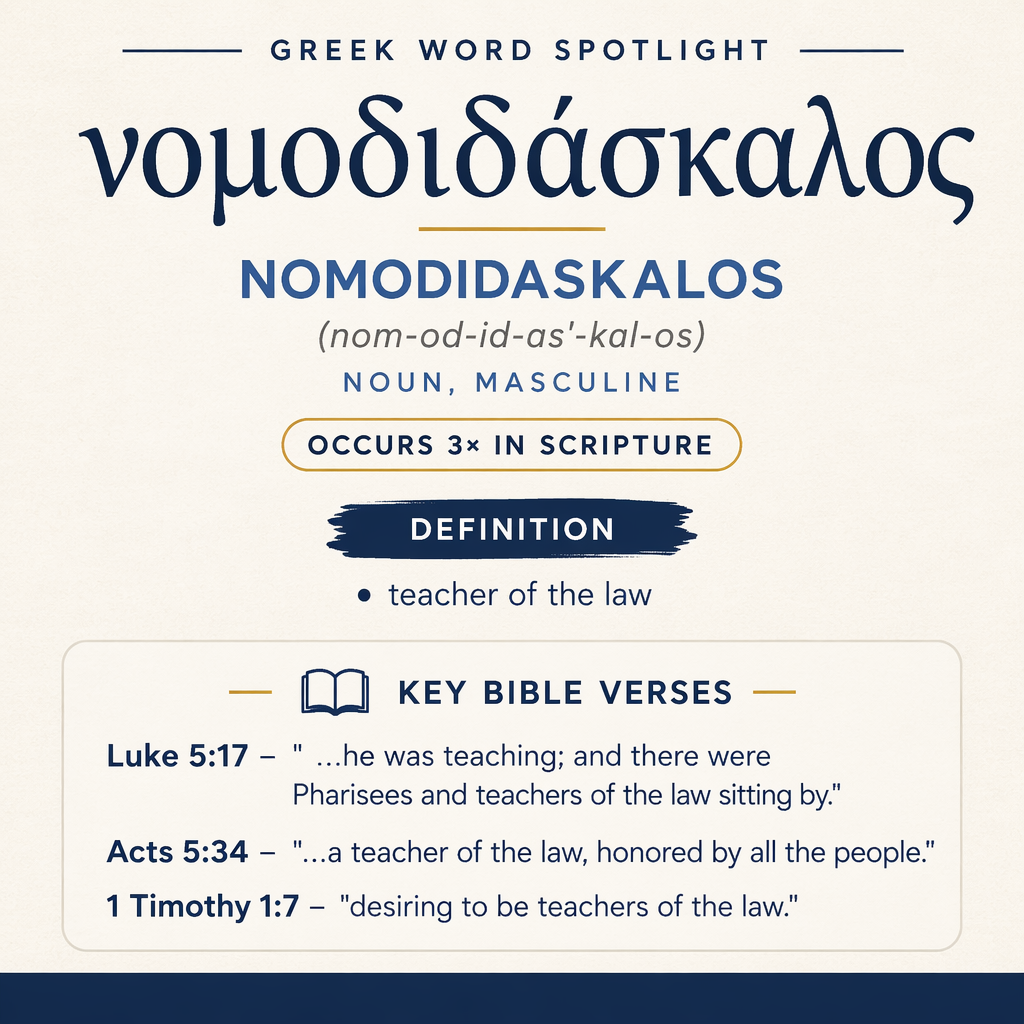
νομοδιδάσκαλος means “teacher of the law” and appears in Luke 5:17, Acts 5:34, and 1 Timothy 1:7.
Scripture Occurrences
This word occurs 3 times in Scripture: Luke 5:17; Acts 5:34; 1 Timothy 1:7.
Learn More →Context Snapshots
Luke 5:17 mentions Pharisees and teachers of the law present while Jesus was teaching. Acts 5:34 identifies Gamaliel as a teacher of the law, and 1 Timothy 1:7 notes some desire to be teachers of the law without understanding.
Learn More →νομοδιδάσκαλος means “teacher of the law.” It appears in three New Testament settings: a description of those present while Jesus teaches (Luke 5:17), a formal designation applied to Gamaliel in the council (Acts 5:34), and Paul’s warning about people who want the status of such teachers without understanding (1 Timothy 1:7).
Root and Related Words
νομοδιδάσκαλος is formed from νόμος (nomos), “law” (Strong’s G3551), and διδάσκαλος (didaskalos), “teacher” (Strong’s G1320). The compound links the act of teaching to the sphere of “law,” presenting a role defined by instruction in that domain.
Occurrences
“On one of those days, he was teaching; and there were Pharisees and teachers of the law sitting by, who had come out of every village of Galilee, Judea, and Jerusalem. The power of the Lord was with him to heal them.” (Luke 5:17)
Here the word functions as a public label for a recognizable group present during Jesus’ teaching. They are placed alongside “Pharisees,” and the scene emphasizes their posture and setting: they are “sitting by,” positioned as attentive observers in a teaching context. Their origin is stressed—“every village of Galilee, Judea, and Jerusalem”—which frames these “teachers of the law” as coming from a wide geographic spread, not merely as local listeners. In this moment they are not described as speaking; instead, the narrative uses the term to identify who is in the room and to highlight that Jesus’ teaching is being heard in the presence of people publicly associated with instruction in “the law.” The closing line, “The power of the Lord was with him to heal them,” sets the atmosphere of authority and action around Jesus while this class of religious instructors is present.
“But one stood up in the council, a Pharisee named Gamaliel, a teacher of the law, honored by all the people, and commanded to put the apostles out for a little while.” (Acts 5:34)
In Acts the term is attached to a named individual within a formal proceeding: “one stood up in the council.” The word helps define Gamaliel’s recognized standing in that setting. He is identified first as “a Pharisee,” then as “a teacher of the law,” and the description adds that he is “honored by all the people.” The combination of these elements portrays him as both institutionally situated (“in the council”) and publicly esteemed. His authority is immediately expressed through action: he “commanded to put the apostles out for a little while.” In this verse, “teacher of the law” is not simply an occupation; it is part of the characterization that explains why his voice and directives carry weight in the council’s deliberation.
“desiring to be teachers of the law, though they understand neither what they say, nor about what they strongly affirm.” (1 Timothy 1:7)
In 1 Timothy the word is framed not as a neutral title but as an ambition: “desiring to be teachers of the law.” The verse immediately critiques this desire by exposing a mismatch between aspiration and comprehension—“though they understand neither what they say, nor about what they strongly affirm.” The term therefore carries an implied claim to competence and authority that, in this sentence, is shown to be empty in certain people’s case. The line also suggests that such teaching can be forceful (“strongly affirm”) while still lacking understanding, so the role named by νομοδιδάσκαλος becomes a touchpoint for evaluating whether someone’s confident assertions actually rest on grasp of the content they speak about.
Sense and Usage
Across these three occurrences, νομοδιδάσκαλος consistently names a person associated with teaching in relation to “the law,” but the passages use that association in different ways. Luke employs the plural to mark out a group whose presence signals that Jesus’ public teaching is being observed by recognized religious instructors drawn from a broad region. Acts uses the singular as a credential attached to Gamaliel within a council setting, where the title aligns with public honor and the capacity to issue commands that shape the proceedings. First Timothy uses the same designation to expose the danger of seeking the standing of a “teacher of the law” as a matter of desire, while lacking the understanding that should accompany such a role.
The word therefore can function either as a social identifier (who is present and what sort of people they are), a marker of recognized authority (why a particular speaker’s intervention matters), or a point of moral and intellectual evaluation (whether the aspiration to teach corresponds to real understanding). In each case, the narrative or argument assumes that being called a “teacher of the law” carries public implications: such people are noticed, their words are expected to matter, and their claims invite scrutiny. The title is not treated as private self-description; it operates in settings where audiences, councils, and communities recognize and respond to the standing the term conveys.
Imagery
The scenes attached to νομοδιδάσκαλος are concrete and public: people “sitting by” while a teacher speaks (Luke 5:17), a respected figure “stood up in the council” to direct the handling of a tense situation (Acts 5:34), and individuals pressing forward with confident speech—“strongly affirm”—despite lacking comprehension (1 Timothy 1:7). Together these passages place the “teacher of the law” in settings where teaching is not merely academic but socially consequential, shaping how hearers watch, judge, and respond.
Sources: Lexical data from Strong’s Exhaustive Concordance and the Translators Brief Lexicon of Extended Strongs for Greek (STEPBible, CC BY). Occurrence data from the Translators Amalgamated Greek New Testament (STEPBible, CC BY). Scripture quotations from the World English Bible (public domain).