
Exploring the Meaning of Noeo in Greek
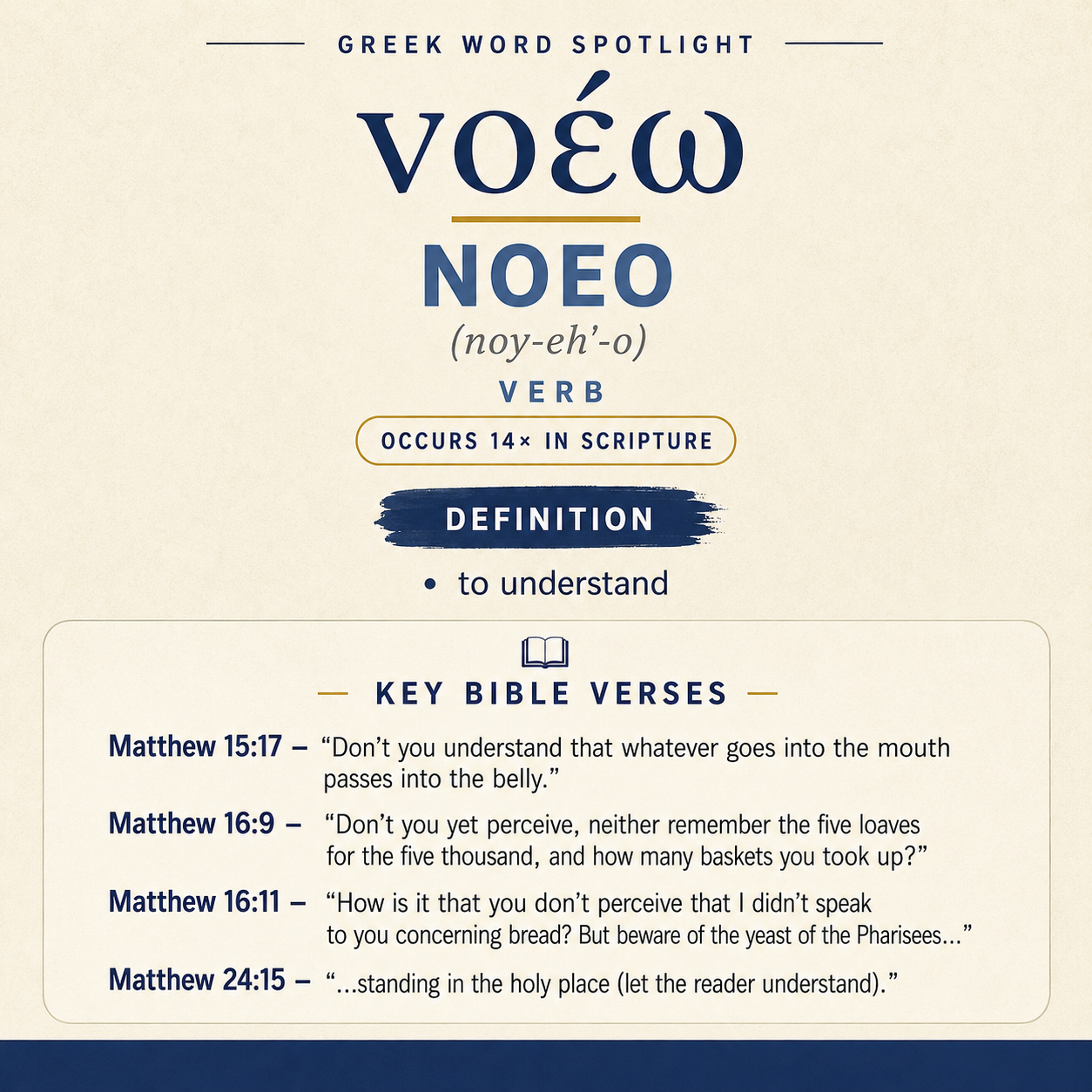
νοέω means “to understand” and occurs 14 times in Scripture, including in Matthew, Mark, and John.
Core Meaning
νοέω is defined as “to understand.” In several passages it is framed as perceiving and grasping what is being said or seen.
Learn More →Gospel Questions
In Matthew 15:17 and Mark 7:18 it challenges understanding about what enters the mouth. In Matthew 16:9–11 and Mark 8:17 it confronts lack of perception.
Learn More →Prophetic Seeing
In Matthew 24:15 and Mark 13:14 it appears in the instruction tied to seeing “the abomination of desolation.” In John 12:40 it is paired with seeing and hardened hearts.
Learn More →νοέω expresses the act of understanding, whether of a straightforward statement, a warning, or the meaning of events being witnessed. In the Gospels it often appears where Jesus presses hearers to grasp what is really being indicated, and in the Epistles it marks the reader’s comprehension of what is revealed or argued.
Root and Related Words
νοέω is related to nous (νοῦς), “mind” (Strong’s G3563), linking the verb’s action to the mind’s grasp of what is being presented.

Occurrences
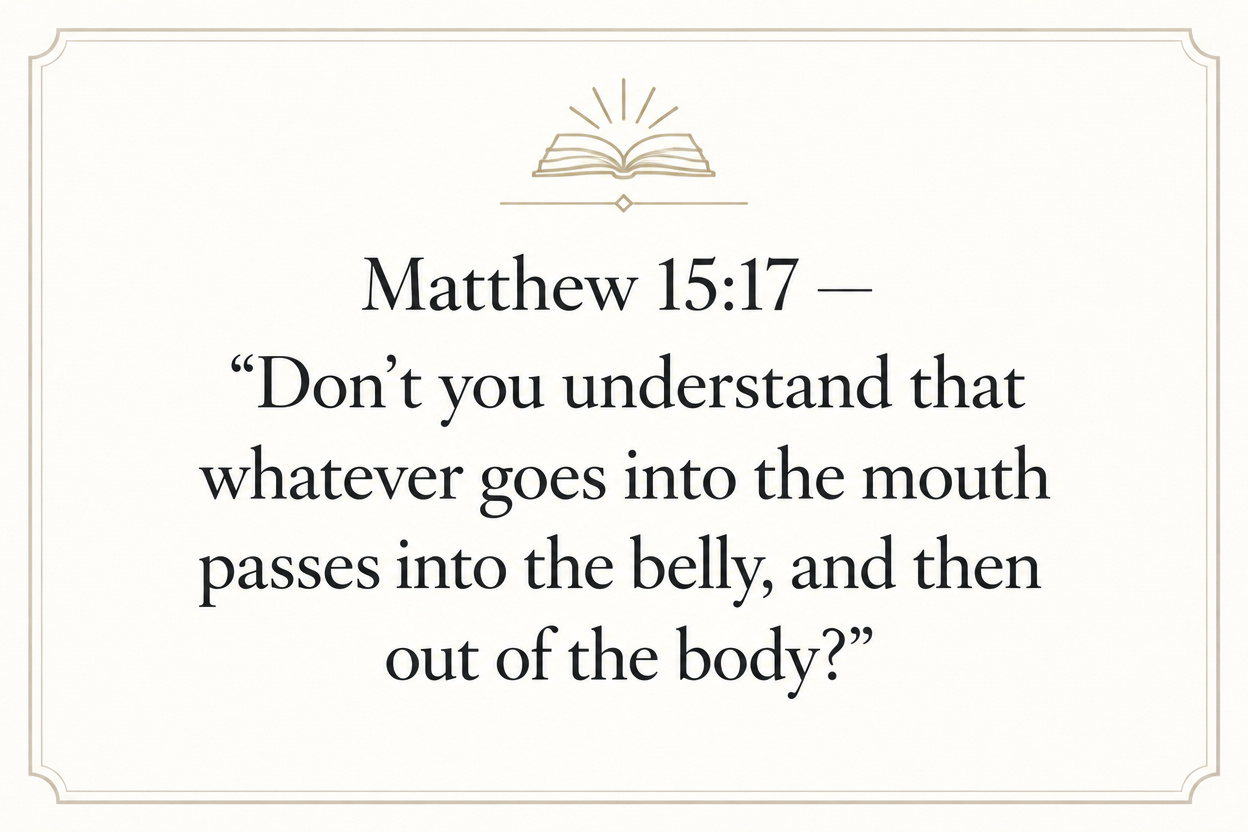
Matthew 15:17 — “Don’t you understand that whatever goes into the mouth passes into the belly, and then out of the body?”
Here νοέω is aimed at a basic but decisive point: Jesus calls for understanding drawn from an obvious bodily process. The issue is not the availability of facts but whether the hearer will grasp the implication of what “goes into the mouth” and what happens to it afterward.
Matthew 16:9 — “Don’t you yet perceive, neither remember the five loaves for the five thousand, and how many baskets you took up?”
Understanding is bound together with perception and memory. The question assumes that recalling a concrete past event (“five loaves,” “five thousand,” “how many baskets”) should lead to understanding; failure to understand is portrayed as a failure to connect remembered provision with the present concern.
Matthew 16:11 — “How is it that you don’t perceive that I didn’t speak to you concerning bread? But beware of the yeast of the Pharisees and Sadducees.”
In this rebuke, understanding is the capacity to recognize what Jesus is and is not talking about. The contrast between “bread” and “the yeast of the Pharisees and Sadducees” frames understanding as discernment of intended reference: the hearer must grasp the warning’s target rather than fixate on the literal topic that is explicitly denied.
Matthew 24:15 — ““When, therefore, you see the abomination of desolation, which was spoken of through Daniel the prophet, standing in the holy place (let the reader understand),”
Understanding is demanded of “the reader” at the moment of recognizing a described sight (“you see… standing in the holy place”). The parenthetical appeal treats understanding as responsible comprehension: the reader must take in the description and grasp its significance in light of what was “spoken of through Daniel the prophet.”
Mark 7:18 — “He said to them, “Are you also without understanding? Don’t you perceive that whatever goes into the man from outside can’t defile him,”
Understanding is presented as something that should follow perception of how defilement works in this teaching. The question “Are you also without understanding?” casts their condition as a lack, and the follow-up presses them to perceive the point about what comes “from outside,” so that they will understand the moral conclusion Jesus is drawing.
Mark 8:17 — “Jesus, perceiving it, said to them, “Why do you reason that it’s because you have no bread? Don’t you perceive yet, neither understand? Is your heart still hardened?”
νοέω stands in a cluster with reasoning and perception, and it is opposed to a “hardened” heart. The scene depicts misunderstanding as a misdirected chain of thought—reasoning from “no bread”—and Jesus frames true understanding as what should have arisen already, if the heart were not hardened against it.
Mark 13:14 — “But when you see the abomination of desolation, spoken of by Daniel the prophet, standing where it ought not” (let the reader understand), “then let those who are in Judea flee to the mountains,”
Again the call is directed to “the reader,” tied to seeing a specific event (“standing where it ought not”). Understanding in this context functions as the hinge between observation and action: once the reader grasps what is being seen, the instruction that follows (“then let those who are in Judea flee”) becomes urgent and concrete.
John 12:40 — ““He has blinded their eyes and he hardened their heart, lest they should see with their eyes, and perceive with their heart, and would turn, and I would heal them.””
Understanding is expressed as inward perception (“perceive with their heart”) connected to turning and healing. The verse portrays a blocked pathway: blinding and hardening prevent seeing and perceiving, and thus prevent the responsive turning that would lead to healing. Understanding here is not mere recognition but a heart-level grasp that moves toward change.
Romans 1:20 — “For the invisible things of him since the creation of the world are clearly seen, being perceived through the things that are made, even his everlasting power and divinity, that they may be without excuse.”
Understanding is grounded in perceiving what is displayed “through the things that are made.” The verse places νοέω in a setting where the created order mediates perception of “the invisible things of him,” resulting in accountability (“without excuse”). Understanding, therefore, is tied to the clarity of what is seen and the moral weight of refusing to grasp it.
Ephesians 3:4 — “by which, when you read, you can perceive my understanding in the mystery of Christ,”
Understanding is shared through reading: the audience can perceive Paul’s understanding “in the mystery of Christ” by engaging what is written. The verb thus connects comprehension to communicated content; it is something that can be recognized in another’s exposition and grasped through attentive reading.
Ephesians 3:20 — “Now to him who is able to do exceedingly abundantly above all that we ask or think, according to the power that works in us,”
The realm of understanding is widened to what can be “think”able, set alongside asking. The verse ties the mind’s reach to human limits (“all that we ask or think”) and contrasts it with God’s ability to act beyond those limits, while still locating the discussion “according to the power that works in us.”
1 Timothy 1:7 — “desiring to be teachers of the law, though they understand neither what they say, nor about what they strongly affirm.”
Understanding is made a qualification for responsible speech and instruction. The problem is doubled: they do not understand “what they say” (their own words) nor the subject matter “about what they strongly affirm.” The verse portrays confident assertion without understanding as a fundamental defect in would-be teaching.
Sense and Usage
Across these passages, νοέω consistently marks understanding as a grasp of meaning that should arise from what is available to the hearer or reader. In several Gospel scenes, understanding is expected to follow from plain observation: what happens to food after it enters the body (Matthew 15:17; Mark 7:18) or what should be inferred from a remembered incident involving “five loaves” and “five thousand” (Matthew 16:9). The verb’s force lies in its insistence that the problem is not shortage of information but failure to connect what is known with what is being concluded.
In other contexts, understanding involves distinguishing the intended reference of speech. When Jesus denies he spoke “concerning bread” and instead warns about “the yeast of the Pharisees and Sadducees” (Matthew 16:11), understanding is the ability to take a speaker at his word about his meaning and to grasp the actual target of the warning. Mark 8:17 similarly links lack of understanding with misguided reasoning (“because you have no bread”), showing that misunderstanding can take the form of an internally coherent but misdirected interpretation.
νοέω can also be demanded as a reader’s responsibility in the face of unfolding events. The repeated parenthetical “let the reader understand” (Matthew 24:15; Mark 13:14) places understanding at the point where a description must be recognized and properly taken in. In Mark the call sits immediately before a concrete directive (“then let those who are in Judea flee to the mountains”), highlighting that understanding is not an isolated mental act; it is the necessary comprehension that makes subsequent response intelligible.
Several Epistle uses set understanding within broader moral and spiritual contexts. Romans 1:20 ties perception to what is “clearly seen” in creation and presses toward accountability, showing understanding as something that carries consequence. Ephesians 3:4 portrays understanding as something that can be perceived in writing, locating it in the act of reading and in the communicability of insight. Ephesians 3:20 places thinking within a doxological frame: what the mind can conceive (“think”) becomes a measure that God’s ability surpasses, even while the verse keeps attention on divine power “that works in us.” In 1 Timothy 1:7, understanding functions as a safeguard against empty confidence, exposing a disconnect between strong affirmation and actual comprehension.
Finally, John 12:40 depicts a tragic inversion: blinding and hardening block seeing and heart-perceiving, so that turning and healing do not occur. This passage frames understanding as more than mental acuity; it is an inward perception connected to response. When that inward capacity is obstructed, the outward signs and inward grasp that would lead to healing are prevented, and the verb’s sphere includes the heart’s engagement with what is seen.
Imagery and Texture
The passages attach understanding to concrete channels: mouths and bellies (Matthew 15:17), remembered loaves and gathered baskets (Matthew 16:9), a warning about “yeast” (Matthew 16:11), a startling sight “standing in the holy place” or “where it ought not” (Matthew 24:15; Mark 13:14), the visible world “since the creation of the world” (Romans 1:20), and the readable page (Ephesians 3:4). νοέω thus regularly appears where something can be seen, read, recalled, or reasoned about—and where the decisive question is whether the observer will actually grasp what those realities signify.
Sources: Lexical data from Strong’s Exhaustive Concordance and the Translators Brief Lexicon of Extended Strongs for Greek (STEPBible, CC BY). Occurrence data from the Translators Amalgamated Greek New Testament (STEPBible, CC BY). Scripture quotations from the World English Bible (public domain).




