
Exploring the Meaning of Mueo in Greek
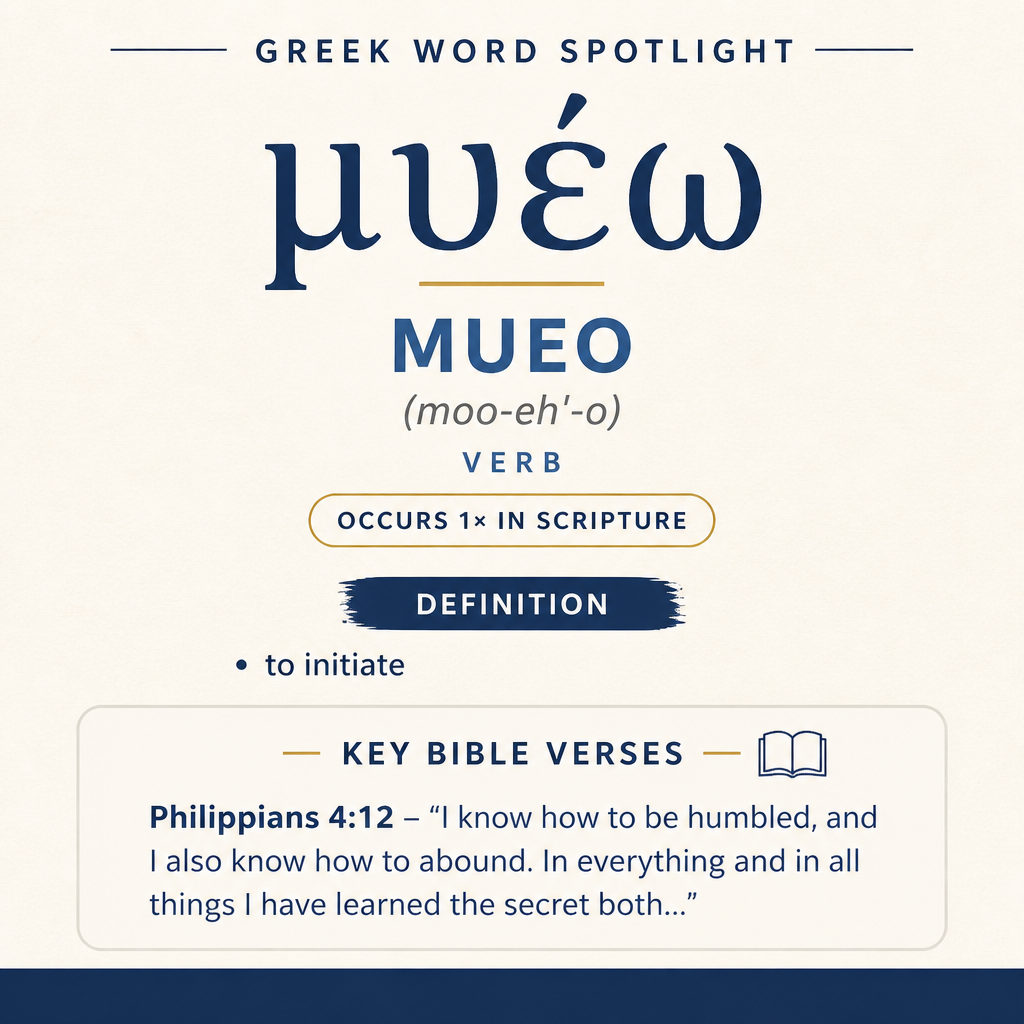
μυέω means “to initiate” and appears once in Scripture, in Philippians 4:12.
Scripture Occurrence
This verb occurs 1 time in Scripture. Its single occurrence is in Philippians 4:12.
Learn More →Context Snapshot
In Philippians 4:12, it appears in a statement about learning the secret in every situation.
Learn More →μυέω means “to initiate,” and it appears once in the New Testament, in Paul’s personal testimony about living through changing circumstances in Philippians 4:12. In that setting it describes a kind of learned entrance into a lived knowledge that spans extremes of need and plenty.
Root and Related Words
μυέω is related to the noun μυστήριον (mysterion), “mystery” (Strong’s G3466). That relationship places μυέω alongside language used for what is hidden or not immediately accessible, with an emphasis on coming to know through being brought in.

Occurrences
“I know how to be humbled, and I also know how to abound. In everything and in all things I have learned the secret both to be filled and to be hungry, both to abound and to be in need.” (Philippians 4:12)
In Philippians 4:12, μυέω stands behind the clause, “I have learned the secret,” where Paul frames his knowledge as something acquired through experience rather than mere information. The verse is arranged as a set of balanced contrasts: “humbled” and “abound,” “filled” and “hungry,” “abound” and “in need.” Within those paired opposites, μυέω presents Paul’s ability to live faithfully across changing conditions as an “initiation” into a practical competence—an entry into understanding that proves itself in both directions of life’s swing.
The movement of the sentence is important. Paul begins with “I know,” stated twice (“I know how to be humbled… I also know how to abound”), then intensifies it with a broader scope: “In everything and in all things.” The verb expressed by μυέω fits that intensification: it is not simply that Paul has opinions about hardship and plenty, but that he has been brought into a settled knowledge that holds across “everything” and “all things.” The verse then spells out the content of that initiation: how to live “to be filled” without being mastered by fullness, and how to be “hungry” without being undone by lack; how to “abound” without losing steadiness, and how to be “in need” without losing direction. The word thus contributes the idea of an entrance into a skill of life that can be practiced under opposite pressures.
Because the statement is autobiographical—“I know… I have learned”—μυέω here is not presented as an abstract principle but as Paul’s personal account of what has happened to him over time. The contrasts suggest repeated exposures to different conditions; the “initiation” is the cumulative result of being brought through them. In this one occurrence, μυέω therefore carries a strongly experiential tone: the knowledge it points to is tested by hunger and plenty, and it shows itself by steadiness in both.
Sense and Usage
The definition “to initiate” in this passage does not describe a ceremony in view, but the transition from not knowing to knowing in a way that changes how one lives. Paul’s wording makes the content of the initiation concrete: it concerns the lived realities of humility and abundance, hunger and fullness, need and plenty. The verb’s force is seen in how Paul treats this as something that can be learned and entered into, not merely chosen in a moment. “In everything and in all things” functions like a frame around the statement, showing that the initiation he describes is comprehensive enough to cover varied circumstances rather than a narrow technique for a single kind of situation.
Within the verse, μυέω also implies that this knowledge is not self-evident. One does not automatically know how to handle “to be filled” and “to be hungry” in a stable way; Paul presents it as something he has been brought into. The sequence “I know… I have learned the secret” underscores that the knowledge involves insight: it is possible to experience hunger and plenty and still not understand how to live well within them. By using a verb meaning “to initiate,” Paul portrays his learning as entry into a deeper grasp that lies beneath the surface of circumstances. The reader is left with the sense that life’s extremes can be teachers, and that there is a kind of instruction that introduces a person to steadiness across them.
The paired clauses also show that the initiation is not limited to hardship. Paul puts “abound” alongside “humbled,” and “filled” alongside “hungry,” treating abundance as a situation that also requires learned wisdom. In that way μυέω points toward initiation into a balanced way of life, where the person is not defined or controlled by either side of the contrast. The word therefore functions in Philippians 4:12 to describe a learned entry into composure that remains coherent when circumstances change.
Imagery and Echoes
The imagery attached to μυέω in Philippians 4:12 comes from the concrete experiences named in the verse: being “humbled,” “abound[ing],” being “filled,” being “hungry,” being “in need.” These are bodily and social realities, and the verb gathers them into a single account of learning. The result is a picture of someone who has passed through alternating conditions and has been introduced, through them, into an inner steadiness that does not depend on any one condition lasting.
Sources: Lexical data from Strong’s Exhaustive Concordance and the Translators Brief Lexicon of Extended Strongs for Greek (STEPBible, CC BY). Occurrence data from the Translators Amalgamated Greek New Testament (STEPBible, CC BY). Scripture quotations from the World English Bible (public domain).




