Exploring the Meaning of Mukterizo in Greek
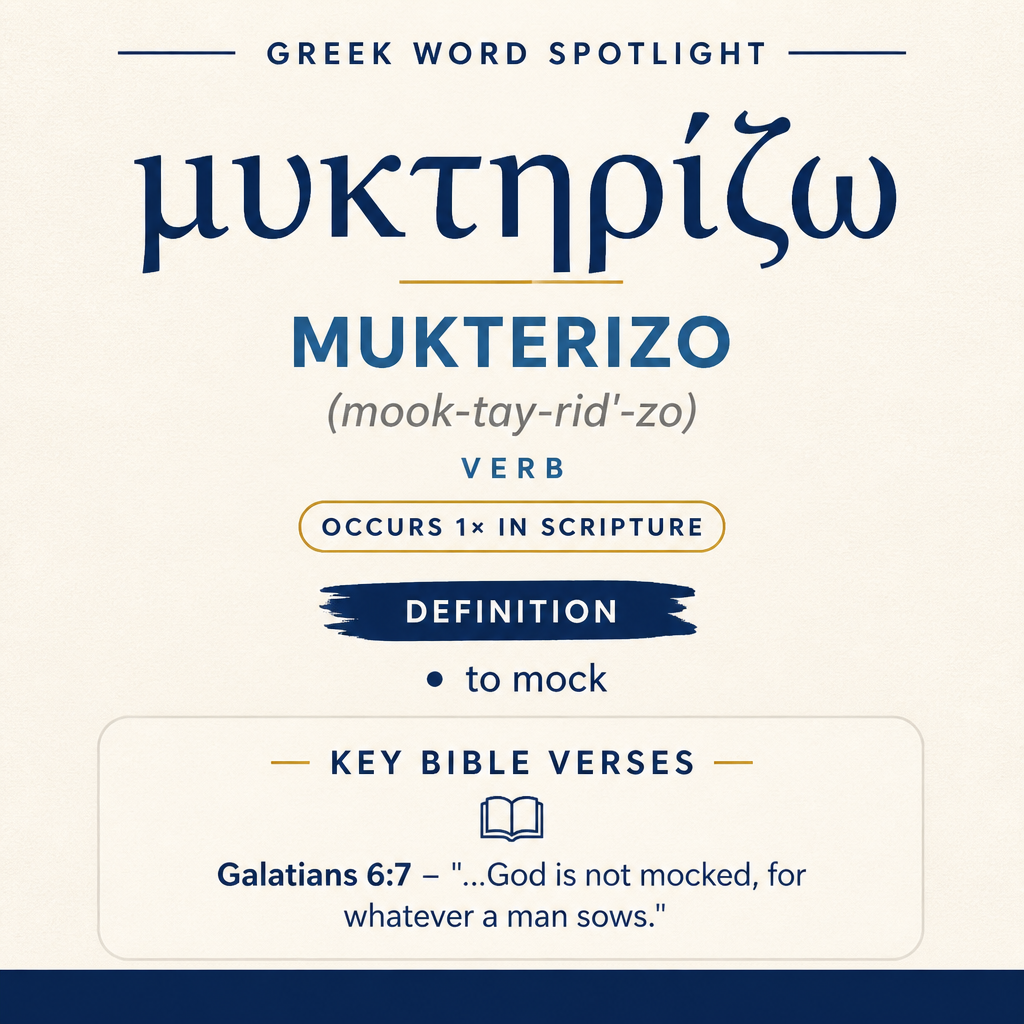
μυκτηρίζω means “to mock” and appears once in Scripture, in Galatians 6:7.
Scripture Occurrence
It occurs 1 time in Scripture. The occurrence is in Galatians 6:7.
Learn More →μυκτηρίζω means “to mock” and is used once in the New Testament, in Paul’s warning to the churches of Galatia (Galatians 6:7). In that setting it names an attitude and action directed toward God, set against the certainty of moral consequence.
Root and Related Words
μυκτηρίζω is related to mykaomai (μυκάομαι), “to roar” (Strong’s G3455). The relationship places μυκτηρίζω within a word-family that Strong’s connects to a term for a loud, forceful sound; in Galatians the idea is applied to human conduct toward God.

Occurrences
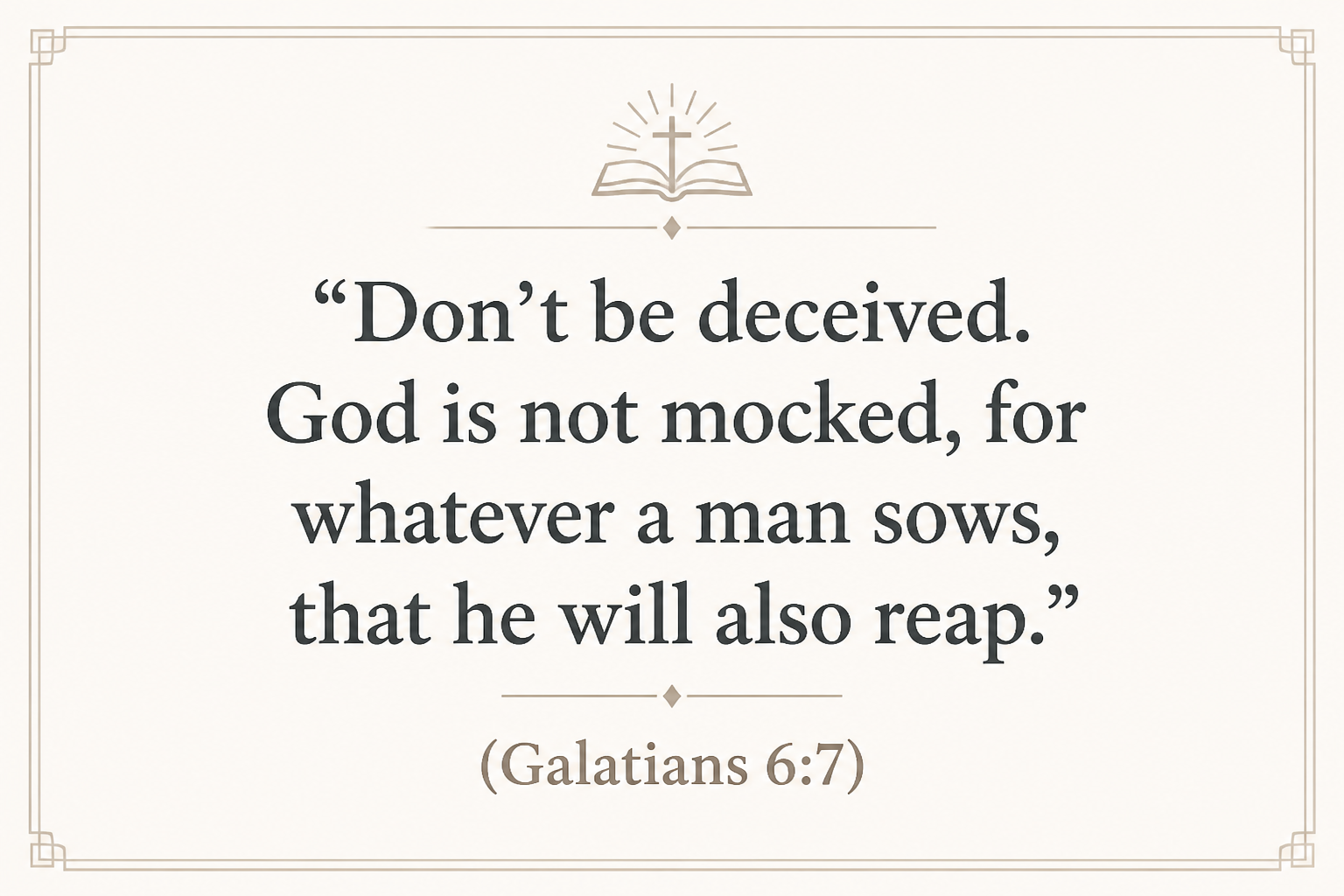
“Don’t be deceived. God is not mocked, for whatever a man sows, that he will also reap.” (Galatians 6:7)
Here μυκτηρίζω appears in the declaration, “God is not mocked,” framed by two short clauses that press the point home. First comes an admonition aimed at perception and judgment: “Don’t be deceived.” The verb then names the concrete form that such deception can take—treating God as an object of contempt. The sentence does not merely forbid ridicule as a social vice; it asserts the futility of directing mockery toward God. The passive wording (“is not mocked”) speaks in the register of settled reality: God does not become the victim of human scorn in any effective or lasting sense.
The second half of the verse grounds the statement with an agricultural analogy: “for whatever a man sows, that he will also reap.” In this immediate context, mocking God is bound up with self-deception about consequences. The logic is simple and tightly connected: because reaping corresponds to sowing, a person cannot act as though God’s moral order can be shrugged off, dismissed, or treated as if it will not hold. The verb thus functions as a moral diagnosis: mocking God is not simply an insult; it is a refusal to take seriously the true connection between actions (“sows”) and outcomes (“reap”).
Within the verse’s rhetoric, “God is not mocked” also serves as a boundary marker for the whole principle that follows. The sowing-and-reaping clause is introduced by “for,” so the statement about mockery is not an isolated warning but the front edge of a reasoned claim: reality is structured such that contempt cannot cancel accountability. The force of μυκτηρίζω in this verse is therefore intensified by its placement: it stands between a warning against deception and an explanation of inevitable consequence.
Sense and Usage
The sense “to mock” in Galatians 6:7 is sharpened by its object: God. Mockery here is not depicted as a passing emotional outburst but as a stance that expresses itself in lived choices. The verse connects mocking with being “deceived,” suggesting that mockery can be an outward symptom of an inward misjudgment—an assumption that one can treat God lightly and still escape the moral harvest that corresponds to one’s planting. In other words, the mockery envisioned is practical; it manifests as a way of proceeding as if one’s actions do not matter before God.
Because the statement is categorical (“God is not mocked”), the verb is used to deny the success of such an attempt. The line does not describe a particular act of sarcasm or a specific moment of derision; it addresses the larger idea of trying to make God the target of contempt in a way that would undo or evade God’s governance. The next clause defines the arena in which this attempt fails: human behavior has outcomes, and those outcomes correspond to what a person does. The verb therefore carries a strong evaluative edge—mockery is paired with deception, and both are contradicted by the fixed pattern of sowing and reaping.
The agricultural imagery (“sows… reap”) supplies a concrete frame for understanding how mocking operates in this context. Sowing is deliberate; it is the choice to place seed in the ground in anticipation of what will follow. Reaping is the later return, not random but matching the earlier act. Set beside this, mocking God is not a harmless expression but a denial of the correspondence between deeds and their results. The verse implies that a person may attempt to make light of God’s moral order—by words, by attitudes, or by a lifestyle that treats accountability as unreal—but the structure of consequence stands. Mockery, then, is exposed as empty bravado: it cannot change what will be reaped.
In terms of discourse, the verb functions as a warning line. It confronts the reader with a plain claim about God and then immediately links that claim to a general principle about human action. The connection keeps the word from being read merely as a prohibition against disrespectful speech; it is a statement about the impossibility of successfully dismissing God. In this way, the verb’s usage in Galatians 6:7 turns “mocking” into a category that includes any posture that tries to treat God as inconsequential.
Imagery
Galatians 6:7 pairs the thought of mocking God with the farm-field sequence of sowing and reaping. That juxtaposition gives the warning a grounded, everyday picture: contempt may be expressed in the moment, but harvest comes in its season. The verse’s imagery makes the point without ornament—just as seed yields its corresponding crop, so human actions yield their corresponding outcomes, and mockery cannot interrupt that return.
Sources: Lexical data from Strong’s Exhaustive Concordance and the Translators Brief Lexicon of Extended Strongs for Greek (STEPBible, CC BY). Occurrence data from the Translators Amalgamated Greek New Testament (STEPBible, CC BY). Scripture quotations from the World English Bible (public domain).