
Exploring the Meaning of Mukaomai in Greek
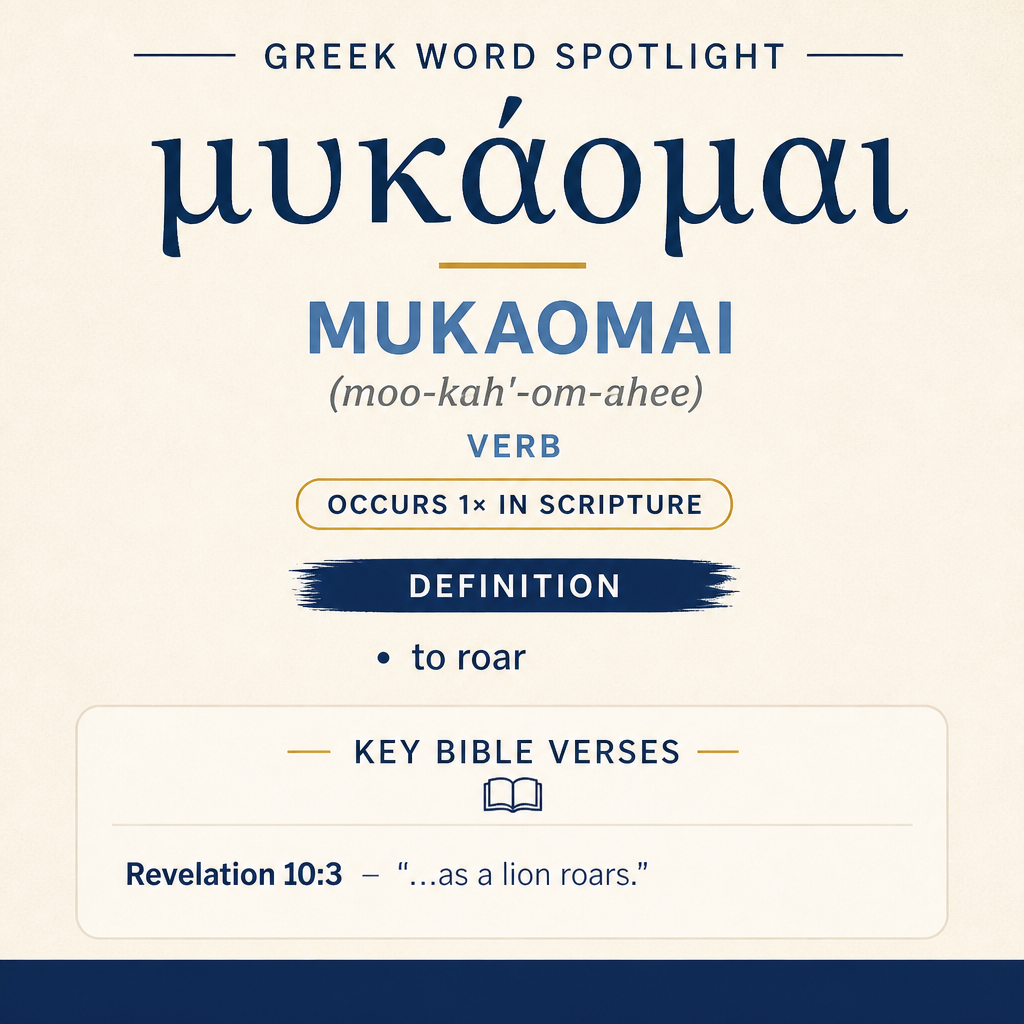
μυκάομαι (Mukaomai) means “to roar” and appears once in Scripture, in Revelation 10:3.
Biblical Occurrence
This verb occurs 1 time in Scripture. Its single occurrence is Revelation 10:3.
Learn More →Verse Context
In Revelation 10:3, “He cried with a loud voice, as a lion roars.” The seven thunders then utter their voices.
Learn More →μυκάομαι means “to roar” and appears once in the New Testament, in Revelation 10:3. In that verse it helps shape an auditory scene that moves from a single loud cry to a response from “the seven thunders.”
Occurrences
“He cried with a loud voice, as a lion roars. When he cried, the seven thunders uttered their voices.” (Revelation 10:3)
In Revelation 10:3, μυκάομαι is brought in through a comparison: the cry is “as a lion roars.” The verb serves the simile by supplying a specific kind of sound—one that is not merely loud in volume (“with a loud voice”) but also marked by a distinctive character, the roar of a lion. The verse frames this roar-like cry as a signal event within the scene: the action happens (“He cried”), it is described by comparison (“as a lion roars”), and it triggers an answering sound (“When he cried, the seven thunders uttered their voices”). The verb therefore supports the text’s sequence of sounds: one cry described as roar-like, followed by multiple voices from the seven thunders. Within the single sentence, the roar imagery intensifies the initial cry and prepares for the escalation from one voice to seven voices.
The comparison “as a lion roars” also sets an expectation about the kind of effect this cry has in the scene. The text does not present the cry as conversational speech; it presents it as a powerful vocal act that can be likened to a lion’s roar. That roar-like quality fits the verse’s emphasis on audible impact: first, the cry is explicitly loud; second, it provokes a subsequent utterance from the seven thunders. The word’s contribution, in context, is to color the cry with a roar’s forcefulness and to mark it as an event that carries beyond the speaker, eliciting a response that itself is expressed in voices.
Sense and Usage
The sense “to roar” in μυκάομαι functions here not as a bare statement that a roar occurred, but as the engine of a simile. The verse already states the volume (“with a loud voice”), then uses the roar comparison to convey the quality of the sound. In this way, the word works at the level of imagery: it selects a familiar category of sound—roaring—and uses it to specify what kind of loudness is meant. Loudness can be shrill, piercing, booming, or sustained; “roars” narrows the reader’s imagination to a sound associated with animal power and resonant force. The definition “to roar” is therefore applied as a descriptive tool that gives contour to the auditory picture.
Because the verse structures the action as cry → thunder-voices, the roar imagery also functions rhetorically to bridge those two elements. A roar is the kind of sound that seems suited to summon an answering reverberation. Revelation 10:3 does not explain the mechanism of how the seven thunders respond; it simply links the response to the initial cry with “When he cried.” Within that simple linkage, the roar comparison gives the initial cry a fitting magnitude for what follows. The word thus helps establish a sense of scale: the first sound is not only loud but roar-like, and the following sounds are not merely noises but “voices” uttered by seven thunders.
In terms of usage, μυκάομαι here does not stand alone as the main predicate; it is embedded in the clause “as a lion roars.” That placement makes its contribution adjectival in effect: it modifies and characterizes the preceding “cried” by providing an analogue. The narrative remains focused on the act of crying out, but it invites the reader to hear it under the aspect of roaring. This is a common way for a single vivid verb to carry much of the sensory weight of a description: rather than multiplying adjectives, the text chooses a comparison driven by a single verb with a strong auditory association.
The immediate co-text also highlights that the roaring comparison is part of an aural chain rather than a static portrait. The verse contains multiple references to vocal sound—“cried,” “loud voice,” “roars,” “cried” again, and “uttered their voices.” In this sound-saturated line, μυκάομαι helps distinguish the first vocal act from the later “voices” of the thunders. The roar-like cry is singular and initiating; the thunder-voices are plural and responsive. Thus, even though the word appears only within a simile, it is strategically placed to make the first sound stand out as the initiating, lion-like cry.
Imagery
Within Revelation 10:3, μυκάομαι contributes an image that is both concrete and auditory: a lion’s roar. The verse uses that image to depict a cry that is not merely spoken but sounded forth with force, and it places that roar-like cry at the head of a sequence in which “the seven thunders uttered their voices.” The result is a tightly framed soundscape: one loud, roar-like cry followed by the answering voices of the thunders.
Sources: Lexical data from Strong’s Exhaustive Concordance and the Translators Brief Lexicon of Extended Strongs for Greek (STEPBible, CC BY). Occurrence data from the Translators Amalgamated Greek New Testament (STEPBible, CC BY). Scripture quotations from the World English Bible (public domain).





