
Exploring the Meaning of Mone in Greek
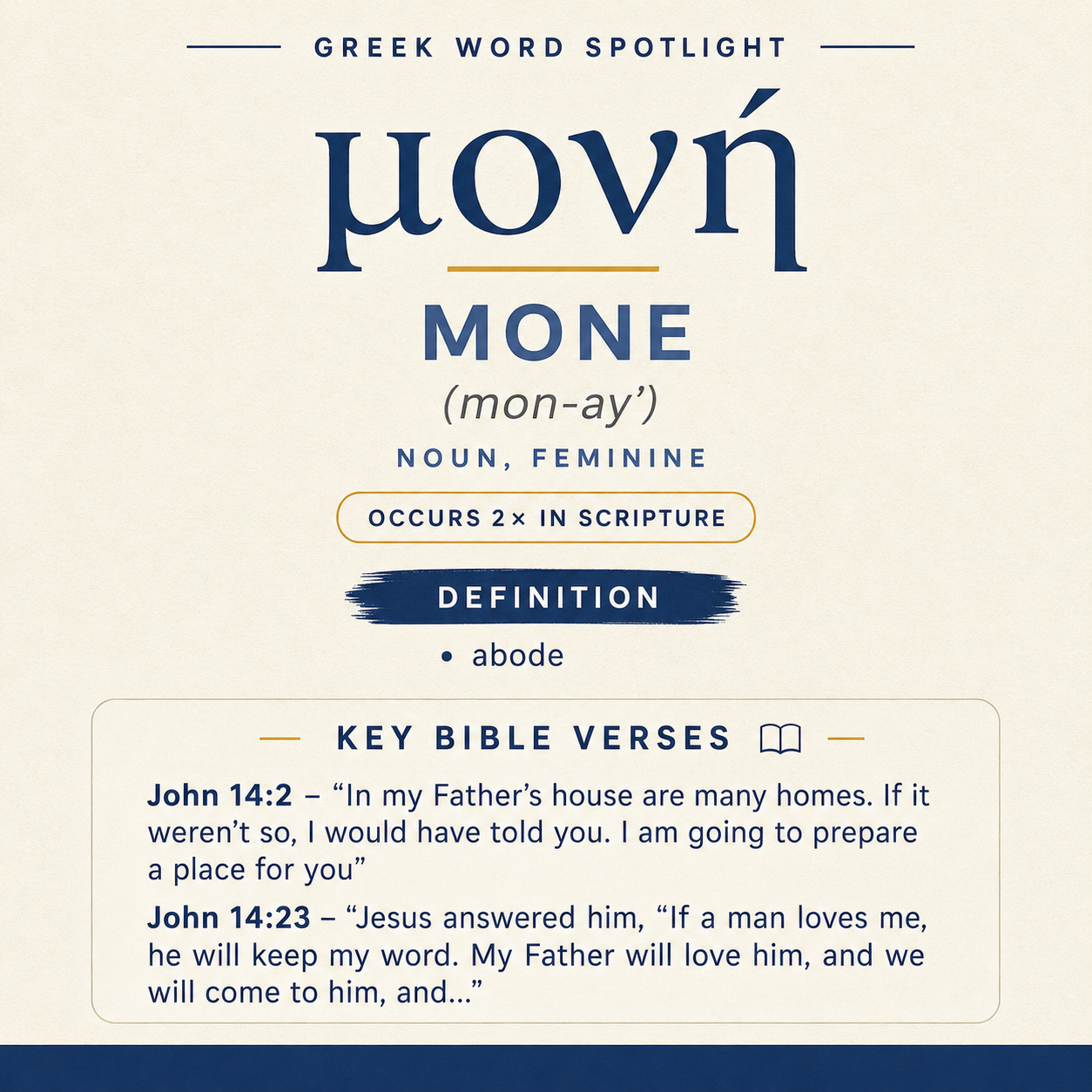
μονή means “abode” and appears twice in Scripture, both in John 14:2 and John 14:23.
Johannine Context
In John 14:2 it appears in Jesus’ words about many homes in the Father’s house. In John 14:23 it appears where Jesus speaks of coming and making a dwelling with the one who loves him.
Learn More →μονή means “abode” and appears in John 14 in Jesus’ teaching about the Father’s house and the Father’s coming to dwell with the one who loves him. In both contexts it contributes the idea of a place of settled residence within the relational setting Jesus describes.
Root and Related Words
μονή is derived from the verb meno (μένω), “to stay” (Strong’s G3306). The relationship between the terms links the noun to the notion of remaining or staying, expressed as a dwelling-place rather than the action itself.

Occurrences
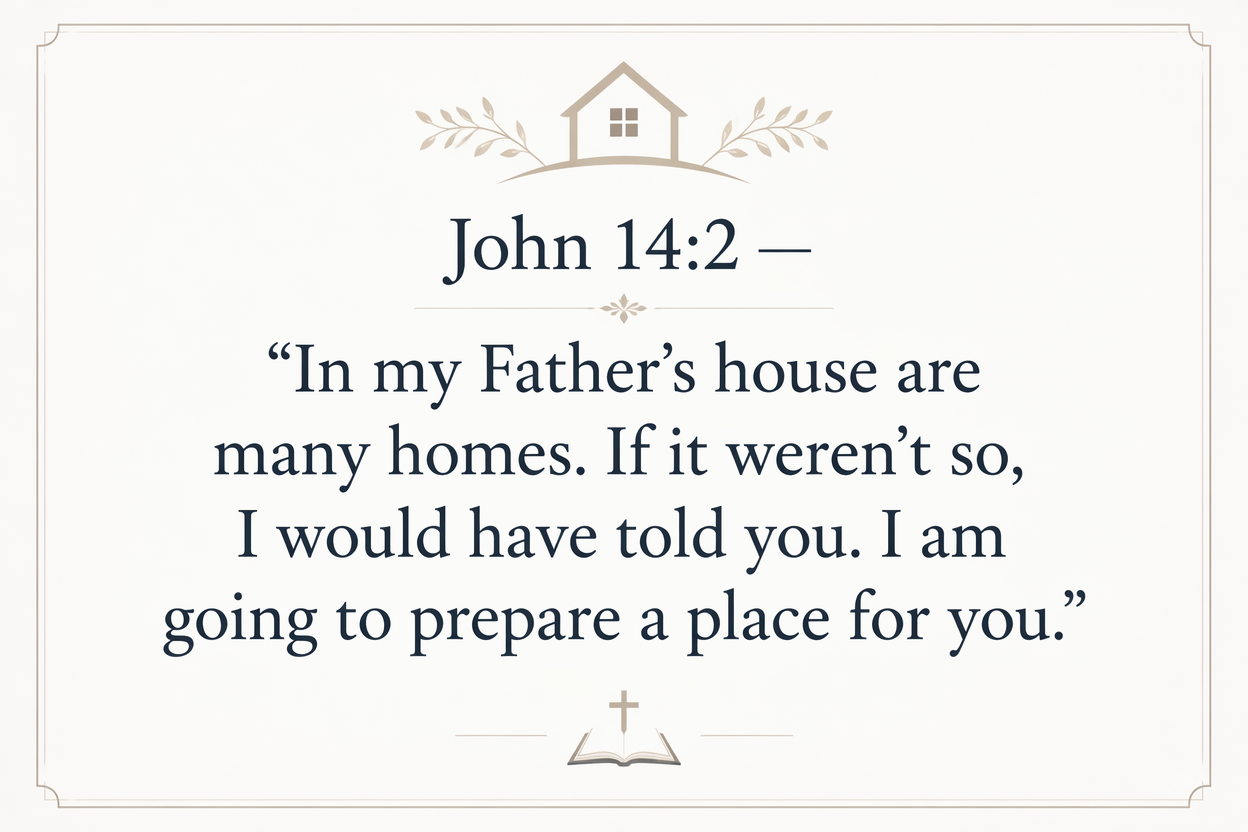
John 14:2 — “In my Father’s house are many homes. If it weren’t so, I would have told you. I am going to prepare a place for you.”
Here μονή is rendered “homes” within the image of “my Father’s house.” The immediate frame is architectural and household: a “house” large enough to contain “many” abodes, with each abode understood as a real “place.” The word therefore functions to individualize the space within the larger house—distinct dwellings within a single household setting—while remaining fully inside the encompassing sphere of the Father’s house. Jesus’ statement “I am going to prepare a place for you” places these abodes in the future-oriented movement of his going and preparing; the abode is not merely described, but presented as something readied for those addressed. In this sentence flow, μονή helps carry the reassurance that the destination is not vague: it is a prepared place of residence located in the Father’s household.
The line “If it weren’t so, I would have told you” adds a note of reliability to the picture. Within that rhetorical assurance, the “many homes” are not presented as speculative; they are treated as part of the settled reality Jesus is disclosing. μονή, as “abode,” thus contributes stability and permanence to the promise: a home in the Father’s house, prepared as a place for the disciples.
John 14:23 — “Jesus answered him, “If a man loves me, he will keep my word. My Father will love him, and we will come to him, and make our home with him.”
In this verse μονή is translated “home,” and the scene shifts from the many dwellings in the Father’s house to a dwelling made “with him,” the person who loves Jesus and keeps his word. The abode is no longer described primarily as a destination to which disciples go; it is described as something the Father and Jesus establish in relation to a person: “we will come to him, and make our home with him.” The word supplies the concrete, domestic metaphor for divine presence: not a visit, but an abiding residence expressed as “home.” The sequence of clauses is tightly linked: love for Jesus is expressed in keeping “my word,” the Father’s love follows (“My Father will love him”), and then the coming and homemaking occur (“we will come… and make our home…”). Within that chain, μονή marks the culmination as a settled indwelling that accompanies and expresses this relationship.
The prepositional phrasing “with him” is especially important to the way the word works here. The abode is not portrayed as distant or impersonal; it is relational proximity—home made “with” a person. The word “home” draws on familiar human experience (where one lives, where one belongs, where one remains) to communicate the intimacy of the coming of the Father and Jesus. In this setting, μονή helps express continuity rather than momentary contact: their coming results in a home established in ongoing association with the one who loves and keeps Jesus’ word.
Sense and Usage
Across its two Johannine occurrences, μονή (“abode”) operates within household imagery to speak of stable residence and settled belonging. John 14:2 uses the word in the plural frame (“many homes”) inside “my Father’s house,” presenting abode as a prepared, located place within a larger household. John 14:23 uses the singular (“make our home”) and relocates the image from an arrangement of dwellings to an act of homemaking in personal relationship—Father and Son coming and establishing residence “with him.” The shared domestic register—house, homes, place, home—keeps the picture coherent even as the direction of movement differs: preparation of a place in one verse; coming and making a home in the other.
This pairing lets the reader hear “abode” in two complementary dimensions without changing the word’s basic sense. In John 14:2 the emphasis falls on the availability and readiness of dwelling-space in the Father’s house: “many,” and “a place for you.” The abode functions as assurance of room and destination within the Father’s household. In John 14:23 the emphasis falls on presence and communion: “we will come” and “make our home with him.” The abode functions as a way of speaking about sustained fellowship, expressed not in abstract terms but in the concrete metaphor of home. Together, the uses show that the word can describe both (a) a dwelling as a place prepared and (b) a dwelling as a home established in proximity, while keeping the central idea of settled residence.
Because the same discourse contains both uses, the resonance between them is natural within the chapter’s imagery. “My Father’s house” provides the larger horizon of belonging; “make our home with him” brings that horizon into lived relational nearness. In both cases, μονή communicates that what is being spoken of is not temporary lodging but a genuine abode—something that can be prepared as a “place” and something that can be made as a “home.” The connection to meno (μένω), “to stay,” fits the way the word serves this discourse: the domestic image expresses staying in the form of an established dwelling.
Imagery
In John 14, μονή carries the imagery of household life—house, home, place—set within Jesus’ promise and explanation. John 14:2 pictures a large house with “many homes,” inviting the reader to imagine secure rooms within a single household. John 14:23 brings the image nearer, portraying the Father and Jesus as coming to a person and making a home “with him,” so that the language of abode becomes a way of picturing enduring, shared dwelling in the context of love and keeping Jesus’ word.
Sources: Lexical data from Strong’s Exhaustive Concordance and the Translators Brief Lexicon of Extended Strongs for Greek (STEPBible, CC BY). Occurrence data from the Translators Amalgamated Greek New Testament (STEPBible, CC BY). Scripture quotations from the World English Bible (public domain).




