Exploring the Meaning of Monos in Greek
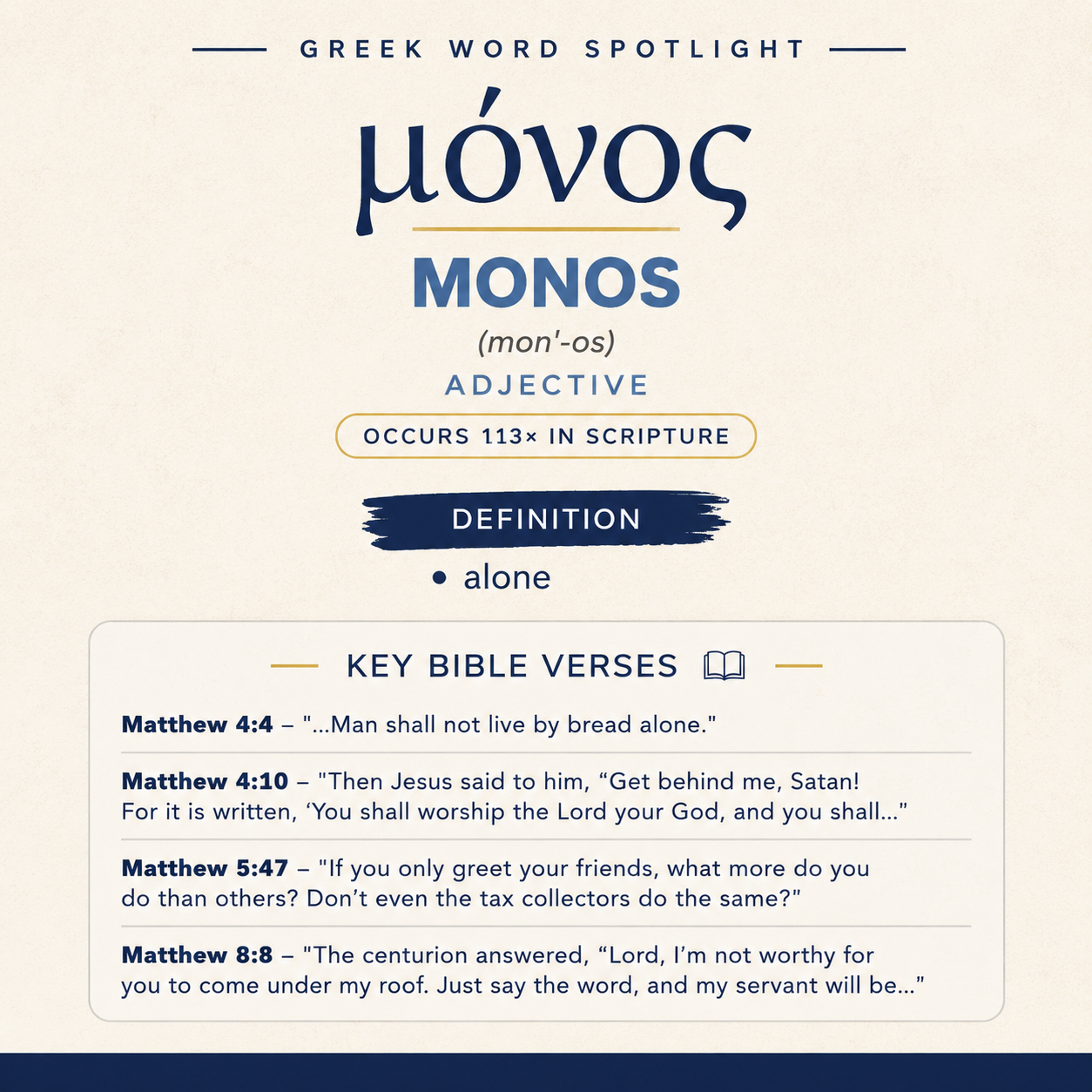
μόνος (Monos) means “alone” and occurs 113 times in Scripture, including Matthew 4:4 and Matthew 14:23.
Matthew Examples
In Matthew 4:4 it appears in “bread alone.” In Matthew 14:23 Jesus goes up the mountain “by himself” to pray.
Learn More →Range of Contexts
In Matthew it appears in varied settings, including greetings (Matthew 5:47) and healings (Matthew 14:36).
Learn More →μόνος expresses the idea of being “alone,” whether in the sense of exclusivity (only one object of worship, only one group permitted) or in the sense of solitary presence (no one else there). In the passages quoted below, it shapes statements about what truly sustains life, whom one serves, how one relates to others, and who remains when everything else falls away.
Occurrences
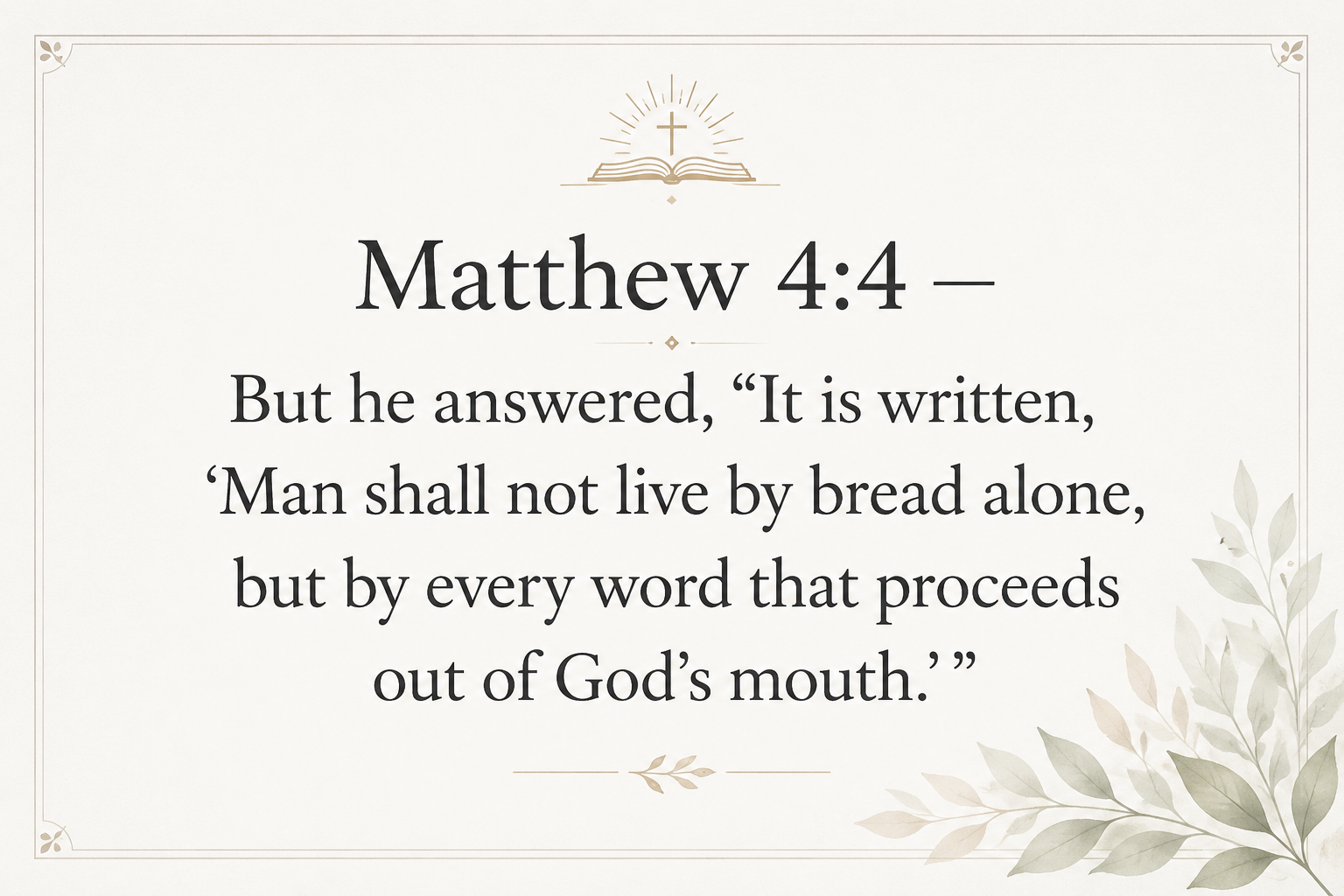
Matthew 4:4 — But he answered, “It is written, ‘Man shall not live by bread alone, but by every word that proceeds out of God’s mouth.’ ”
Here μόνος marks a limit: bread by itself is treated as insufficient to account for human life. The contrast that follows (“but by every word…”) makes “alone” do argumentative work—excluding bread as a sole basis and opening the field to another sustaining source named in the quotation.
Matthew 4:10 — Then Jesus said to him, “Get behind me, Satan! For it is written, ‘You shall worship the Lord your God, and you shall serve him only.’ ”
In this citation, μόνος presses exclusivity into the command: worship and service are directed to one recipient and to no other. The word tightens the demand beyond merely prioritizing God; it defines worship/service as an undivided loyalty in the face of a competing demand.
Matthew 5:47 — If you only greet your friends, what more do you do than others? Don’t even the tax collectors do the same?
“Only” narrows the action to a restricted circle (“your friends”), and that restriction becomes the basis of the question’s challenge. μόνος makes the greeting practice look ordinary precisely because it is limited: it remains inside the boundaries of familiarity rather than extending beyond them.
Matthew 8:8 — The centurion answered, “Lord, I’m not worthy for you to come under my roof. Just say the word, and my servant will be healed.
Although the English here reads “Just say the word,” the force is that a single utterance is enough; no physical visit is required (“to come under my roof”). μόνος contributes the idea that the spoken word, standing by itself, is sufficient for the healing requested.
Matthew 9:21 — for she said within herself, “If I just touch his garment, I will be made well.”
The woman’s inner reasoning depends on a minimal condition: one contact, and nothing more. μόνος concentrates her hope onto a lone act (“touch his garment”) as the decisive point at which restoration will occur.
Matthew 12:4 — how he entered into God’s house, and ate the show bread, which was not lawful for him to eat, neither for those who were with him, but only for the priests?
“Only for the priests” sets a boundary around lawful access to the sacred bread. μόνος functions as an exclusionary marker: it defines a privileged group and implies that everyone outside that group (including David and “those who were with him”) stands on the other side of the rule being discussed.
Matthew 14:23 — After he had sent the multitudes away, he went up into the mountain by himself to pray. When evening had come, he was there alone.
This scene uses μόνος spatially and socially: after dismissing the crowds, Jesus is depicted as separated from all others. The repetition of solitude (“by himself… alone”) makes the setting one of unshared presence, emphasizing a private posture for prayer and the quiet of evening on the mountain.
Matthew 14:36 — and they begged him that they might just touch the fringe of his garment. As many as touched it were made whole.
The request mirrors the earlier “just touch” logic: contact with the fringe alone is asked for as the needed point of connection. μόνος narrows what is sought—no extended interaction is specified—yet the verse reports wholeness following that simple touch.
Matthew 17:8 — Lifting up their eyes, they saw no one, except Jesus alone.
μόνος here isolates what remains visible: all other figures are excluded from the scene, leaving a single presence in view. The wording emphasizes a transition from a moment of multiple sights to the clarity of one: “no one, except Jesus alone.”
Matthew 18:15 — “If your brother sins against you, go, show him his fault between you and him alone. If he listens to you, you have gained back your brother.
In this instruction, μόνος specifies the social setting for confrontation: the conversation is to occur with no third party present. The solitude is purposeful—“between you and him alone”—aimed at restoration (“you have gained back your brother”) rather than public exposure.
Matthew 21:19 — Seeing a fig tree by the road, he came to it, and found nothing on it but leaves. He said to it, “Let there be no fruit from you forever!” Immediately the fig tree withered away.
Here the idea of “alone” appears as “nothing… but leaves,” a constricted finding that excludes fruit. μόνος sharpens the observation into a stark absence: the tree is defined by what is present by itself (leaves) and what is missing (fruit), setting the stage for the spoken judgment and the immediate withering.
Matthew 21:21 — Jesus answered them, “Most certainly I tell you, if you have faith, and don’t doubt, you will not only do what was done to the fig tree, but even if you told this mountain, ‘Be taken up and cast into the sea,’ it would be done.
“Not only… but even…” uses the language of restriction and extension. μόνος marks the initial deed (what happened to the fig tree) as not the sole possibility; the saying pushes beyond a single example to a wider scope of what could be done when faith is undivided by doubt.

Sense and Usage
Across these sayings and narratives, μόνος consistently works by narrowing: it draws a line around what counts, who is involved, or what remains. In some places the narrowing is doctrinal and directional, as when worship and service are confined to a single object (“serve him only,” Matthew 4:10). In others it is evaluative, exposing the smallness of a practice that stays inside safe limits (“only greet your friends,” Matthew 5:47). The same narrowing can be pastoral and protective, prescribing a one-on-one context for correction that aims at recovery rather than escalation (“between you and him alone,” Matthew 18:15).
μόνος also appears where minimal means are set over against expected or expanded means. The centurion’s request in Matthew 8:8 portrays a lone word as sufficient, contrasted with the ordinary expectation of coming physically “under my roof.” The woman’s thought in Matthew 9:21 and the crowd’s plea in Matthew 14:36 similarly treat a single touch as the decisive contact. In these scenes, “alone” does not describe isolation so much as sufficiency: one act, by itself, is held to be enough for the outcome named.
Finally, μόνος can frame what is left when all else is dismissed or disappears. The mountain prayer scene (Matthew 14:23) locates solitude in a concrete setting—after the crowds are sent away, evening finds Jesus there alone. The vision-like moment in Matthew 17:8 uses the word to focus the disciples’ sight: everything else is excluded until “Jesus alone” remains. Even the fig tree observation (Matthew 21:19) relies on a similar rhetorical effect: “nothing… but leaves” presents a lone remaining feature that defines the tree’s condition and leads into the enacted consequence.
Imagery
Within these passages, μόνος repeatedly creates a stark visual and social field: a mountain at evening with one person present (Matthew 14:23), a lifted gaze finding a single figure remaining (Matthew 17:8), a roadside tree characterized by one feature without the other (Matthew 21:19). Even when the word serves argument rather than description, it carries a picturing force—bread by itself set against another sustenance (Matthew 4:4), greeting confined to friends (Matthew 5:47), a private meeting limited to two people (Matthew 18:15). The effect is a recurring emphasis on what stands by itself, whether as the only rightful focus, the only remaining presence, or the only condition named for an action to take place.
Sources: Lexical data from Strong’s Exhaustive Concordance and the Translators Brief Lexicon of Extended Strongs for Greek (STEPBible, CC BY). Occurrence data from the Translators Amalgamated Greek New Testament (STEPBible, CC BY). Scripture quotations from the World English Bible (public domain).