
Exploring the Meaning of Mnemosunon in Greek
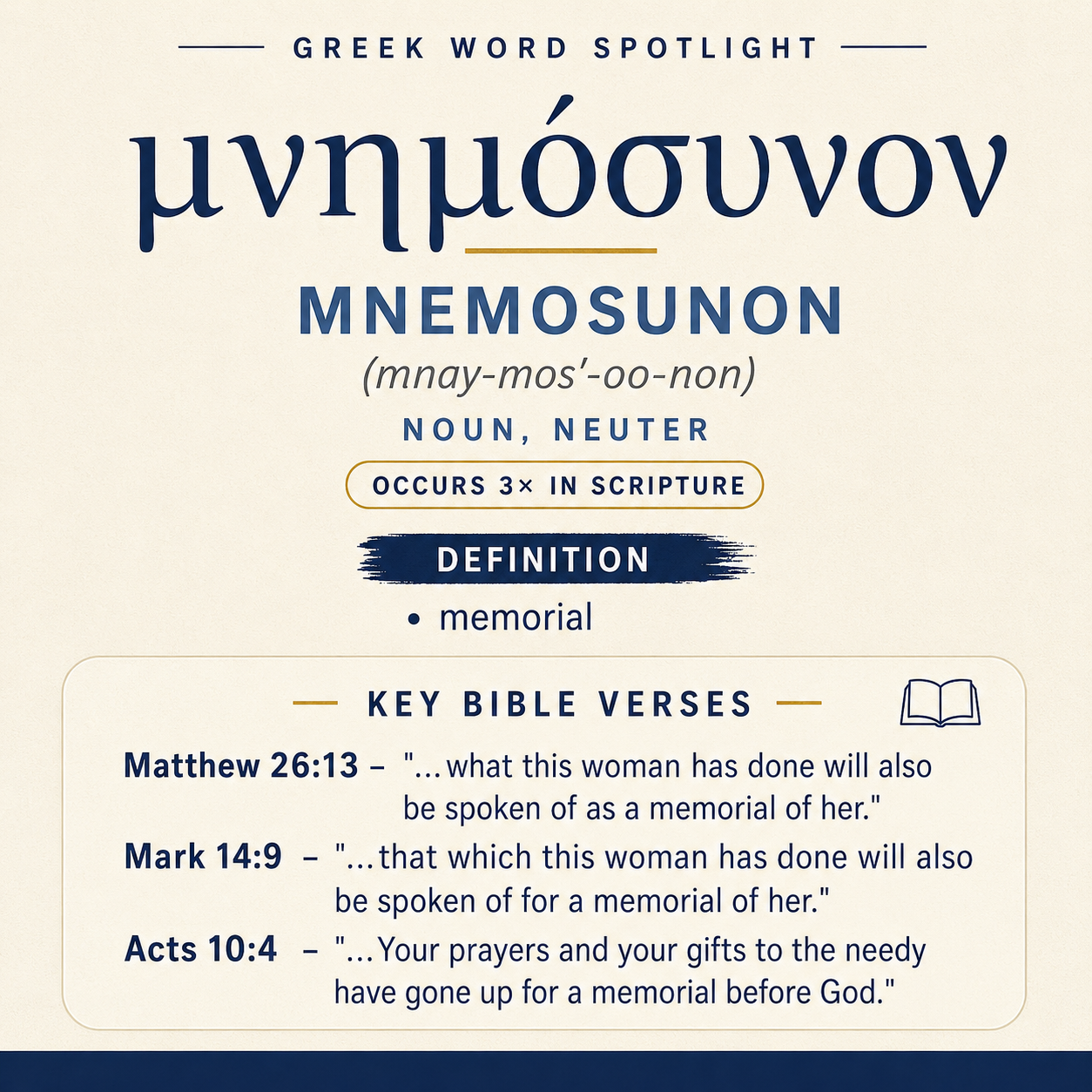
μνημόσυνον means “memorial” and appears in Matthew 26:13, Mark 14:9, and Acts 10:4.
Gospel Context
In Matthew 26:13 and Mark 14:9, it refers to what a woman has done being remembered wherever the Good News is preached.
Learn More →μνημόσυνον means “memorial,” a term used for something that is spoken of or presented in a way that keeps it before others. It appears in Jesus’ words about a woman’s action in Matthew and Mark, and in an angelic message to Cornelius in Acts.
Root and Related Words
μνημόσυνον (Mnemosunon) derives from the verb μνημονεύω (mnemoneuō, Strong’s G3421), “to remember.” The connection places the noun in the sphere of remembered things—acts, gifts, or realities that are kept in view by being recalled and spoken of.

Occurrences
“Most certainly I tell you, wherever this Good News is preached in the whole world, what this woman has done will also be spoken of as a memorial of her.” (Matthew 26:13)
Here μνημόσυνον is tied directly to speech: “will also be spoken of.” The memorial is not described as a physical object; it is the continuing recounting of “what this woman has done.” The setting is explicitly global (“in the whole world”) and linked to the spread of “this Good News,” so the memorial is carried along the same channels as preaching. In this sentence, the noun gathers up the woman’s deed into something that persists through repeated mention, ensuring that the act remains present to listeners wherever the message goes.
“Most certainly I tell you, wherever this Good News may be preached throughout the whole world, that which this woman has done will also be spoken of for a memorial of her.” (Mark 14:9)
Mark’s wording parallels Matthew closely, but with the phrase “spoken of for a memorial of her,” which foregrounds purpose: the speaking functions for a memorial. The memorial is again anchored in the content of proclamation (“this Good News”) and in the woman’s completed action (“that which this woman has done”). The scope is again universal (“throughout the whole world”), so μνημόσυνον marks the woman’s deed as one that travels beyond its original place and time through retelling. In this scene the memorial is not separated from the gospel proclamation; it is attached to it, as though the deed becomes a remembered accompaniment to the message wherever it is preached.
“He, fastening his eyes on him, and being frightened, said, “What is it, Lord?” He said to him, “Your prayers and your gifts to the needy have gone up for a memorial before God.” (Acts 10:4)
In Acts, μνημόσυνον is used in a vertical direction rather than a horizontal one. Cornelius, frightened, addresses the speaker as “Lord,” and receives the explanation: “Your prayers and your gifts to the needy have gone up for a memorial before God.” The memorial is described as something that “has gone up,” a spatial image that fits the phrase “before God.” Here the noun gathers two kinds of activity—prayers and gifts to the needy—into a single remembered presence. The memorial is not merely among people through conversation; it is “before God,” indicating that these actions stand in God’s sight as something that is kept in view.
Sense and Usage
Across these passages, “memorial” functions as a marker of enduring regard for an action. In Matthew 26:13 and Mark 14:9, the memorial is created and maintained by public recounting: the woman’s deed is made lasting through being “spoken of” wherever the good news is preached. The term therefore attaches durability to a concrete act by placing it within an ongoing pattern of speech. The memorial is as wide as the preaching’s reach (“the whole world”), and it is as lasting as the continuation of that preaching, since the memorial is carried by the same repeated proclamation.
Acts 10:4 extends the same basic idea of a memorial into a different relational frame. Instead of a deed being remembered by the worldwide community through testimony, prayers and gifts “have gone up” and stand “before God.” The noun here draws attention to divine awareness: what Cornelius has done is not lost or unnoticed, but present in a way that can be spoken of from heaven’s perspective. The phrase “for a memorial before God” places the remembering on God’s side of the relationship, while still grounding it in specific acts (“your prayers and your gifts to the needy”).
In both uses, μνημόσυνον is closely connected to actions rather than to mere thoughts or ideas. The woman’s deed, Cornelius’s prayers, and his gifts to the needy are each named as the content that the memorial refers to. The word thus serves as a way of treating certain actions as having continuing significance: either they remain on the lips of those who proclaim the good news, or they remain before God as remembered offerings. The memorial is not an additional work added to the act; it is the continuing presence of the act in a realm of remembrance—public speech in the Gospels, and divine presence in Acts.
Imagery and Emphasis
The passages give μνημόσυνον vivid movement. In the Gospels, the memorial moves outward: preaching spreads “throughout the whole world,” and with it the woman’s action is repeatedly “spoken of.” In Acts, the memorial moves upward: prayers and gifts “have gone up” and stand “before God.” Together these scenes portray a memorial as something that does not stay confined to the moment of the deed; it travels—carried by proclamation among people, or rising into God’s presence—so that the act remains in view.
Sources: Lexical data from Strong’s Exhaustive Concordance and the Translators Brief Lexicon of Extended Strongs for Greek (STEPBible, CC BY). Occurrence data from the Translators Amalgamated Greek New Testament (STEPBible, CC BY). Scripture quotations from the World English Bible (public domain).




