
Exploring the Meaning of Mneme in Greek
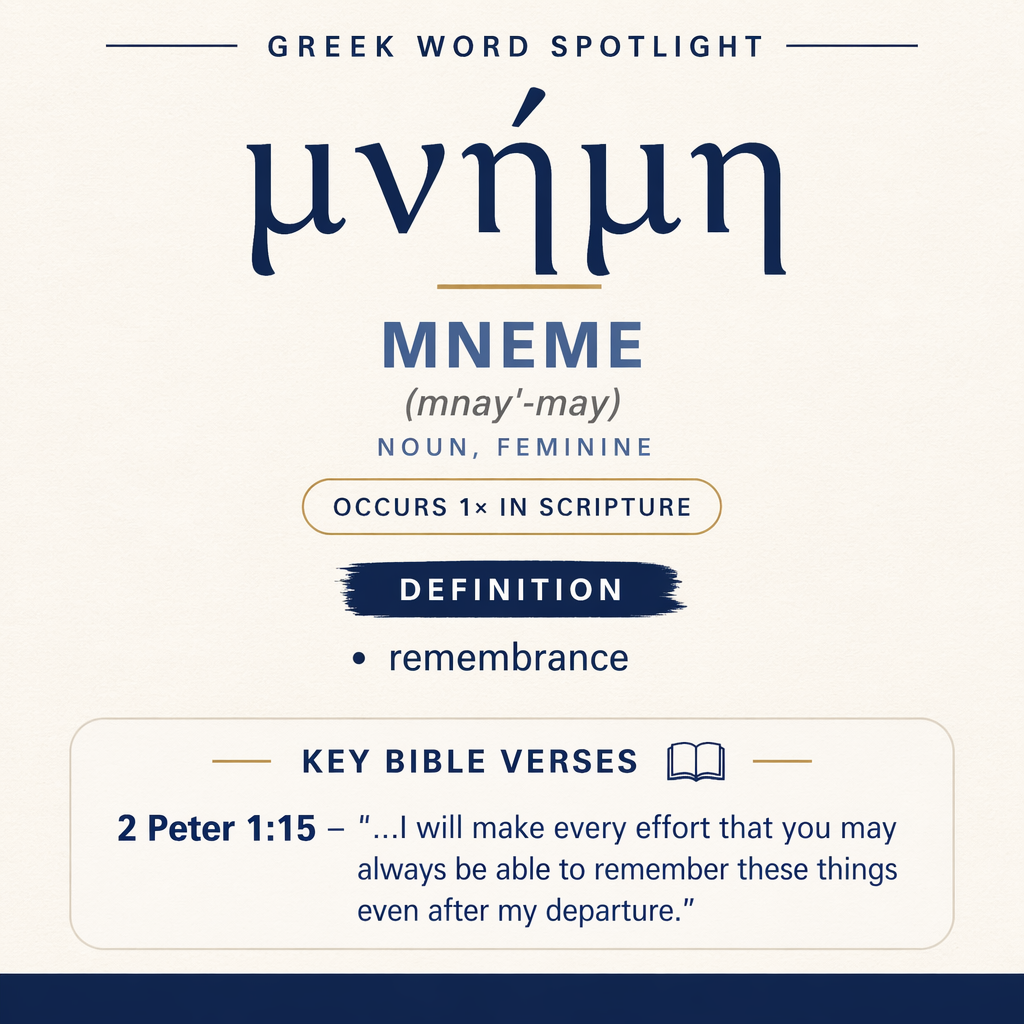
μνήμη means “remembrance” and appears once in Scripture, in 2 Peter 1:15.
Verse Context
In 2 Peter 1:15, it relates to remembering “these things” even after Peter’s departure.
Learn More →μνήμη expresses “remembrance,” and it appears once in the New Testament, in Peter’s resolve to secure an enduring recollection of his teaching after his departure. In its lone setting, the word sits at the intersection of deliberate effort, ongoing ability, and the passing of time.
Root and Related Words
μνήμη is related to the verb mimnēskō (μιμνήσκω), “to remember” (Strong’s G3403). The noun names what the verb performs: the act or reality of holding something in mind, now viewed as a continuing “remembrance.”

Occurrences
“Yes, I will make every effort that you may always be able to remember these things even after my departure.” (2 Peter 1:15)
In this line Peter speaks in the first person (“I will make every effort”) with a forward-looking purpose clause (“that you may always be able…”). μνήμη belongs to that purpose: it marks the intended outcome of Peter’s exertion—an enduring remembrance on the part of his hearers. The sentence frames remembrance not as a passing mental event but as an ability that can be present “always,” extending beyond a decisive change in circumstances (“even after my departure”).

The immediate object of this remembrance is explicitly stated: “these things.” The phrase is left content-full but unspecified in this single verse; what matters here is that remembrance is tethered to definite, communicable content rather than to a vague impression. Peter’s goal is not merely that his audience once encountered “these things,” but that they remain capable of recalling them reliably across time, including a time when his personal presence can no longer reinforce the message.
Equally important is the means implied by Peter’s wording: remembrance is something he aims to secure through intentional action (“make every effort”). The verse does not describe the method, but it does portray remembrance as something that can be strengthened or supported by pastoral diligence. In the logic of the sentence, Peter’s effort is instrumental; the hearers’ continued capacity to remember is the desired result.
Sense and Usage
The definition “remembrance” is given concrete shape in 2 Peter 1:15 by three features: persistence, content, and succession in time. First, persistence: the verse stacks terms of continuity (“always,” “even after”) that make remembrance durable. μνήμη therefore carries the idea of recollection that lasts, not merely a momentary flash of memory. Second, content: remembrance is directed toward “these things,” indicating that μνήμη concerns something definite that can be kept in mind and brought back to mind. Third, succession in time: the statement anticipates an “after,” a period following Peter’s “departure.” Remembrance is depicted as the mechanism by which instruction continues to function when the teacher is absent.
Within this single occurrence, μνήμη also stands close to notions of readiness and capacity. Peter’s concern is not simply that the audience remembers at some points, but that they remain “able to remember.” This casts remembrance as a capability that can be maintained. The verse’s emphasis on ability suggests remembrance can be facilitated: it can be made easier, more assured, more consistently available to the community across changing conditions.
μνήμη further implies a relationship between memory and testimony. Peter anticipates his departure and responds with effort aimed at continued remembrance; the effect is that his message outlives his presence. In this way, the word sits in a setting where remembrance serves continuity—ensuring that what was taught remains active in the community’s mind and life after the speaker is gone. The verse does not define the content of “these things,” but it strongly defines the function of remembrance: it preserves received instruction across time and absence.
Finally, the occurrence presents remembrance as both personal and communal. The speaker acts (“I will make every effort”), and the audience is addressed in the second person plural sense (“that you may always be able…”). μνήμη thus operates in the space between a teacher’s responsibility and a community’s ongoing grasp of what it has been given. Remembrance is not pictured as private nostalgia, but as a shared, sustained recollection of specific teachings.
Imagery
Although μνήμη is an abstract term, its lone context evokes a simple, concrete picture: a speaker preparing for absence and taking steps so that what he has taught remains present in the minds of others. The word gathers the passage’s sense of continuity—something carried forward “even after” a departure—so that what was once heard can still be brought to mind with clarity and steadiness.
Sources: Lexical data from Strong’s Exhaustive Concordance and the Translators Brief Lexicon of Extended Strongs for Greek (STEPBible, CC BY). Occurrence data from the Translators Amalgamated Greek New Testament (STEPBible, CC BY). Scripture quotations from the World English Bible (public domain).




