
Exploring the Meaning of Mnema in Greek
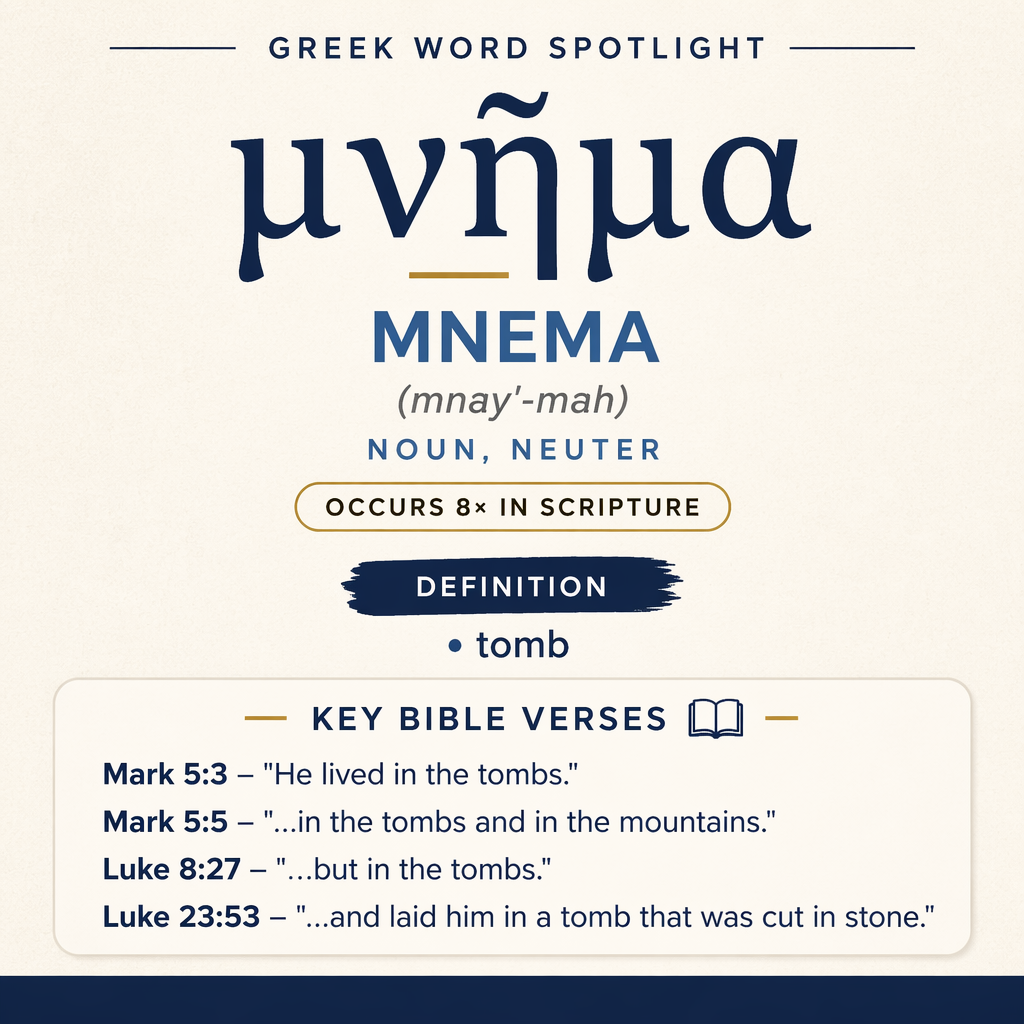
μνῆμα (Mnema) means “tomb” and occurs 8 times in Scripture, including Mark 5, Luke 23–24, Acts 2 and 7, and Revelation 11.
Core Meaning
μνῆμα means “tomb.” It refers to places where the dead are laid or where bodies are found.
Learn More →Gospel Usage
In Mark 5:3 and 5 it describes the tombs where a demon-possessed man lived. In Luke 23:53 and 24:1 it names the tomb where Jesus was laid and later visited.
Learn More →Other Occurrences
Acts 2:29 uses it for David’s tomb, and Acts 7:16 for the tomb associated with Abraham’s purchase. Revelation 11:9 uses it in a context of dead bodies viewed for three and a half days.
Learn More →μνῆμα means “tomb,” a concrete term for a place associated with the dead. In the passages where it appears, it can mark both a grim dwelling-place for the afflicted and the intended resting-place for a body, whether newly laid, long known, or deliberately withheld.
Occurrences
“He lived in the tombs. Nobody could bind him any more, not even with chains,” (Mark 5:3)
Here μνῆμα defines the man’s living environment: he “lived in the tombs.” The word frames his condition by locating him among places of burial rather than in ordinary habitation, reinforcing the social and physical isolation implied by the failed attempts to restrain him (“Nobody could bind him any more”). The tombs function as a setting of danger and disorder, a space where normal control and care have broken down.
“Always, night and day, in the tombs and in the mountains, he was crying out, and cutting himself with stones.” (Mark 5:5)
μνῆμα again names one of the places where the man’s torment is expressed: “in the tombs and in the mountains.” The paired locations broaden the scene from a single spot to a bleak range of haunts, but the tombs remain central as the place where his suffering is publicly audible (“crying out”) and physically visible (“cutting himself with stones”). The word contributes a funerary backdrop to living misery: the tombs are not merely a backdrop but a key feature of where his distress plays out “Always, night and day.”
“When Jesus stepped ashore, a certain man out of the city who had demons for a long time met him. He wore no clothes, and didn’t live in a house, but in the tombs.” (Luke 8:27)
In Luke the contrast is explicit: “didn’t live in a house, but in the tombs.” μνῆμα stands opposite “house,” highlighting displacement from normal shelter and community. The description of the man—“had demons for a long time,” “wore no clothes”—sets a scene of prolonged degradation, and μνῆμα specifies the concrete alternative residence that matches that condition. The tombs are depicted as the place he inhabits when ordinary human living arrangements have been abandoned.
“He took it down, and wrapped it in a linen cloth, and laid him in a tomb that was cut in stone, where no one had ever been laid.” (Luke 23:53)
Here μνῆμα is the destination of careful burial actions: taking the body down, wrapping it, and laying it. The phrase “a tomb that was cut in stone” depicts a solid, prepared burial place; “where no one had ever been laid” presents it as unused, set apart for this burial. In this scene μνῆμα is not an ominous haunt but a defined, tangible place used with intent and reverence, and the wording stresses the distinctiveness of this particular tomb.
“But on the first day of the week, at early dawn, they and some others came to the tomb, bringing the spices which they had prepared.” (Luke 24:1)
μνῆμα serves as the focal location for action at “early dawn”: they “came to the tomb” with prepared spices. The word anchors the movement and purpose of the visitors; it is the site where care for the dead is meant to be carried out. Because the verse emphasizes timing (“first day of the week,” “early dawn”) and preparation (“spices which they had prepared”), μνῆμα is the concrete point where grief, duty, and ritual attention converge.
““Brothers, I may tell you freely of the patriarch David, that he both died and was buried, and his tomb is with us to this day.” (Acts 2:29)
In Acts 2, μνῆμα is invoked as an enduring, known landmark: “his tomb is with us to this day.” The word functions in an argument grounded in public memory and visible reality: David “died and was buried,” and the tomb remains as an attested burial place in the present. μνῆμα thus carries the sense of a continuing physical site that testifies to a completed burial and a historical death.
“and they were brought back to Shechem, and laid in the tomb that Abraham bought for a price in silver from the children of Hamor of Shechem.” (Acts 7:16)
Here μνῆμα is a specific, identified burial place with a remembered transaction attached to it: “the tomb that Abraham bought for a price in silver.” The verb “laid” places bodies in the tomb as a final act, while the purchase detail roots the tomb in established possession and recognized claim. μνῆμα in this verse is not merely a generic grave but a particular site tied to place (“Shechem”) and to lawful acquisition (“bought for a price in silver”).
“From among the peoples, tribes, languages, and nations, people will look at their dead bodies for three and a half days, and will not allow their dead bodies to be laid in a tomb.” (Revelation 11:9)
In Revelation, μνῆμα appears in a negated form: the dead bodies “will not allow” to be “laid in a tomb.” The tomb is presented as what should ordinarily receive the dead, but is intentionally denied. By placing μνῆμα at the end of the clause, the verse makes burial itself the withheld act, intensifying the exposure described (“people will look at their dead bodies for three and a half days”). μνῆμα thus signifies the expected endpoint for the dead body—an endpoint refused for a time.

Sense and Usage
Across these passages, μνῆμα consistently denotes a tomb as a real, locatable place, but the word’s narrative force shifts with context. In the accounts of the demonized man (Mark 5:3, 5; Luke 8:27), tombs are depicted as spaces that the living can inhabit when alienated from ordinary society and shelter. Luke makes the contrast stark by placing “house” and “tombs” in direct opposition, turning μνῆμα into a marker of social displacement: the place of the dead becomes an address for someone who is alive but profoundly afflicted. Mark further fills the setting with ongoing cries and self-harm, so that μνῆμα becomes part of the geography of torment—an environment where suffering is continual (“Always, night and day”).
In the burial narratives (Luke 23:53; Luke 24:1), μνῆμα functions as the proper site for careful, purposeful acts directed toward the body. The tomb in Luke 23:53 is described with particularity—cut in stone, unused—so μνῆμα carries the weight of a prepared, set-apart place. Luke 24:1 emphasizes approach and intention: people come with spices prepared in advance, treating the tomb as the expected locus for honoring the dead. In these scenes, μνῆμα is not a dwelling or wilderness haunt but the concrete point where burial practices and mourning duties are enacted.
Acts uses μνῆμα in discourse that appeals to memory, location, and continuity. In Acts 2:29, the tomb’s ongoing presence (“with us to this day”) makes it a tangible reference point: it stands as evidence of death and burial in the shared world of speaker and hearers. In Acts 7:16, μνῆμα is attached to purchase and place, giving the tomb a narrative history and a recognized claim. The tomb here is both receptacle (“laid in the tomb”) and a site with a known origin story (bought for a price), linking burial to land and lawful possession.
Revelation 11:9 uses μνῆμα to express the denial of normal burial. By stating that people “will not allow” the bodies to be laid in a tomb, the verse assumes the tomb as the fitting place for the dead while portraying a deliberate interruption of that expectation. In this way μνῆμα carries a cultural and narrative baseline: the dead are meant to be placed in a tomb, and refusing that placement becomes a form of public exposure and dishonor within the scene’s own terms.
Imagery
μνῆμα gathers a set of stark images across these texts: tombs as places where human life can be driven into the margins (Mark 5:3, 5; Luke 8:27), and the tomb as the intended destination of a body treated with care (Luke 23:53; Luke 24:1). It can be a fixed point of public reference—“his tomb is with us to this day” (Acts 2:29)—or a specific site anchored to a remembered purchase and a named location (Acts 7:16). And it can be the very thing denied to the dead, making the absence of burial an element of the scene’s horror (Revelation 11:9).
Sources: Lexical data from Strong’s Exhaustive Concordance and the Translators Brief Lexicon of Extended Strongs for Greek (STEPBible, CC BY). Occurrence data from the Translators Amalgamated Greek New Testament (STEPBible, CC BY). Scripture quotations from the World English Bible (public domain).




