
Exploring the Meaning of Mignumi in Greek
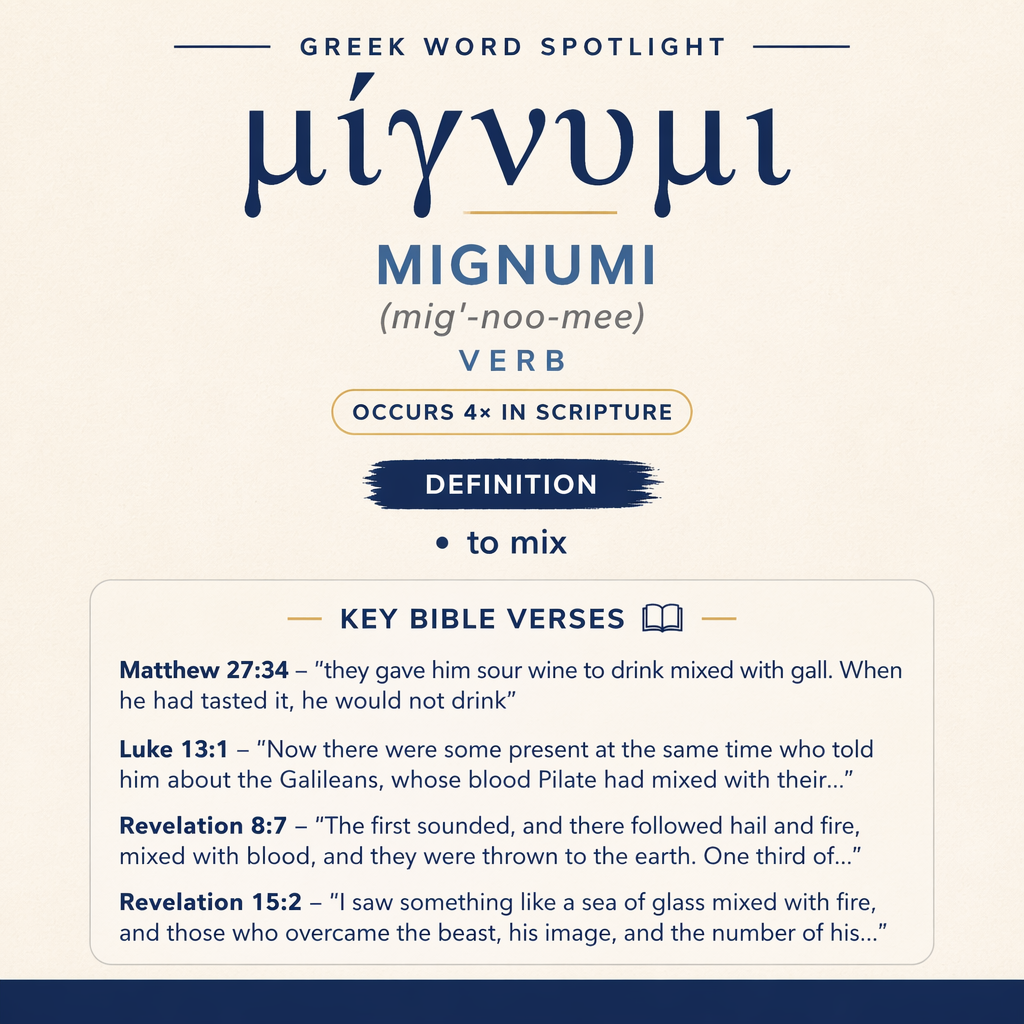
μίγνυμι means “to mix” and appears four times: Matthew 27:34; Luke 13:1; Revelation 8:7; Revelation 15:2.
Core Meaning
μίγνυμι means “to mix.” It describes substances being combined together.
Learn More →Gospel Scenes
In Matthew 27:34, sour wine is mixed with gall. In Luke 13:1, Pilate mixed the Galileans’ blood with their sacrifices.
Learn More →Revelation Images
In Revelation 8:7, hail and fire are mixed with blood. In Revelation 15:2, a sea of glass is mixed with fire.
Learn More →μίγνυμι describes the act of combining one substance with another so that they are presented together. It appears in scenes of suffering, violence, and apocalyptic judgment where the mixture itself becomes a striking detail in what is given, what is done, and what is seen.
Occurrences
“they gave him sour wine to drink mixed with gall. When he had tasted it, he would not drink.” (Matthew 27:34)
Here μίγνυμι marks an intentional alteration of what is offered: “sour wine” is presented not alone but as a drink “mixed with gall.” The mixture is the point of description, because it defines the character of the offered drink and frames the response that follows: “When he had tasted it, he would not drink.” The verb draws attention to a combined preparation—something made by joining two components—so that the tasting is of a compounded thing rather than a simple beverage. Within the sentence, the mixture functions as an explanatory feature: the offered drink is identified by its composite nature, and the refusal is narrated immediately after the taste of that composite.
“Now there were some present at the same time who told him about the Galileans, whose blood Pilate had mixed with their sacrifices.” (Luke 13:1)
In this report, μίγνυμι is used to describe a violent, defiling combination: “blood” is said to have been “mixed with their sacrifices.” The verb presents the act as one of forcing two things into a single, mingled reality—blood and sacrificial offerings treated as together rather than distinct. The sentence’s weight falls on the shocking conjunction: what belongs to “the Galileans” (their blood) has been combined with what belongs to their worship (their sacrifices). By using a mixing verb, the description underscores not only death but the intrusive interpenetration of categories that would ordinarily be kept apart in sacrificial practice: the outcome is not merely bloodshed, but blood introduced into and blended with what was being offered.
“The first sounded, and there followed hail and fire, mixed with blood, and they were thrown to the earth. One third of the earth was burned up, and one third of the trees were burned up, and all green grass was burned up.” (Revelation 8:7)
μίγνυμι here characterizes the composition of what falls in judgment: “hail and fire” are described as “mixed with blood.” The verb does not merely add an extra element to the scene; it specifies that the phenomena arrive in a blended form, with blood present within the hail-and-fire event itself. That compounded description strengthens the terror of what is “thrown to the earth,” because the mixture turns the storm into something more than a natural disaster—it is depicted as a combined agent carrying multiple destructive features at once. The subsequent effects—burning of “one third of the earth,” “one third of the trees,” and “all green grass”—unfold after the description of the mixed hail and fire, so the mixture serves as the narrated form of the plague that initiates the devastation.
“I saw something like a sea of glass mixed with fire, and those who overcame the beast, his image, and the number of his name, standing on the sea of glass, having harps of God.” (Revelation 15:2)
In this vision, μίγνυμι gives a paradoxical texture to what is seen: “a sea of glass” is “mixed with fire.” The verb highlights that the sea is not a single, uniform element; it is a composite spectacle, combining the clarity or solidity suggested by “glass” with the dynamic, threatening element of “fire.” This mixed sea is also a platform: “those who overcame the beast… standing on the sea of glass.” By describing the surface as mixed, the text presents their standing place as wondrous and formidable at the same time—an arena that visually holds together unlike elements. The mixture is therefore part of the vision’s staging: it shapes the setting in which the victors appear, harps in hand, without shifting the focus away from the striking scene that supports them.
Sense and Usage
Across these four passages, μίγνυμι consistently signals a deliberate or observable combining of materials so that they are encountered together as one prepared thing (a drink), one violated offering (sacrifices with blood), or one compounded phenomenon in a vision (hail and fire with blood; a sea of glass with fire). The verb’s force lies in how it makes the composite character narratively decisive: the story does not simply mention multiple elements present in proximity; it identifies them as joined in a way that changes what the object or event is.
In narrative settings (Matthew 27:34; Luke 13:1), the mixing is tied to agency and action. Someone “gave” a drink already mixed, and Pilate “had mixed” blood with sacrifices; in both cases, the mixture is not accidental background but the described result of human intention and intervention. The mixture becomes a moral and experiential marker: it defines what is offered to drink and it defines the horror reported about sacrificial worship interrupted by violence.
In visionary settings (Revelation 8:7; 15:2), the mixing shapes what is seen as an integrated marvel or terror. “Hail and fire, mixed with blood” presents a single event in which distinct elements are fused in the description, and the resulting plague is thrown down with sweeping ecological effect. “A sea of glass mixed with fire” similarly binds the scene into one object of sight: the sea’s appearance is explained by the unusual joining of elements, and that mixed appearance becomes the setting on which the conquerors stand. In both, μίγνυμι helps the visions communicate complexity by portraying the phenomena as composites rather than sequences or separate items placed side by side.
μίγνυμι also links these passages by the kinds of materials it joins. In three of the four occurrences, the mixture includes something associated with pain or violence—“gall,” “blood,” and “blood” again—while the remaining occurrence joins “fire” to the otherwise glass-like sea. The word thus serves the narrative and visionary emphasis on intensified experience: the combined elements sharpen the sensory and moral impression of what is given, what has happened, and what is unfolding. The verb is especially suited to portraying situations where the combination itself is the point: the mixture changes how the object is received (a drink tasted and refused), how a reported atrocity is understood (blood forced into sacrifices), and how judgment and victory are framed visually (plagues and a fiery-glass sea).
Imagery
The imagery carried by μίγνυμι in these verses is concrete and memorable because it depends on substances that remain recognizable even when combined. “Sour wine… mixed with gall” (Matthew 27:34) evokes a prepared drink whose character is altered by what is added. “blood Pilate had mixed with their sacrifices” (Luke 13:1) depicts an appalling intermingling that turns worship into a scene marked by blood. In Revelation, the mixing becomes cosmic: “hail and fire, mixed with blood” (Revelation 8:7) falls and burns, and “a sea of glass mixed with fire” (Revelation 15:2) stands as a strange, awe-inspiring stage for those holding “harps of God.” In each, the verb makes the reader picture not two separate things, but a combined reality that heightens the scene’s impact.
Sources: Lexical data from Strong’s Exhaustive Concordance and the Translators Brief Lexicon of Extended Strongs for Greek (STEPBible, CC BY). Occurrence data from the Translators Amalgamated Greek New Testament (STEPBible, CC BY). Scripture quotations from the World English Bible (public domain).




