Exploring the Meaning of Migma in Greek
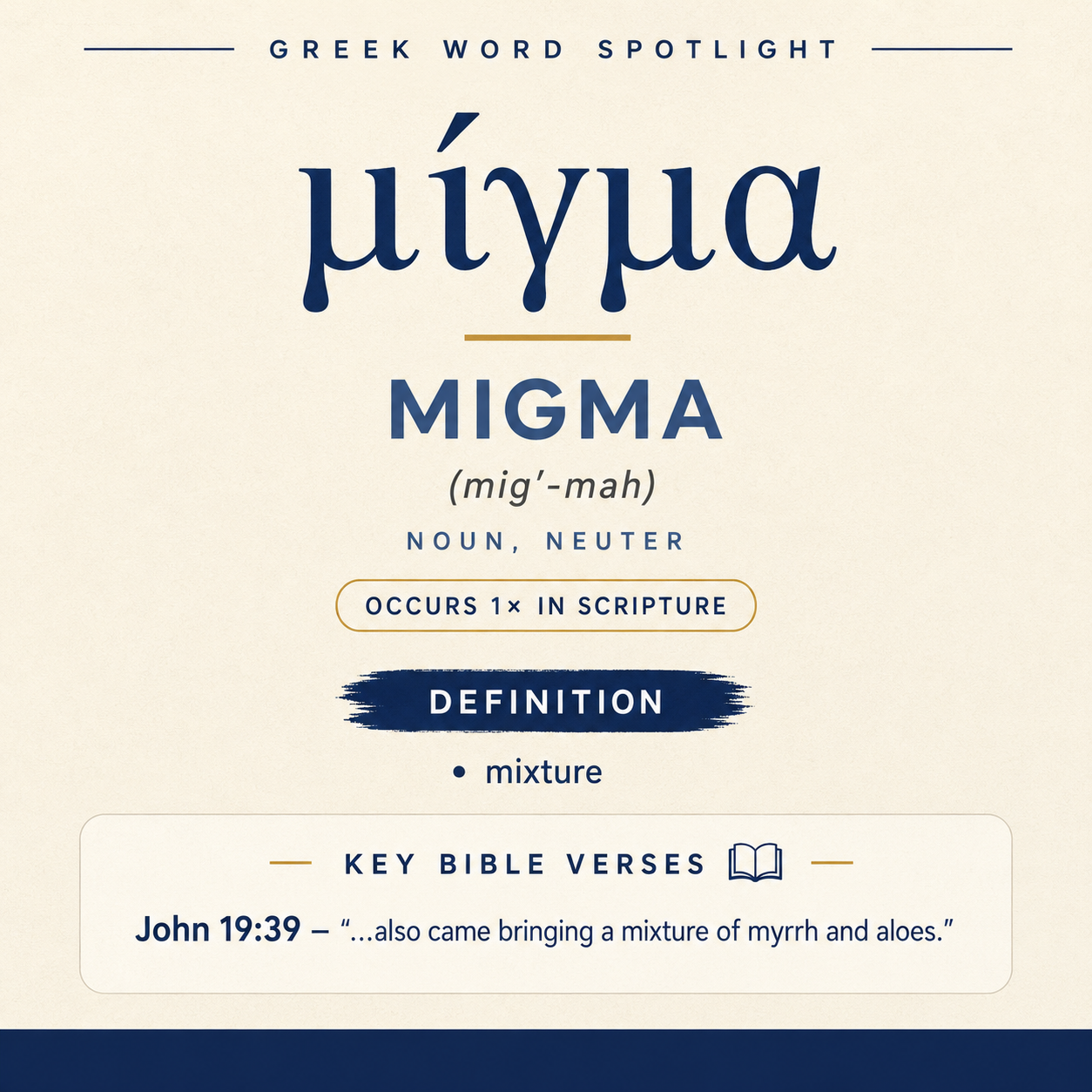
μίγμα means “mixture” and appears once in Scripture, in John 19:39.
Scripture Occurrence
It occurs one time in Scripture. The occurrence is in John 19:39.
Learn More →μίγμα refers to a “mixture,” and it appears in the burial scene narrated in John 19:39. In that context it names a combined preparation of fragrant materials brought for Jesus’ body.
Root and Related Words
μίγμα is derived from the verb mignymi (μίγνυμι), “to mix” (Strong’s G3396). The noun expresses the result of that action: something formed by bringing ingredients together into a combined whole.

Occurrences
“Nicodemus, who at first came to Jesus by night, also came bringing a mixture of myrrh and aloes, about a hundred Roman pounds.” (John 19:39)
Here μίγμα names what Nicodemus brings: a prepared blend composed of “myrrh and aloes.” The verse presents it as a single item (“a mixture”) even while specifying its two components, so the word gathers distinct substances into one described gift. By choosing a term that focuses on the combined product, the narrative directs attention away from loose, separate ingredients and toward a purposeful preparation—something already put together for use.
The immediate phrasing also gives μίγμα a clarifying function: it explains the relationship between the two aromatics (“of myrrh and aloes”) by stating that they are not merely carried side-by-side but joined as one combined substance. The addition “about a hundred Roman pounds” further frames the μίγμα as a substantial quantity. In this verse the word therefore serves both as a descriptor of composition (a blend) and as an organizing noun that can be weighed and transported as a single provision.
Sense and Usage
The definition “mixture” is concrete and material in this passage. μίγμα does not describe a vague association of things; it points to a tangible compound made from identifiable ingredients. John 19:39 expresses this with the construction “a mixture of myrrh and aloes,” which shows how the term naturally takes a genitive of materials to specify what has been combined. In this setting the word is not abstract or figurative; it denotes a physical preparation suited to handling, measurement, and application.
Because μίγμα foregrounds the combined whole, it highlights unity of product rather than variety of parts. The verse could have listed the two aromatics alone, yet the statement “bringing a mixture” adds an interpretive layer: the myrrh and the aloes are presented as intentionally integrated. In other words, μίγμα signals that the ingredients have already been brought into a state of combination before the action of bringing them to Jesus’ burial context. The focus is on the prepared state of the materials, not on the act of mixing at the tomb.
Within the verse’s narrative flow, μίγμα also contributes to characterization through concreteness. Nicodemus “also came bringing” something specific, prepared, and weighty. The word’s ordinary, practical sense fits the scene’s physicality: a burial involves bodies, spices, linens, and weight—things that are carried and used. By naming the item as a “mixture,” the verse presents the offering as a purposeful compound meant for a particular use in burial practice, without needing to describe procedures beyond the simple fact of what it is.
Imagery
John 19:39 gives μίγμα a sensory profile through its stated ingredients. Even without expanding beyond the verse, “myrrh and aloes” evokes fragrance and material richness, and μίγμα frames these as a single combined substance. The weight mentioned (“about a hundred Roman pounds”) adds heft to the imagery: the “mixture” is not a token amount but a large, bodily, carryable preparation brought to the burial scene.
Sources: Lexical data from Strong’s Exhaustive Concordance and the Translators Brief Lexicon of Extended Strongs for Greek (STEPBible, CC BY). Occurrence data from the Translators Amalgamated Greek New Testament (STEPBible, CC BY). Scripture quotations from the World English Bible (public domain).