
Exploring the Meaning of Metreo in Greek
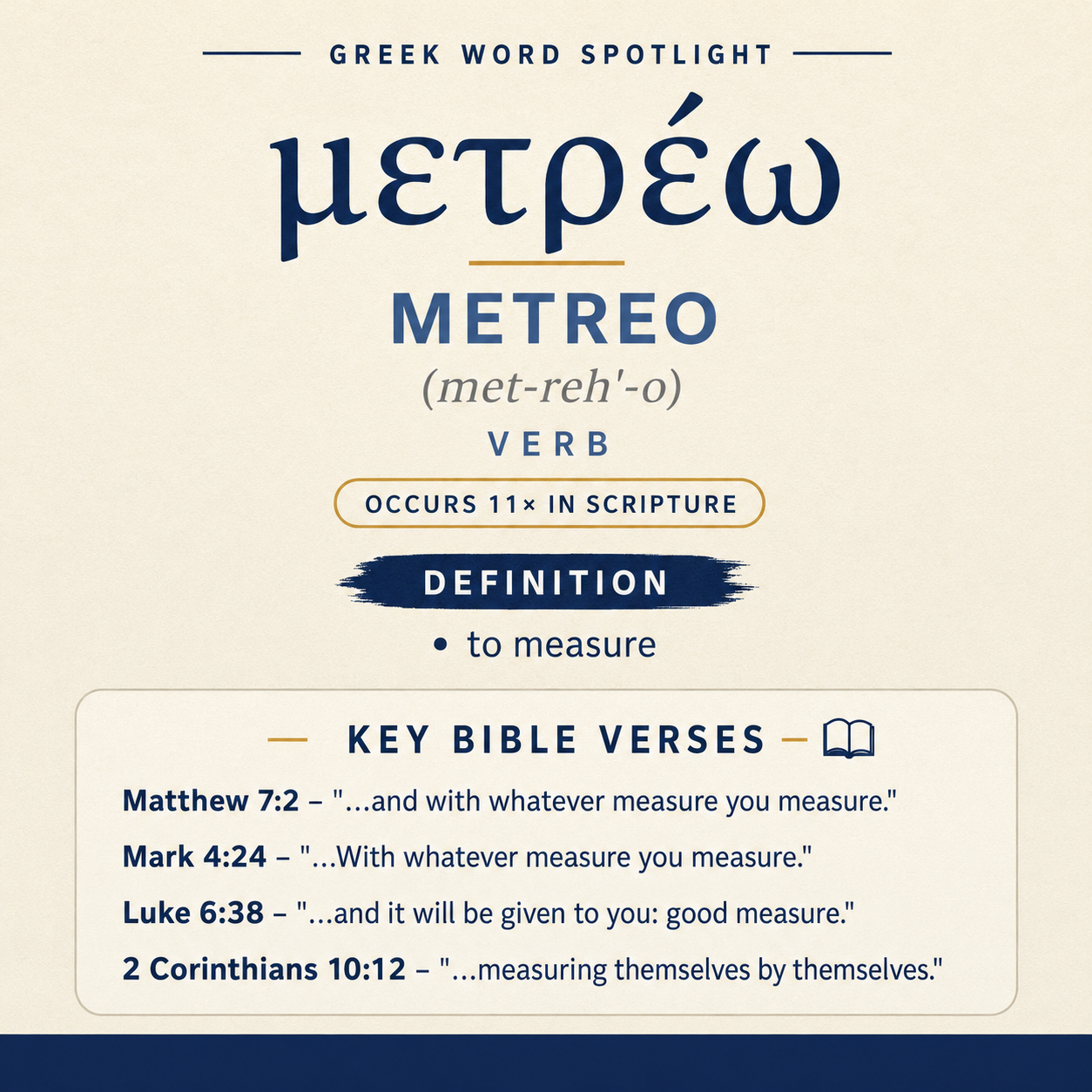
μετρέω means “to measure,” appearing 11 times in Scripture, including Matthew 7:2, Mark 4:24, Luke 6:38, 2 Corinthians 10:12, and Revelation 11 and 21.
Core Meaning
μετρέω means “to measure.” It is used for the act of measuring in the listed passages.
Learn More →Gospel Usage
In Matthew 7:2 and Mark 4:24, measuring is tied to how one measures toward others. Luke 6:38 includes “good measure” in the context of giving.
Learn More →Revelation Scenes
Revelation 11:1–2 uses μετρέω for measuring the temple, while the outer court is not measured. Revelation 21:15–16 describes measuring the city with a reed.
Learn More →μετρέω means “to measure,” appearing in Jesus’ teaching on reciprocal standards, in Paul’s critique of self-comparison, and in Revelation’s scenes of measuring sacred space and the New Jerusalem. Across these passages, measuring can describe both a literal act with a measuring instrument and a figurative act of applying a standard that returns to the one who uses it.
Occurrences
“For with whatever judgment you judge, you will be judged; and with whatever measure you measure, it will be measured to you.” (Matthew 7:2)
Here measuring functions as a parallel to judging: the “measure” one uses becomes the measure applied back. The verb frames measurement as an action that establishes a standard; the sentence then turns that same standard around onto the measurer, emphasizing reciprocity.

“He said to them, “Take heed what you hear. With whatever measure you measure, it will be measured to you, and more will be given to you who hear.” (Mark 4:24)
The command “Take heed what you hear” sets the context: the act of measuring is linked to hearing and receiving. Measuring depicts the way a person apportions or applies a standard in response to what is heard, and the saying promises that the same kind of measurement comes back—followed by an added abundance (“and more will be given to you who hear”).
““Give, and it will be given to you: good measure, pressed down, shaken together, and running over, will be given to you. For with the same measure you measure it will be measured back to you.” (Luke 6:38)
Measuring is embedded in the imagery of a full container: “good measure, pressed down, shaken together, and running over.” The verb relates to the standard used in giving—how one measures out to others. The vivid description of the “measure” being compressed and overflowing intensifies the idea that the return is not merely equal, but lavishly filled within the same measuring framework.
“For we are not bold to number or compare ourselves with some of those who commend themselves. But they themselves, measuring themselves by themselves, and comparing themselves with themselves, are without understanding.” (2 Corinthians 10:12)
In this critique, measuring is self-referential: “measuring themselves by themselves.” The verb conveys the act of establishing one’s standard internally and then using it as the yardstick for evaluation. Within the sentence’s logic, this kind of measuring is paired with “comparing,” and together they characterize a closed loop of assessment that leads to being “without understanding.”
“A reed like a rod was given to me. Someone said, “Rise, and measure God’s temple, and the altar, and those who worship in it.” (Revelation 11:1)
Measuring becomes a commanded, concrete action performed with an instrument: “A reed like a rod.” The objects to be measured include “God’s temple” and “the altar,” extending even to “those who worship in it.” The verb thus operates spatially and inclusively: the act of measuring defines what is encompassed by the measuring activity in this scene.
“Leave out the court which is outside of the temple, and don’t measure it, for it has been given to the nations. They will tread the holy city under foot for forty-two months.” (Revelation 11:2)
The prohibition “don’t measure it” creates a sharp boundary by withholding measurement from “the court which is outside of the temple.” Measuring, by contrast, is reserved for what is to be included, while the unmeasured area is explicitly “leave[d] out.” The verb therefore marks distinction: what is measured and what is deliberately excluded from measurement in the unfolding vision.
“He who spoke with me had for a measure a golden reed to measure the city, its gates, and its walls.” (Revelation 21:15)
This scene again uses a measuring tool—“a golden reed”—but the focus shifts to a city and its structures. The verb governs a comprehensive survey: “to measure the city, its gates, and its walls.” Measuring here is architectural and extensive, mapping the city’s features in an orderly way.
“The city is square, and its length is as great as its width. He measured the city with the reed, twelve thousand twelve stadia. Its length, width, and height are equal.” (Revelation 21:16)
The measurement yields proportions and magnitude: the city’s shape is “square,” and the measured result is “twelve thousand twelve stadia.” The verb anchors the statement’s geometry, leading to the conclusion that “Its length, width, and height are equal.” Measuring is the means by which the city’s symmetry is stated and its dimensions are reported.
“Its wall is one hundred forty-four cubits, by the measure of a man, that is, of an angel.” (Revelation 21:17)
Although the verb itself is not repeated in this sentence, the immediate context continues the measuring theme by specifying “the measure.” The wall’s height is given numerically (“one hundred forty-four cubits”), and the phrase “by the measure of a man, that is, of an angel” ties the measurement to a recognizable standard while still belonging to the visionary setting introduced by the angelic guide.

Sense and Usage
Across these passages, “to measure” moves between two main kinds of use: applying a standard to people and actions, and taking dimensions of places and structures. In Matthew 7:2, Mark 4:24, and Luke 6:38, measuring is paired with reciprocity: the measure used becomes the measure received. The sayings do not describe the instrument or the units; instead, they stress the character of the standard—what sort of measuring one chooses to employ. Luke’s “good measure, pressed down, shaken together, and running over” supplies concrete market-like imagery for the outcome of the measuring process, making the return feel tangible and abundant while still framed by the same measuring principle.
In 2 Corinthians 10:12, measuring becomes a metaphor for evaluation in a social and moral sense. The critique does not deny that measuring can happen; it targets the reference point—“by themselves”—and shows how measuring can become distorted when it uses the self as both rule and object. The verb’s force lies in the act of setting a yardstick and then using it for assessment; when the yardstick is self-generated and self-applied, it produces a form of comparison that the sentence calls “without understanding.”
Revelation portrays measuring as a guided act within prophetic vision. In Revelation 11:1–2, the instrument (“A reed like a rod”) and the commands (“Rise, and measure…”; “don’t measure…”) give measuring the role of marking boundaries—what is included (temple, altar, worshipers) and what is excluded (the outer court). In Revelation 21:15–17, measuring is the orderly description of the city’s form and scale. The repeated mention of the reed, the city’s symmetry, and the stated dimensions show measuring as a way of presenting the city as structured, proportionate, and describable in definite terms. Even the phrase “by the measure of a man, that is, of an angel” keeps measurement connected to an intelligible standard while remaining within the narrative setting of an angelic mediator.
Imagery and Emphasis
The word’s imagery ranges from the everyday to the visionary: a “measure” used in judging, hearing, and giving, and a reed used to mark temples and cities. In the teaching passages, measuring is a moral and relational act that rebounds—what one measures out returns in kind. In Revelation, measuring is spatial and visual, tracing what is counted in and what is left out, then presenting a city whose dimensions and equality of length, width, and height are stated as measured realities.
Sources: Lexical data from Strong’s Exhaustive Concordance and the Translators Brief Lexicon of Extended Strongs for Greek (STEPBible, CC BY). Occurrence data from the Translators Amalgamated Greek New Testament (STEPBible, CC BY). Scripture quotations from the World English Bible (public domain).




