
Exploring the Meaning of Mesos in Greek
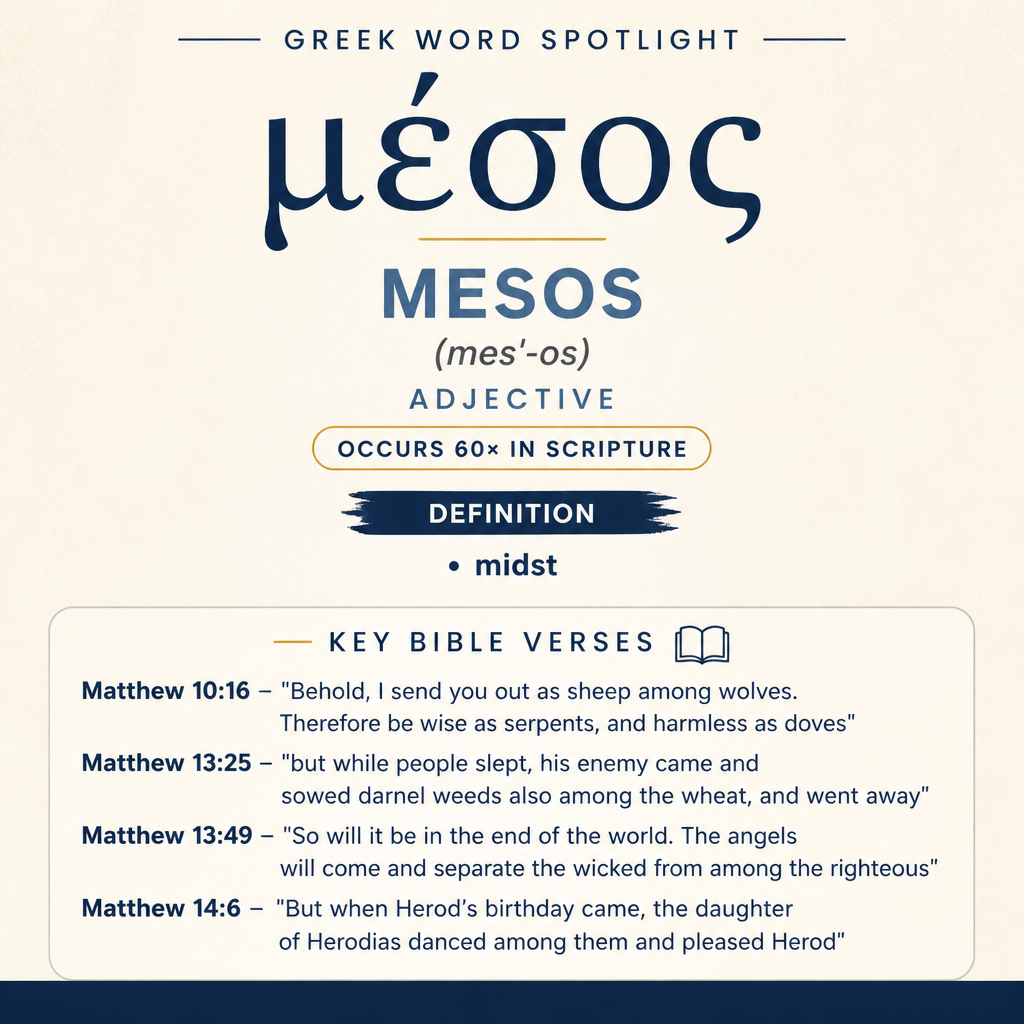
μέσος (Mesos) means “midst” and occurs 60 times in Scripture, including Matthew 18:20 and Matthew 10:16.
Core Meaning
μέσος is defined as “midst.” It describes being in the middle or among others.
Learn More →Gospel Examples
It appears in scenes like Jesus being “in the middle” where two or three gather (Matthew 18:20). It is also used for being “among” wolves, wheat, or people (Matthew 10:16; 13:25; 14:6).
Learn More →Noted Occurrences
Matthew 18:2 uses it when Jesus sets a little child “in the middle” of them. Mark 3:3 includes the command, “Stand up.”
Learn More →μέσος expresses the idea of the “midst,” placing someone or something within others or within a space. In the passages below it repeatedly marks a location or position inside a group, inside a region, or inside a larger setting, shaping how each scene is pictured.
Occurrences
“Behold, I send you out as sheep among wolves. Therefore be wise as serpents, and harmless as doves.” (Matthew 10:16)
Here the word frames the disciples’ mission as one carried out in the midst of danger. The image is not of wolves at a distance but of sheep situated within them, so the warning and the call to be “wise” and “harmless” are tied to being placed inside a threatening environment.
“but while people slept, his enemy came and sowed darnel weeds also among the wheat, and went away.” (Matthew 13:25)
The sowing happens in the midst of what already belongs in the field: weeds are placed within the wheat itself. The word sharpens the act as infiltration rather than replacement—something alien introduced into the existing crop so that the mixture will only be recognized later.
“So will it be in the end of the world. The angels will come and separate the wicked from among the righteous,” (Matthew 13:49)
The separation is described as extraction from the midst of a larger company. The righteous are pictured as a defined group within which the wicked are presently found; the angels’ work is not merely to sort two distant crowds but to remove one set from inside the other.
“But when Herod’s birthday came, the daughter of Herodias danced among them and pleased Herod.” (Matthew 14:6)
The dance is located in the midst of the gathered celebrants. The word places the dancer inside the social circle, where her performance functions publicly and immediately affects Herod within the same shared space.
“Jesus called a little child to himself, and set him in the middle of them,” (Matthew 18:2)
The child is positioned in the midst of the disciples as a visible center of attention. The placement makes the child not peripheral but central, turning the group’s shared space into the setting for what Jesus is about to teach by means of that positioned presence.
“For where two or three are gathered together in my name, there I am in the middle of them.” (Matthew 18:20)
The saying depicts Jesus’ presence as located in the midst of even a very small assembly. The stress falls on presence within the gathering itself—where they are “gathered together”—so the group is defined not only by meeting but by a presence situated among them.
“But at midnight there was a cry, ‘Behold! The bridegroom is coming! Come out to meet him!’” (Matthew 25:6)
The time marker “at midnight” evokes a moment in the midst of the night, when normal activity is suspended. The cry interrupts that middle-of-the-night stillness, so the urgency of “Come out to meet him!” is heightened by the unexpected timing in the night’s central hours.
“He said to the man who had his hand withered, “Stand up.”” (Mark 3:3)
The brief command functions in a public setting where the man is to be made visible. The idea of being brought into the midst is carried by the summons to stand, drawing the man out from the edges into the shared space where the next action and its meaning will be observed by those present.
“When evening had come, the boat was in the middle of the sea, and he was alone on the land.” (Mark 6:47)
The boat’s position is in the midst of a vast expanse, emphasizing distance from shore and exposure on open water. By contrasting the boat “in the middle of the sea” with “he was alone on the land,” the scene sets a spatial separation that heightens isolation: the disciples surrounded by sea, Jesus on land.
“Again he departed from the borders of Tyre and Sidon, and came to the sea of Galilee, through the middle of the region of Decapolis.” (Mark 7:31)
The travel route is traced as passing through the midst of a region. Rather than skirting boundaries, the movement is pictured as going through the interior, presenting the journey as one that crosses the heart of the Decapolis region on the way to the sea of Galilee.
“He took a little child, and set him in the middle of them. Taking him in his arms, he said to them,” (Mark 9:36)
As in Matthew 18, the child is placed in the midst so that the group must face what is set before them. The gesture “Taking him in his arms” follows the placement, so the child’s central position becomes the setting for an embodied lesson delivered within the circle of the disciples.
“The high priest stood up in the middle, and asked Jesus, “Have you no answer? What is it which these testify against you?”” (Mark 14:60)
The high priest’s stance “in the middle” portrays him taking a central, commanding position in the proceeding. From that place in the midst he addresses Jesus with public questions, turning the center of the assembly into a platform for accusation and response.

Sense and Usage
Across these passages, “midst” consistently does spatial work: it places a person, object, or action inside a larger context so the surrounding environment becomes part of the meaning. Sometimes that surrounding context is hostile (sheep situated within wolves), sometimes mixed (weeds introduced within wheat; the wicked presently within the righteous), and sometimes communal (a dancer within celebrants; a child positioned within disciples; Jesus present within a gathered few). In each case, the point is not merely proximity but interior placement—being within rather than beside.
The word also scales from small circles to broad landscapes. It can set the center of a group (a child “in the middle of them,” a leader standing “in the middle”) and it can locate something inside a vast or extended space (a boat in the sea’s middle; a route through the middle of a region; a cry breaking out at midnight in the night’s midst). This flexibility lets the narrative move easily between the intimate and the expansive while preserving the same basic idea: a focal point situated inside something larger.
In several scenes, being in the midst creates visibility and public force. The child placed in the middle becomes unavoidable to the disciples’ gaze; the high priest standing in the middle makes his interrogation an event framed by the assembly. Even the command “Stand up” functions in that direction, calling someone into a position where what happens next will be seen and weighed. In other scenes, being in the midst heightens vulnerability: the sheep among wolves and the boat in mid-sea are defined by what surrounds them.
Imagery
The recurring picture is of a center within a surround: a small figure set inside a circle, a boat set inside open water, an unseen seed sown inside a crop, a voice heard in the night’s middle hours. These uses make “midst” a vivid locator—one that repeatedly draws attention to what encloses and frames the action, whether that frame is a crowd, a field, a region, a sea, or the dark interior of the night.
Sources: Lexical data from Strong’s Exhaustive Concordance and the Translators Brief Lexicon of Extended Strongs for Greek (STEPBible, CC BY). Occurrence data from the Translators Amalgamated Greek New Testament (STEPBible, CC BY). Scripture quotations from the World English Bible (public domain).





