Exploring the Meaning of Mesoo in Greek
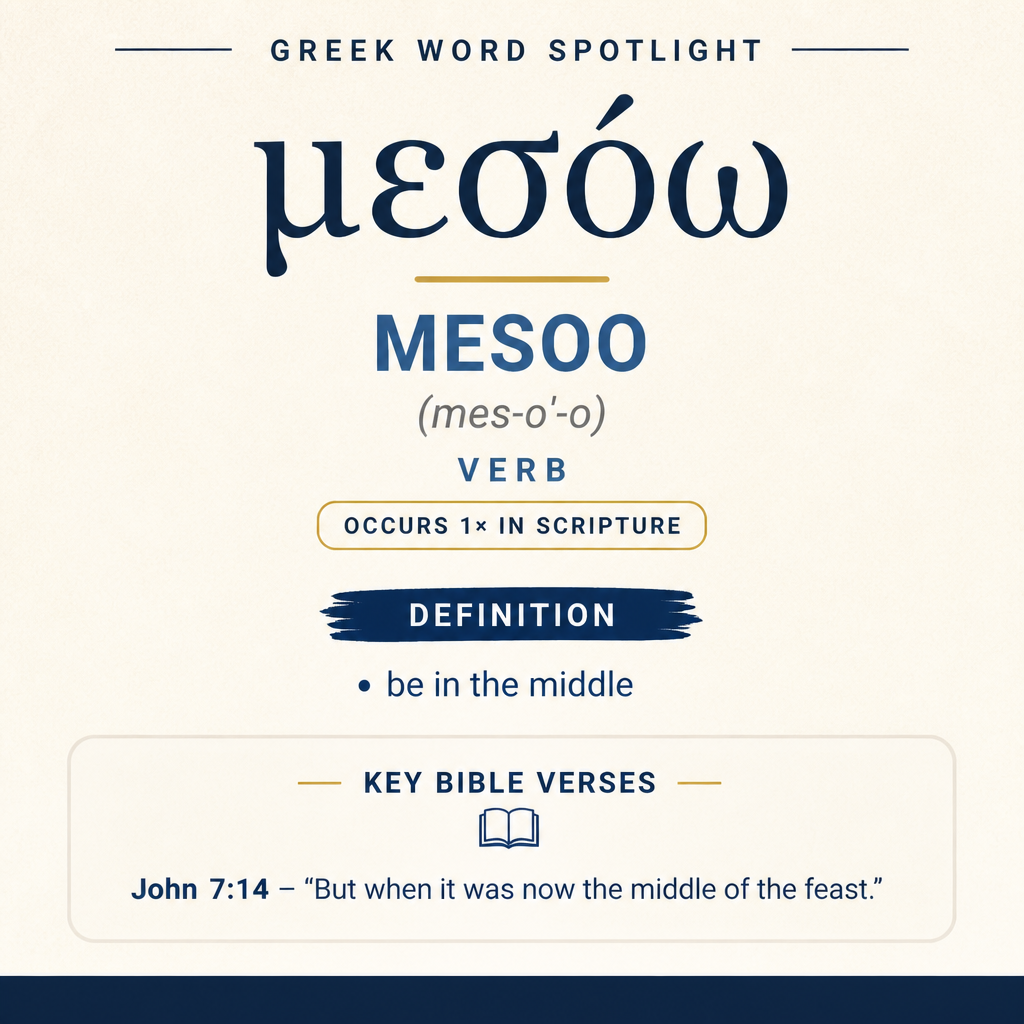
μεσόω means “be in the middle” and appears once in Scripture, in John 7:14.
Scripture Occurrence
This word occurs 1 time in Scripture. Its single occurrence is in John 7:14.
Learn More →Verse Context
In John 7:14 it refers to the middle of the feast. The verse says Jesus went up into the temple and taught.
Learn More →μεσόω expresses being in the middle. It appears in John 7:14 in the temporal setting “the middle of the feast,” marking a decisive point within a larger span of days.
Root and Related Words
μεσόω is related to mesos (μέσος), “midst” (Strong’s G3319). The relationship points to the central idea of “middle-ness,” expressed here in verbal form.

Occurrences
“But when it was now the middle of the feast, Jesus went up into the temple and taught.” (John 7:14)
Here μεσόω locates the action at a midpoint within an ongoing festival. The line divides the scene into a “before” and “after” inside the same occasion: first, the feast is underway; then, at its middle, Jesus goes up into the temple and begins teaching. The word serves as a time-marker, not by giving a calendar date but by placing the moment within the interior of a known period (“the feast”).
Because the verse couples this midpoint with immediate movement and speech—“Jesus went up into the temple and taught”—the middle becomes the hinge on which the narrated action turns. The focus is not on how long the feast lasts or how its days are counted, but on the significance of Jesus’ appearance and instruction at a point that is neither the opening nor the close. The “middle” is presented as a recognizable stage of the feast, a moment when the gathering context remains in full swing and the temple is an active setting for public teaching.
Within the verse, the word’s contribution is also structural: it frames the teaching as occurring within the feast rather than adjacent to it. “The middle of the feast” situates the teaching amid the event’s ongoing life—after it has begun and while it continues—so that the temple instruction is portrayed as part of what happens during the feast itself. In narrative terms, the midpoint functions as a clear reference point inside a larger episode.
Sense and Usage
The sense “be in the middle” works in John 7:14 as a way of expressing interior location within a span of time. The verse uses the “middle” to anchor the reader in the progression of the feast: the moment belongs to the feast, and not merely to a time near it. The word thus serves to identify a central segment of an extended occasion, emphasizing that the action occurs when the event is already in progress.
This “middle” language carries a particular narrative force. A beginning often introduces; an ending concludes; the middle suggests continuity and development. In the verse, the midpoint does not describe a vague general time (“sometime during”), but a defined position within the feast’s course. That defined position gives the reader a sense of timing and pacing: the festival has advanced to a certain stage, and at that stage Jesus enters the temple setting and teaches. The verb’s idea of being “in the middle” functions as a tight coordinate inside the storyline.
Because the only expressed domain here is temporal (“the middle of the feast”), the word’s value is to specify where within an interval an action takes place. It highlights that the teaching is not presented as preliminary or concluding activity, but as happening within the central stretch of the festival. The wording makes the midpoint itself meaningful as a moment of arrival and instruction: Jesus’ ascent into the temple and his teaching are fixed to the feast’s interior, where participation and public attention are naturally assumed by the scene’s setting.
The related word mesos (μέσος), “midst,” helps frame how “middle” language operates: it points to what lies within, rather than at edges. In John 7:14, that inward placement shapes the reader’s perception of the action—Jesus’ teaching is not outside the feast’s rhythms but set in its midst, at an internal point clearly marked as “the middle.”
Imagery
The single occurrence carries concrete imagery through its setting: a feast underway, the temple as the place of ascent and instruction, and a moment described by its position within the feast rather than by an external timestamp. “The middle of the feast” evokes the sense of standing at a midpoint in a continuing stream of days, where the event is fully active and the scene turns toward public teaching.
Sources: Lexical data from Strong’s Exhaustive Concordance and the Translators Brief Lexicon of Extended Strongs for Greek (STEPBible, CC BY). Occurrence data from the Translators Amalgamated Greek New Testament (STEPBible, CC BY). Scripture quotations from the World English Bible (public domain).