Exploring the Meaning of Menuo in Greek
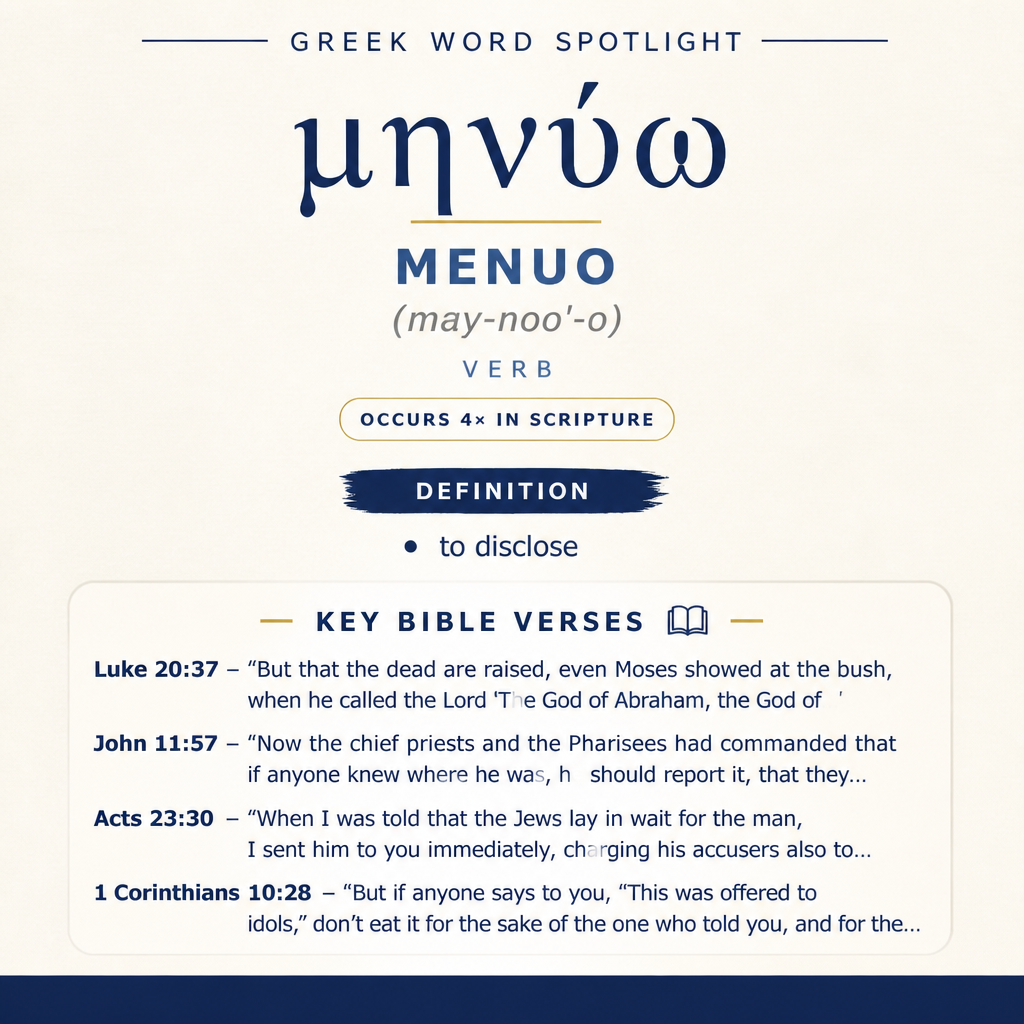
μηνύω means “to disclose” and occurs 4 times in Scripture: Luke 20:37; John 11:57; Acts 23:30; 1 Corinthians 10:28.
Scripture Occurrences
It appears 4 times in Scripture: Luke 20:37; John 11:57; Acts 23:30; 1 Corinthians 10:28.
Learn More →Reported Disclosure
In John 11:57, it is used for reporting where someone is. In 1 Corinthians 10:28, it is used for telling someone about food offered to idols.
Learn More →μηνύω expresses the act of disclosing—bringing information out into the open so that it becomes known. In the New Testament it appears in scenes ranging from public teaching about resurrection to official reporting that enables arrest or legal action.
Root and Related Words
Strong’s links μηνύω with two related terms: μασσάομαι (massaomai), “to gnaw” (Strong’s G3145), and μνάομαι (mnaomai), “to remember” (Strong’s G3415). These connections place μηνύω alongside vocabulary concerned with internal activity that results in something being brought forward—whether by working something over or by holding it in mind—though in usage μηνύω itself is characterized by the movement from knowing to making known.

Occurrences
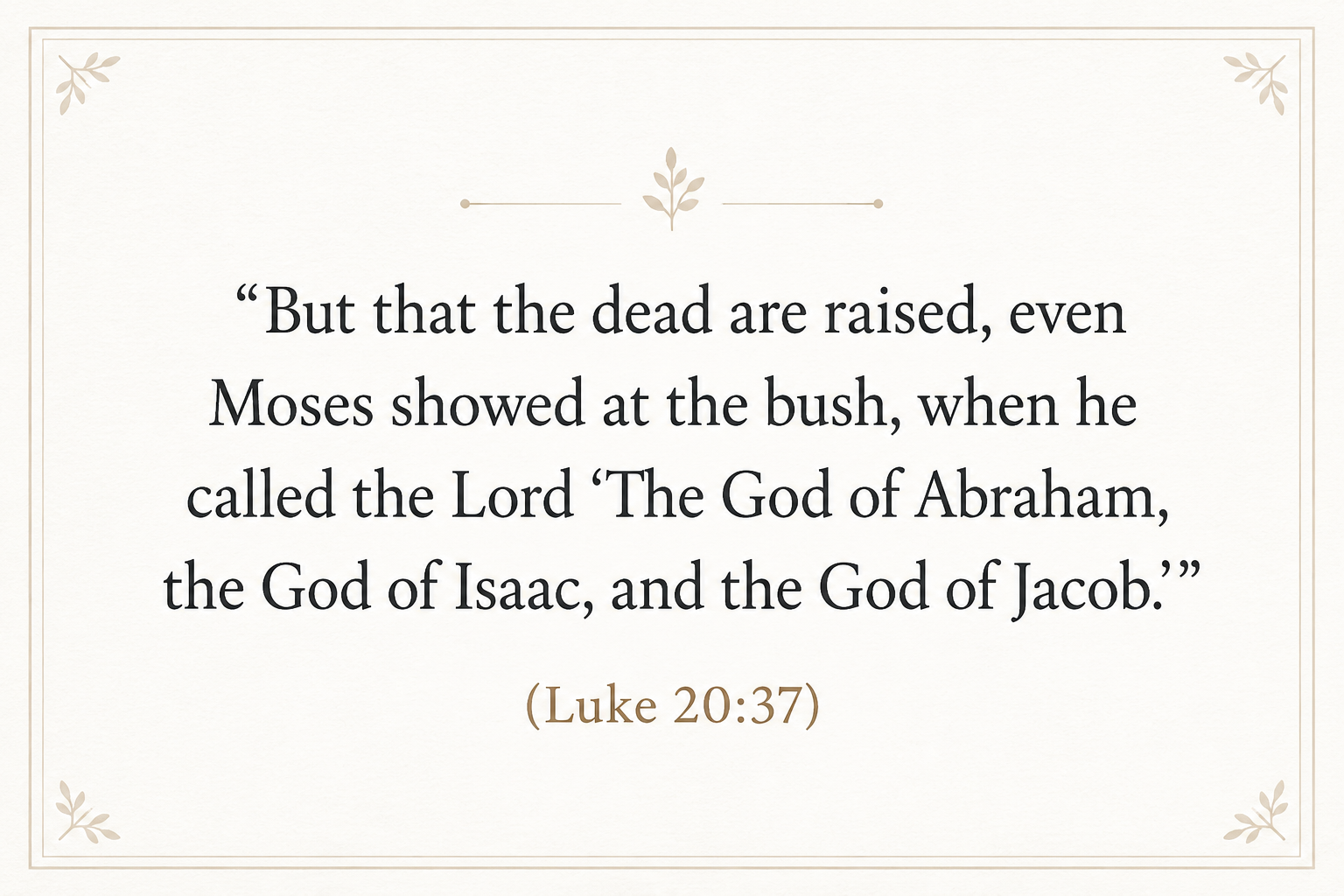
“But that the dead are raised, even Moses showed at the bush, when he called the Lord ‘The God of Abraham, the God of Isaac, and the God of Jacob.’” (Luke 20:37)
Here the verb functions in a setting of scriptural argument. The point at issue is “that the dead are raised,” and the disclosure is framed as something “even Moses showed at the bush.” In this context, disclosing is not gossip or accusation but making a truth evident by appeal to a recognized episode and to Moses’ manner of speaking about God. The verse ties the disclosure to a concrete moment (“at the bush”) and to cited words (“The God of Abraham, the God of Isaac, and the God of Jacob”), presenting disclosure as a means of drawing out implications already embedded in the sacred narrative and speech.
“Now the chief priests and the Pharisees had commanded that if anyone knew where he was, he should report it, that they might seize him.” (John 11:57)
In John, disclosure is demanded under authority: “had commanded” sets the tone of obligation. The condition “if anyone knew where he was” highlights that the matter to be disclosed is location—knowledge that may be privately held but is expected to be made public to the authorities. The purpose clause “that they might seize him” shows the practical consequence of reporting: disclosure becomes the enabling step for capture. The verse therefore situates μηνύω in an environment of surveillance and enforcement, where the transfer of information from individuals to leaders is instrumental and coercive.
“When I was told that the Jews lay in wait for the man, I sent him to you immediately, charging his accusers also to bring their accusations against him before you. Farewell.” (Acts 23:30)
This occurrence sits inside official correspondence and judicial procedure. The disclosure comes in the passive (“When I was told”), focusing attention on the arrival of intelligence: the content is that “the Jews lay in wait for the man,” a report of danger and ambush. That disclosure triggers decisive administrative action (“I sent him to you immediately”), and it is paired with formal instruction concerning due process (“charging his accusers also to bring their accusations against him before you”). In this scene, disclosure has the character of actionable reporting—information given to an official that changes how an accused person is handled and where the case is heard.
“But if anyone says to you, “This was offered to idols,” don’t eat it for the sake of the one who told you, and for the sake of conscience. For “the earth is the Lord’s, with all its fullness.”” (1 Corinthians 10:28)
In Corinthian instruction, disclosure occurs in ordinary social interaction: “if anyone says to you” introduces a spoken notification about food—“This was offered to idols.” The command “don’t eat” is explicitly grounded not in the food alone but in relational and moral considerations: “for the sake of the one who told you, and for the sake of conscience.” Here disclosure shapes behavior by altering what the hearer now knows in the moment of decision. The one who discloses becomes morally relevant: the hearer refrains in deference to the notifier and to conscience, showing that the act of making something known can create obligations that did not exist before the information was expressed.
Sense and Usage
Across these passages, μηνύω consistently involves a movement from concealed or unspoken knowledge to stated, communicable knowledge. What varies is the sphere in which disclosure operates and the kind of responsibility it creates. In Luke 20:37, disclosure is argumentative and public: a truth about resurrection is made evident by bringing forward Moses’ words and the setting “at the bush.” The disclosure aims at persuasion and recognition; it treats disclosure as an interpretive act that clarifies what is already present in authoritative speech.
John 11:57 shifts disclosure into the realm of commanded reporting. The focus is not the insightfulness of the disclosure but compliance: whoever “knew where he was” is expected to transmit that knowledge. Disclosure there is a mechanism of power—information flows upward to enable seizing someone.
Acts 23:30 shows disclosure functioning within governance and protection. The reported information concerns a plotted attack (“lay in wait”), and the response is immediate relocation and procedural instruction. The disclosure in this verse is tightly coupled to action: once the danger is made known to an official, the official adjusts the situation and frames the next steps for accusers to present their case.
In 1 Corinthians 10:28, disclosure is conversational but ethically weighty. The statement about what the food “was offered to” introduces a new factor into a shared meal. The verse portrays disclosure as something that reshapes communal life: it affects what one will do at the table, and it does so “for the sake of” both the speaker and conscience. The discloser’s speech is treated as meaningful even if the broader principle (“the earth is the Lord’s, with all its fullness”) is also affirmed, because once the information is voiced it becomes a conscientious concern.
Seen together, these uses show that disclosure can serve several ends—explanation, enforcement, protection, and conscience-driven restraint—while remaining the same basic act: making something known that would otherwise remain unexpressed. The object disclosed may be a doctrinal point drawn from Scripture (Luke), a person’s whereabouts (John), a threat and legal situation (Acts), or the religious association of food (1 Corinthians). In each case, the disclosure matters because it changes what is publicly recognized and therefore what actions are now appropriate: teaching draws a conclusion, authorities pursue an arrest, officials reroute a prisoner and set legal steps, and diners abstain for relational and moral reasons.
Imagery in Context
The passages attach disclosure to distinct images of communication. Luke 20:37 pictures disclosure as something “showed” in a remembered scene “at the bush,” tying making-known to a moment of divine naming. John 11:57 frames disclosure as a report demanded by leaders, with the implied image of watchers relaying a location so that a seizure can occur. Acts 23:30 evokes the flow of intelligence within administration—news of an ambush reaching an official and prompting immediate transfer. First Corinthians 10:28 places disclosure at a table, where a simple sentence (“This was offered to idols”) can redirect a meal for “the sake of conscience.”
Sources: Lexical data from Strong’s Exhaustive Concordance and the Translators Brief Lexicon of Extended Strongs for Greek (STEPBible, CC BY). Occurrence data from the Translators Amalgamated Greek New Testament (STEPBible, CC BY). Scripture quotations from the World English Bible (public domain).