
Exploring the Meaning of Mentoi in Greek
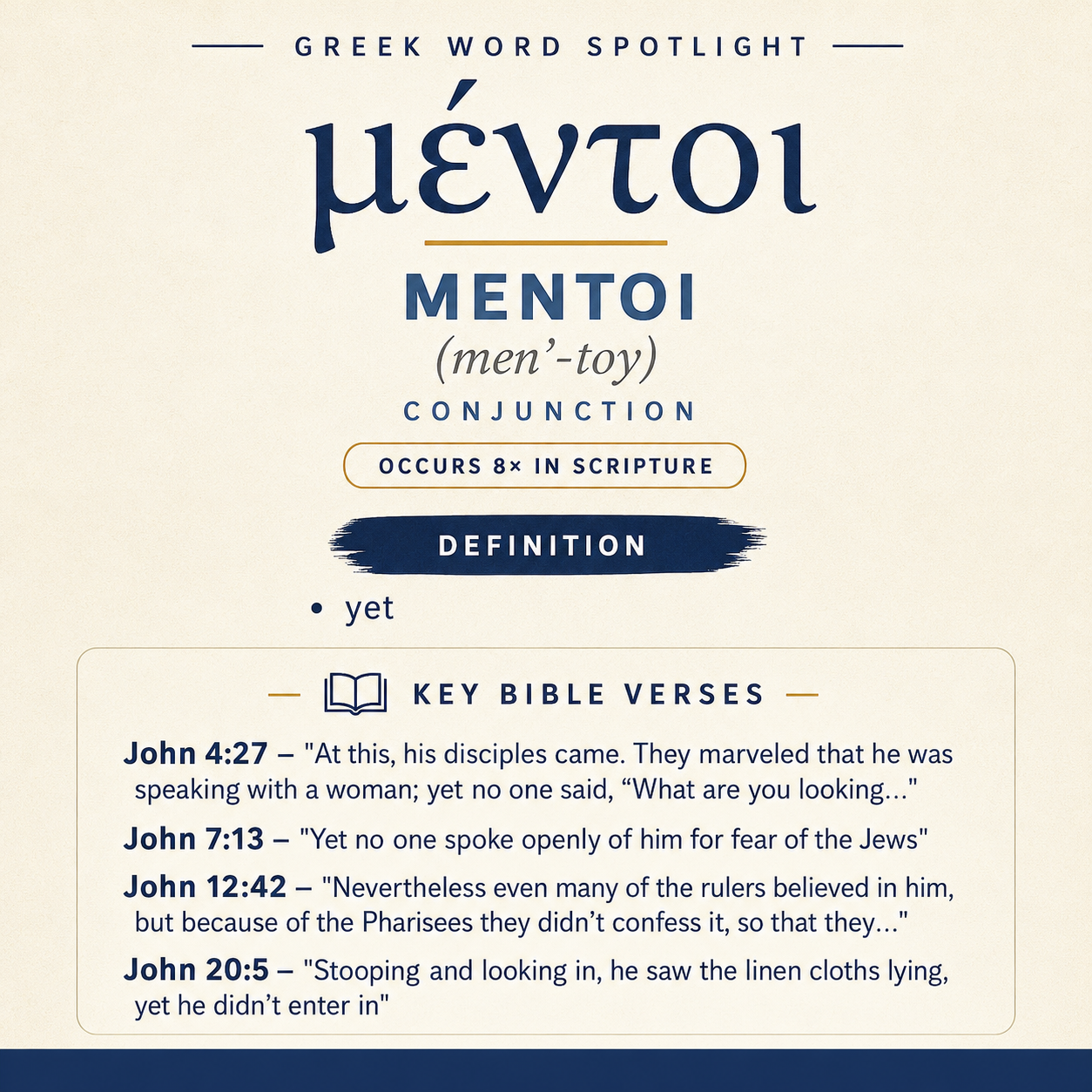
μέντοι (Mentoi) means “yet” and occurs 8 times in Scripture, including John, 2 Timothy, James, and Jude.
Scripture Locations
It appears in John 4:27; 7:13; 12:42; 20:5; 21:4; 2 Timothy 2:19; James 2:8; Jude 1:8.
Learn More →Verse Examples
In John 7:13 it introduces contrast: “Yet no one spoke openly of him.” In John 20:5 it marks a detail: he saw the linen cloths, “yet he didn’t enter in.”
Learn More →μέντοι expresses a “yet” that holds two realities together without cancelling either one. In the New Testament it regularly appears at points where the narrative or argument turns on a surprise, a restraint, or a persistence in the face of expectations.
Occurrences
John 4:27 — “At this, his disciples came. They marveled that he was speaking with a woman; yet no one said, “What are you looking for?” or, “Why do you speak with her?””
Here “yet” marks the tension between the disciples’ reaction and their silence. They “marveled” at what they saw, and μέντοι introduces the counterpoint: despite that inner astonishment, “no one said” what they were evidently thinking. The word links emotional disturbance with outward restraint, showing that the amazement did not become interrogation.

John 7:13 — “Yet no one spoke openly of him for fear of the Jews.”
In this setting μέντοι frames a social pressure that prevents public speech. The clause is blunt: “no one spoke openly.” “Yet” brings forward a contrast implied by the situation—there is a reason to speak of “him,” but fear closes mouths. The word highlights how fear can coexist with interest or discussion, forcing speech into hidden channels rather than “openly.”
John 12:42 — “Nevertheless even many of the rulers believed in him, but because of the Pharisees they didn’t confess it, so that they wouldn’t be put out of the synagogue,”
Although the English verse begins “Nevertheless,” μέντοι functions as the hinge that holds together belief and non-confession. The rulers “believed in him,” and μέντοι introduces the surprising qualifying reality: “they didn’t confess it” because of fear of consequences. The conjunction lets both statements stand—genuine belief on one side, withheld public allegiance on the other—without rewriting either one into the other.
John 20:5 — “Stooping and looking in, he saw the linen cloths lying, yet he didn’t enter in.”
μέντοι here is almost visual: it sits between seeing and stepping. The disciple “saw the linen cloths lying,” a detail that might prompt immediate action, but “yet he didn’t enter in.” The word marks a pause at the threshold. It underlines a moment where evidence is present, but physical movement does not immediately follow, producing suspense in the scene.
John 21:4 — “But when day had already come, Jesus stood on the beach, yet the disciples didn’t know that it was Jesus.”
This “yet” sets presence against recognition. Jesus is there—“stood on the beach”—and daylight has come, circumstances that could suggest clarity. μέντοι introduces the surprising limitation: “the disciples didn’t know that it was Jesus.” The conjunction keeps the narrative from assuming that visibility guarantees understanding; it signals that the scene includes a real disconnect between what is objectively true and what the disciples grasp.
2 Timothy 2:19 — “However God’s firm foundation stands, having this seal, “The Lord knows those who are his,” and, “Let every one who names the name of the Lord depart from unrighteousness.””
Here μέντοι (“However”) sets a stable reality over against whatever might threaten confidence. The statement is emphatic: “God’s firm foundation stands.” “Yet” introduces that firmness as the decisive counterweight, then the verse expands with two inscriptions: divine knowledge (“The Lord knows those who are his”) and an ethical demand (“depart from unrighteousness”). μέντοι thus marks a move from potential unsettlement to grounded assurance and obligation.
James 2:8 — “However, if you fulfill the royal law according to the Scripture, “You shall love your neighbor as yourself,” you do well.”
μέντοι introduces a qualifying point within moral reasoning. The condition “if you fulfill the royal law” is affirmed with “you do well,” and “yet” (rendered “However”) signals that this is not a mere aside but an important counterbalance in the argument’s flow. It steers attention to a concrete criterion—fulfilling the law named by the quotation—so that evaluation is anchored in a specific practice rather than in claims alone.
Jude 1:8 — “Yet in the same way, these also in their dreaming defile the flesh, despise authority, and slander celestial beings.”
In Jude, μέντοι pushes forward a forceful continuation: “Yet in the same way.” The word carries the sense of persistence in a pattern; what has just been described is not isolated. The verse then lists actions—“defile,” “despise,” “slander”—and μέντοι frames them as the stubborn outworking of a known type of behavior. It is a connective “yet” that keeps the warning moving, insisting that the same kind of corruption is active here too.

Sense and Usage
Across these passages μέντοι consistently introduces a “yet” that preserves contrast without dissolving either side. In John’s narratives it often joins what is seen or true with what is unexpectedly withheld: marveling paired with silence (John 4:27), social awareness paired with fear-driven secrecy (John 7:13), belief paired with non-confession (John 12:42), observation paired with hesitation (John 20:5), and physical presence paired with lack of recognition (John 21:4). In each case μέντοι keeps the reader from flattening the scene into a single, uncomplicated reaction; it signals that the moment contains a countervailing fact that must be held alongside the first.
In the epistolary occurrences μέντοι likewise introduces a counter-statement that stabilizes or sharpens moral evaluation. “However God’s firm foundation stands” (2 Timothy 2:19) uses “yet” to assert what remains fixed, and the verse’s twofold seal shows how that stability includes both divine discernment and a call to depart from unrighteousness. James 2:8 uses “However” to mark a decisive condition—fulfilling the “royal law”—as the measure of doing well; the conjunction gives that conditional clause argumentative weight. Jude 1:8 begins with “Yet” to press a continuity of wrongdoing; it is not a soft exception but a firm linkage that carries the reader forward into concrete accusations.
Thus μέντοι does more than add a mild contrast. It regularly flags a significant turn: a restraint where speech would be expected, a fear that blocks open confession, a hesitation at a threshold, a failure to recognize what stands plainly before the eyes, or a durable foundation that stands regardless of surrounding instability. The word invites careful reading of what follows it, because what follows often corrects an easy inference from what precedes.
Imagery in Context
Several occurrences attach μέντοι to vivid scene-changes and thresholds. A group arrives and chooses not to speak (John 4:27); public speech is held back by fear (John 7:13); a witness looks in but does not enter (John 20:5); morning light reveals a figure on the shore, yet recognition lags behind sight (John 21:4). Even where the context is more doctrinal or exhortational, the conjunction still works like a hinge: it turns the reader from one side of a reality to the other and insists that both are part of the picture (2 Timothy 2:19; James 2:8; Jude 1:8).
Sources: Lexical data from Strong’s Exhaustive Concordance and the Translators Brief Lexicon of Extended Strongs for Greek (STEPBible, CC BY). Occurrence data from the Translators Amalgamated Greek New Testament (STEPBible, CC BY). Scripture quotations from the World English Bible (public domain).





