Exploring the Meaning of Didomi
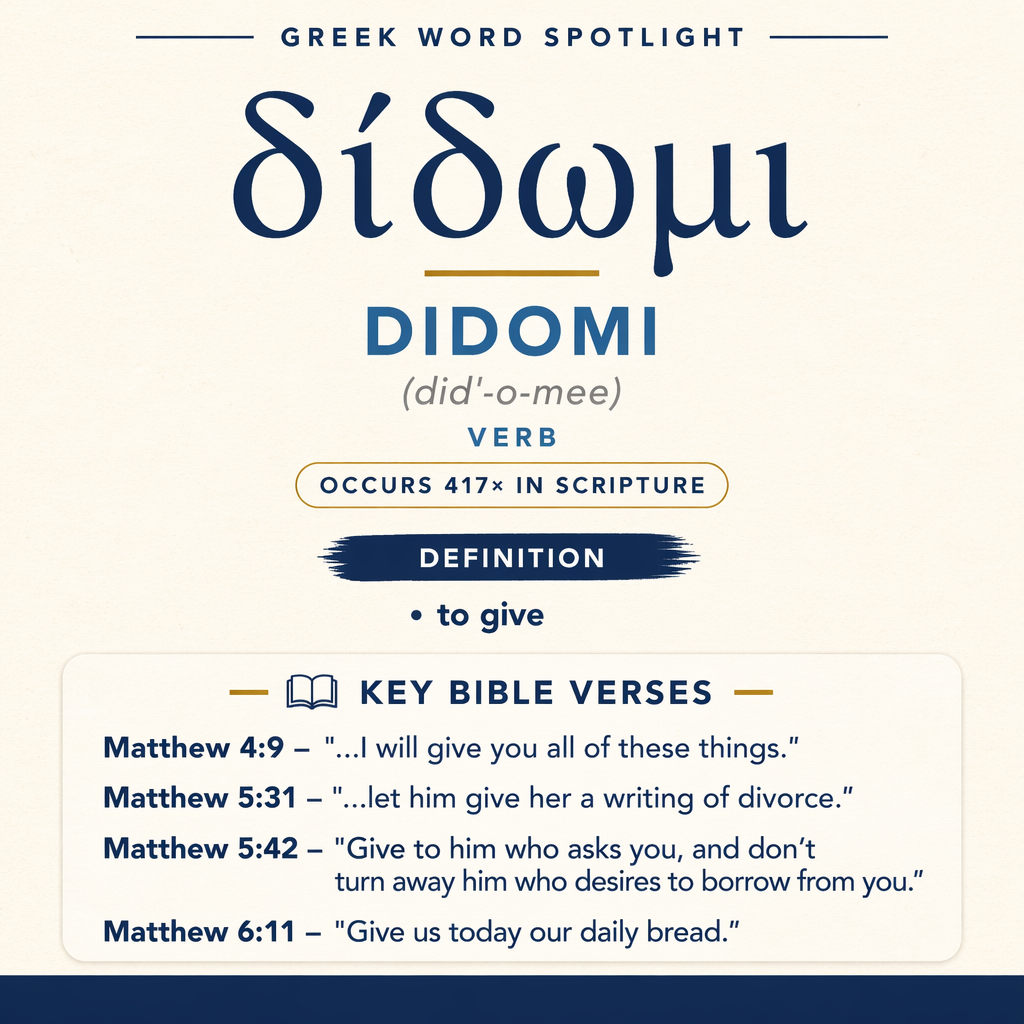
δίδωμι means “to give” and occurs 417 times in Scripture, including Matthew 4:9; 5:42; 6:11; 7:7; and 9:8.
Core Meaning
δίδωμι means “to give.” In Matthew, it describes actions of giving, such as offering “all of these things” (Matthew 4:9).
Learn More →Teaching Commands
Jesus commands giving: “Give to him who asks you” (Matthew 5:42) and “Give us today our daily bread” (Matthew 6:11).
Learn More →Given by God
It is used for what God gives, including “such authority to men” (Matthew 9:8). It also appears in promises like “it will be given you” (Matthew 7:7).
Learn More →δίδωμι expresses the act of giving, appearing widely in the New Testament and in the selected passages across Matthew’s teaching and narrative scenes. In these occurrences it ranges from offers and commands to divine provision, granted authority, and what is “given” in response to asking.
Occurrences
Matthew 4:9 — “He said to him, “I will give you all of these things, if you will fall down and worship me.”
Here δίδωμι is framed as a conditional offer: “I will give you all of these things” is set explicitly as the promised transfer of “these things” in exchange for an act of worship. The verb carries the force of proposed bestowal, but it is tethered to a demand (“if you will fall down and worship me”), so the giving is presented as a bargaining pledge rather than a freely rendered gift.

Matthew 5:31 — ““It was also said, ‘Whoever shall put away his wife, let him give her a writing of divorce,’”
In this citation of what “was also said,” δίδωμι marks an action required in a formal procedure: the husband is to “give her a writing of divorce.” The object is a document, and the giving is directed toward the woman, making the verb serve a legal-social handover that effects or accompanies separation.
Matthew 5:42 — “Give to him who asks you, and don’t turn away him who desires to borrow from you.”
δίδωμι stands as a direct imperative shaping conduct toward “him who asks.” The giving envisioned is interpersonal and responsive: a request meets a commanded act of granting. The parallel prohibition (“don’t turn away him who desires to borrow from you”) places “give” within a posture of open-handedness toward need and petition.
Matthew 6:11 — “Give us today our daily bread.”
This petition addresses God with δίδωμι in the form of a request for provision. The giving sought is concrete (“daily bread”) and immediate (“today”), presenting giving as daily sustenance rather than a one-time transfer. The plural “us” makes it communal, not merely private.
Matthew 7:6 — ““Don’t give that which is holy to the dogs, neither throw your pearls before the pigs, lest perhaps they trample them under their feet, and turn and tear you to pieces.”
δίδωμι is negated: “Don’t give that which is holy to the dogs.” The saying places giving under discernment, not as an indiscriminate act. The second image (“neither throw your pearls before the pigs”) parallels the first: what is valuable or set apart is not to be handed over to those pictured as hostile or incapable of proper regard, because the result may be contempt and violence (“trample… and turn and tear you to pieces”).
Matthew 7:7 — ““Ask, and it will be given you. Seek, and you will find. Knock, and it will be opened for you.”
δίδωμι appears in a promise formula tied to “Ask”: “it will be given you.” The passive phrasing highlights the recipient’s experience—something comes to the asker—without naming the giver in this sentence. Giving is positioned as an answer corresponding to asking, alongside parallel assurances for seeking and knocking.
Matthew 7:11 — “If you then, being evil, know how to give good gifts to your children, how much more will your Father who is in heaven give good things to those who ask him!”
Two uses of δίδωμι sit in an argument from human parenthood to divine generosity. First, ordinary parents “give good gifts” to their children, an everyday pattern of bestowal within a family relationship. Then the comparison intensifies: “how much more will your Father who is in heaven give good things to those who ask him!” Here giving is explicitly anchored in the Father’s readiness to respond to petition, and the objects (“good gifts,” “good things”) define the giving as beneficial in intent and outcome.
Matthew 9:8 — “But when the multitudes saw it, they marveled and glorified God, who had given such authority to men.”
δίδωμι describes God as the one “who had given such authority to men.” The act of giving here is not material provision but the bestowal of “authority,” an enabling capacity recognized by the crowd’s reaction (“they marveled and glorified God”). The perfective sense of “had given” places the giving prior to the moment of observation, with the present scene interpreting what has happened as rooted in God’s grant.
Matthew 10:1 — “He called to himself his twelve disciples, and gave them authority over unclean spirits, to cast them out, and to heal every disease and every sickness.”
In this commissioning scene, δίδωμι narrates Jesus’ action toward “his twelve disciples”: he “gave them authority over unclean spirits.” The giving is functional and purposive, immediately specified by outcomes—“to cast them out” and “to heal every disease and every sickness.” The verb thus marks a transfer of authorized capacity for ministry actions described in the same sentence.
Matthew 10:8 — “Heal the sick, cleanse the lepers, and cast out demons. Freely you received, so freely give.”
δίδωμι appears as an imperative set in moral proportion to prior reception: “Freely you received, so freely give.” Giving is framed as the matching counterpart to receiving, with “freely” shaping the manner—uncoerced, unpriced, and not treated as merchandise. The surrounding commands (heal, cleanse, cast out) situate this giving in the context of mission, where what is done and what is extended to others is not to be constrained by payment.
Matthew 10:19 — “But when they deliver you up, don’t be anxious how or what you will say, for it will be given you in that hour what you will say.”
δίδωμι returns in passive promise: “it will be given you in that hour what you will say.” The object is speech content (“what you will say”), and the time marker “in that hour” emphasizes timely provision under pressure (“when they deliver you up”). Giving here functions as supply for witness in a hostile setting, relieving anxiety by assuring a granted utterance when needed.
Matthew 12:39 — “But he answered them, “An evil and adulterous generation seeks after a sign, but no sign will be given to it but the sign of Jonah the prophet.”
δίδωμι is used to deny a requested grant: “no sign will be given to it.” The generation “seeks after a sign,” but giving is withheld, except for a specified sign (“but the sign of Jonah the prophet”). The verb thus marks not only the act of granting but also the authority to refuse granting; what is “given” is controlled by the one who gives, not by the one who demands.

Sense and Usage
Across these passages δίδωμι consistently denotes giving as an act that places something into another’s possession or experience, but the scenes show that “giving” can take different shapes depending on the giver, the object, and the relational setting. In Matthew 4:9, giving is presented as a promised transfer tied to worship, revealing how an offer to give can function as inducement. In Matthew 5:31 the object is a “writing of divorce,” showing giving in a procedural, formal handover. In Matthew 5:42 and 6:11, giving appears in imperatives and petitions that treat giving as an answer to human need—either the need of the one who asks from another person or the need of a community asking God for bread.
Matthew 7 widens the picture by placing giving under both discernment and promise. The negative command “Don’t give that which is holy to the dogs” (7:6) assumes that some potential acts of giving are inappropriate because the recipient may respond with contempt and harm; giving is not automatically virtuous when it exposes what is “holy” to trampling and violence. Immediately afterward, “Ask, and it will be given you” (7:7) depicts giving as the corresponding divine response to asking, and 7:11 anchors that hope in a comparison: human parents give good gifts; the heavenly Father gives good things to those who ask. In these statements the verb’s sense is stable, but its rhetoric shifts: giving is both a practical human action and a theological assurance about God’s readiness to grant what is good.
Matthew 9:8 and 10:1 locate δίδωμι in the realm of granted authority. The “authority” is treated as something that can be given, and its effects are visible in deeds that prompt amazement and praise (9:8) and in a defined commission “to cast them out, and to heal” (10:1). This use shows that giving can establish capability and authorization, not merely provide objects. Matthew 10:8 then binds giving to the ethics of ministry: those who have received freely must give freely, making giving a fitting outward movement of what has first been received. Matthew 10:19 extends the same pattern into crisis: words for defense or testimony are themselves something that can be given “in that hour.” Finally, Matthew 12:39 shows giving as something that may be withheld; the authority to give includes the authority to deny, and the only “sign” granted is the one specified by Jesus.
Imagery in Matthew
The selected scenes attach δίδωμι to tangible pictures: bread asked for “today,” a document placed into someone’s hands, pearls thrown where they will be trampled, gifts given to children, and authority handed over for casting out spirits and healing. Even when the object is not material—“authority” or “what you will say”—the verb still presents it as a grant received, emphasizing giving as an act that supplies, enables, or authorizes within relationships of request, responsibility, and rule.
Sources: Lexical data from Strong’s Exhaustive Concordance and the Translators Brief Lexicon of Extended Strongs for Greek (STEPBible, CC BY). Occurrence data from the Translators Amalgamated Greek New Testament (STEPBible, CC BY). Scripture quotations from the World English Bible (public domain).