Exploring the Meaning of Manteuomai in Greek
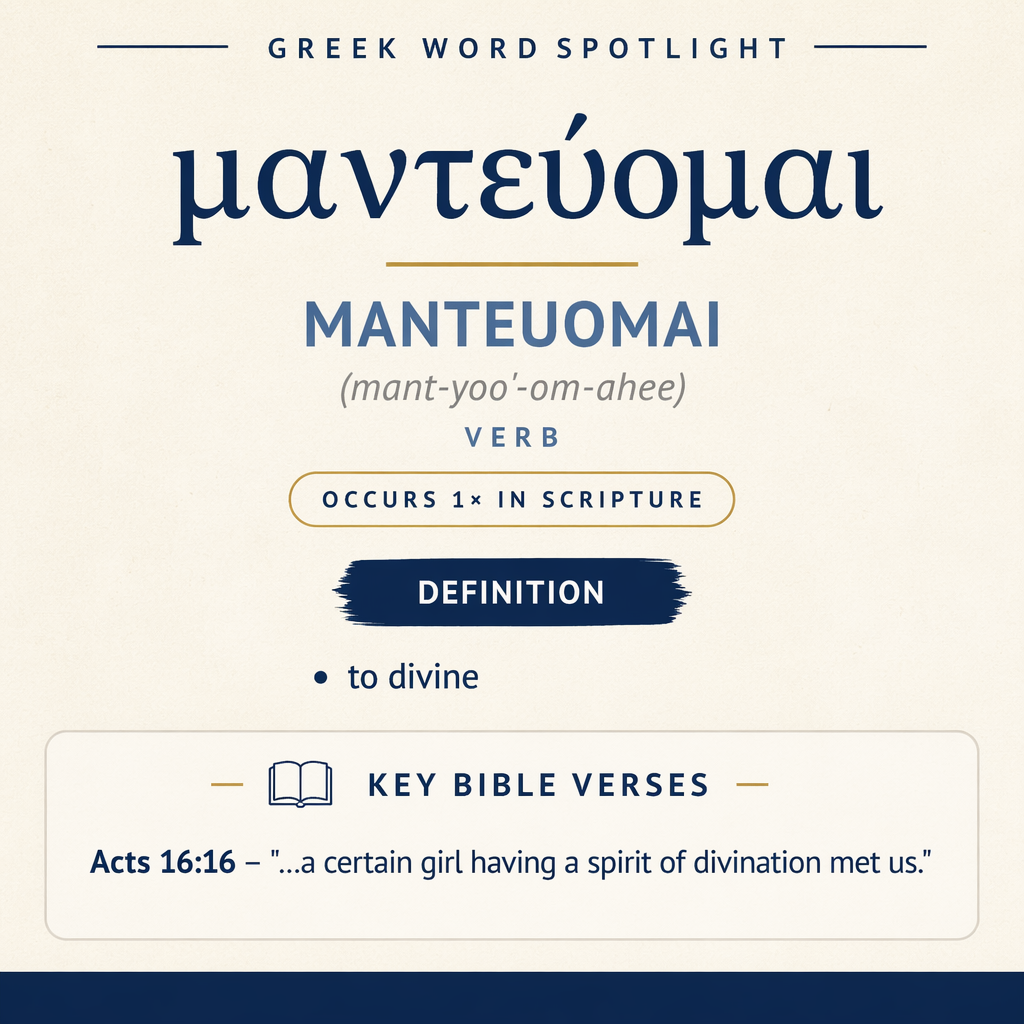
μαντεύομαι means “to divine” and occurs once in Scripture, in Acts 16:16.
Acts 16:16 Context
In Acts 16:16, a certain girl with a spirit of divination met those going to prayer. She brought her masters much gain.
Learn More →μαντεύομαι means “to divine,” and it appears once in the New Testament narrative of Acts, in a scene where a girl’s activity of divination is tied directly to her owners’ profit. The verb is presented in connection with a “spirit of divination” and the economic gain produced through fortune telling.
Root and Related Words
μαντεύομαι is related to the verb mainomai (μαίνομαι), “to rave” (Strong’s G3105). The relationship places the act of divining alongside a verb that describes raving, a connection that frames divination as a kind of driven or frenzied activity rather than a neutral skill.

Occurrences
“As we were going to prayer, a certain girl having a spirit of divination met us, who brought her masters much gain by fortune telling.” (Acts 16:16)
In this episode, μαντεύομαι functions as the verbal idea behind the girl’s “fortune telling,” set within a compact description of how her activity works in the story. First, the setting is communal and religious (“As we were going to prayer”), and the encounter interrupts that movement: the girl “met us.” The narrative then identifies the source associated with her practice—she is described as “having a spirit of divination.” Within the same sentence, the results of her divining are made explicit and measurable: she “brought her masters much gain.” The verb’s significance here is therefore not merely that divination occurs, but that it is presented as an ongoing means of income under the control of “masters,” who benefit from what she produces through divining.
The verse also places the practice in the public, transactional world: her divining is effectively a service that generates “much gain.” By pairing the spiritual description (“spirit of divination”) with the economic outcome (“much gain”), Acts 16:16 depicts divination as an activity with both a claimed spiritual source and a tangible social impact. The girl’s action is not described in isolation; it is bound up with a relationship of exploitation or at least ownership (“her masters”) and with the marketplace value of “fortune telling.” In this scene, μαντεύομαι helps the reader understand why the girl matters to the unfolding narrative: what she does has consequences not only for herself but for those who profit from her practice.
Sense and Usage
The sense “to divine” in Acts 16:16 is expressed through a tightly linked chain: a person, an enabling “spirit,” and an outcome of gain. Divining is not portrayed as a private curiosity but as a repeatable practice that can be monetized—something that can “bring…much gain” to others. The definition “to divine” therefore plays out as an activity that claims access to hidden knowledge for the purpose of telling fortunes, and it is described in a way that highlights dependency: the girl’s practice is associated with a “spirit,” and her labor serves “her masters.”
The verse’s wording also shows how this divining is understood socially. The girl is encountered while others are “going to prayer,” a setting that contrasts with the commercial character of fortune telling. Without needing further detail, the sentence presents divination as a recognized practice (“fortune telling”) that can attract customers and produce steady profit, so much so that it is worth mentioning as “much gain.” In that light, μαντεύομαι is not treated as a momentary prediction but as a defining feature of the girl’s role in the story—an activity that establishes her identity (“a certain girl having a spirit of divination”) and her function (“brought her masters much gain”).
Because the only explicit depiction of μαντεύομαι is tied to “fortune telling,” the word’s usage here carries a practical, public sense: divining is an act performed in the presence of others, encountered on the way, and significant enough to shape relationships of power and money. The verb’s contribution is thus to name the act that links the spiritual claim (“spirit of divination”) to the commercial benefit (“gain”).
Imagery
The imagery attached to μαντεύομαι in Acts 16:16 is grounded in a street-level meeting—an unexpected encounter “going to prayer”—where divining appears not in a temple or classroom but in ordinary movement through the city. The verse paints divination as something embodied by a particular person and carried into public spaces, with its presence made visible through the economic ripple it creates for “her masters.”
Sources: Lexical data from Strong’s Exhaustive Concordance and the Translators Brief Lexicon of Extended Strongs for Greek (STEPBible, CC BY). Occurrence data from the Translators Amalgamated Greek New Testament (STEPBible, CC BY). Scripture quotations from the World English Bible (public domain).