
Exploring the Meaning of Mainomai in Greek
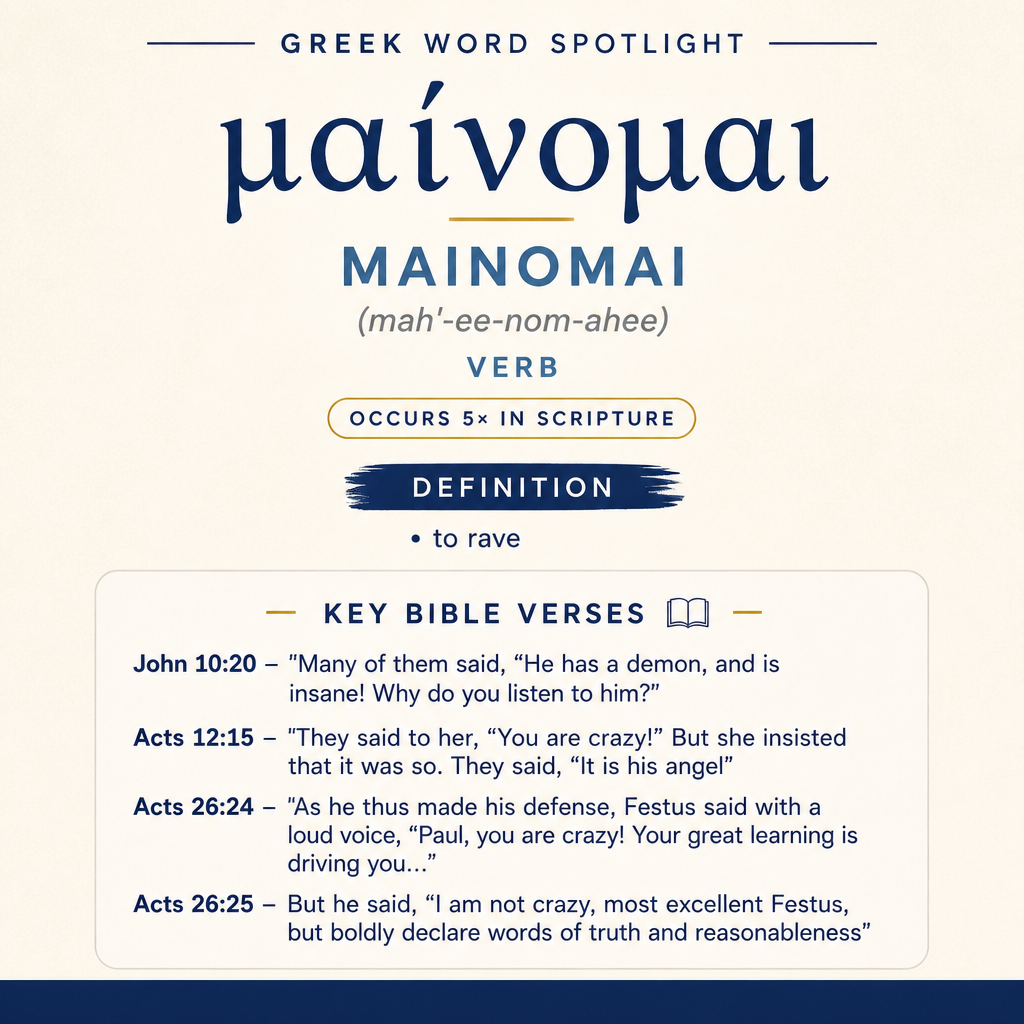
μαίνομαι means “to rave” and appears five times in Scripture (John 10:20; Acts 12:15; Acts 26:24–25; 1 Corinthians 14:23).
Core Meaning
μαίνομαι is defined as “to rave.” In its occurrences, it is used as an accusation of being crazy or insane.
Learn More →Where It Appears
It occurs five times in Scripture. The references are John 10:20; Acts 12:15; Acts 26:24–25; and 1 Corinthians 14:23.
Learn More →Scene Contexts
In John 10:20 and Acts 12:15, speakers dismiss someone as insane or crazy. In Acts 26:24–25, Festus calls Paul crazy and Paul denies it; in 1 Corinthians 14:23 it is linked to outsiders’ perception of disorderly speech.
Learn More →Mainomai means “to rave.” In the New Testament it appears in charged moments where speakers label another person (or a whole gathering) as mentally deranged, using the accusation to dismiss what is being said.
Occurrences
John 10:20 — “Many of them said, “He has a demon, and is insane! Why do you listen to him?””
Here the word functions as a public verdict meant to end a conversation. The crowd’s claim joins two assertions—“He has a demon” and “is insane!”—and then draws a practical conclusion: “Why do you listen to him?” Mainomai serves as the language of disqualification. It is not offered as a clinical observation but as a rationale for refusing attention, turning a dispute about Jesus’s words into a judgment about his sanity.
Acts 12:15 — “They said to her, “You are crazy!” But she insisted that it was so. They said, “It is his angel.””
In this scene, mainomai marks disbelief expressed as ridicule. The community responds to the woman’s report by labeling her “crazy!”—a way of explaining away her insistence without engaging the content of what she claims. The narrative contrast is sharp: “But she insisted that it was so.” The accusation becomes a tool for social correction, pressing her to doubt herself. Their alternative explanation—“It is his angel.”—shows how quickly the charge of craziness can coexist with another attempt to account for the report; the word functions as an immediate, dismissive reaction rather than a settled evaluation.
Acts 26:24 — “As he thus made his defense, Festus said with a loud voice, “Paul, you are crazy! Your great learning is driving you insane!””
Here mainomai is spoken by an authority figure “with a loud voice,” turning the charge into a public interruption. Festus frames Paul’s condition as a result of intellectual excess: “Your great learning is driving you insane!” The word is used polemically, recasting Paul’s “defense” not as reasoned testimony but as uncontrolled mental disturbance. The volume (“with a loud voice”) underlines the rhetorical function: the accusation aims to seize the room’s attention and reframe the hearing around Paul’s alleged instability.
Acts 26:25 — “But he said, “I am not crazy, most excellent Festus, but boldly declare words of truth and reasonableness.”
This is the only occurrence where the word is explicitly denied by the person accused. Paul’s reply keeps the charge in view (“I am not crazy”) while countering it with a contrasting description of his speech: “words of truth and reasonableness.” Mainomai thus becomes a contested label in a forensic setting—one side asserting mental ravings, the other claiming sober, rational declaration. The direct address “most excellent Festus” also shows Paul answering the insult without mirroring its tone; he treats the accusation as something to be rebutted with the character of his message.
1 Corinthians 14:23 — “If therefore the whole assembly is assembled together and all speak with other languages, and unlearned or unbelieving people come in, won’t they say that you are crazy?”
In this conditional scenario, mainomai is anticipated as an outsider’s verdict on a chaotic-sounding gathering. The setting is “the whole assembly… assembled together” with “all speak with other languages,” and the observers are “unlearned or unbelieving people.” The word captures how such visitors might interpret the experience: not as meaningful communication but as a collective episode of ravings. Here the accusation is not tied to a single person’s message; it is the impression created by the group’s simultaneous speech. Mainomai conveys the social effect of unintelligibility—how easily incomprehensible speech can be judged as madness by those who lack context.

Sense and Usage
Across these passages, mainomai operates as a charged social diagnosis: it labels speech or behavior as the kind that belongs to ravings rather than to coherent reasoning. The word consistently appears in direct speech, spoken as a verdict (“You are crazy!”) or as a predicted verdict (“won’t they say that you are crazy?”). This pattern places the emphasis on how the label functions in argument and community life: it is a way to control what is taken seriously.
In John 10:20 the accusation is aimed at Jesus and is immediately leveraged to discourage listening. The dynamic is similar in Acts 26:24, where Festus interrupts Paul’s defense and attributes his condition to “great learning.” In both, the word is wielded to undermine an audience’s receptivity: if someone is “insane,” the hearer is implied to be foolish for giving attention. The charge is a form of gatekeeping—deciding whose speech counts as credible.
Acts 12:15 shows mainomai in a more domestic register. The speakers are not opponents but fellow believers reacting to unexpected news. Yet the effect is the same: the word invalidates testimony by shifting the problem from the claim (“it was so”) to the claimant (“You are crazy!”). The quick move to an alternative explanation (“It is his angel.”) reveals how the accusation can function as an initial defense mechanism against surprise; it protects the group from having to revise expectations by treating the messenger as unreliable.
Acts 26:25 sharpens the semantic contours by placing mainomai alongside its opposite in the same sentence. Paul does not merely deny the label; he sets “not crazy” against “words of truth and reasonableness.” The contrast suggests that, in this discourse setting, mainomai is the charge that one’s speech is the product of disordered raving rather than rational declaration. The dispute is not about whether Paul is animated or passionate, but whether his speaking belongs to the category of ravings that should be dismissed.
In 1 Corinthians 14:23 the word frames the perception of outsiders who encounter uncontrolled, simultaneous speech. The scenario implies that the label can be triggered not only by the content of what is said but by the hearer’s inability to discern meaning. Mainomai therefore marks a breakdown in communicative intelligibility as experienced by observers: when people cannot understand what is happening, “crazy” becomes a plausible social interpretation. This use does not depend on an actual assessment of internal mental state; it reflects the outsider’s inference based on what is heard and seen.
Taken together, these occurrences show mainomai as a relational term—one that frequently appears at the boundary between speaker and audience. It is invoked to sever trust (“Why do you listen to him?”), to deny testimony (“You are crazy!”), to publicly discredit an argument (“with a loud voice”), or to warn how behavior will be read by newcomers (“won’t they say…”). The word’s force lies in its ability to convert contested speech into a presumed incapacity, moving the discussion from the merits of the message to the alleged condition of the messenger—or, in the Corinthian scenario, to the supposed condition of the whole group.
Imagery
The passages consistently picture mainomai as a shouted or spoken label, the kind of word that can fill a room and redirect its judgment. Whether in a crowd challenging listeners (John 10:20), friends pushing back against an unexpected report (Acts 12:15), a governor interrupting a defense (Acts 26:24), a defendant responding with calm counter-claims (Acts 26:25), or outsiders reacting to a confusing assembly (1 Corinthians 14:23), the imagery is of accusation and perception: “crazy” is the quick verdict that turns speech into “raving” in the ears of those who hear it.
Sources: Lexical data from Strong’s Exhaustive Concordance and the Translators Brief Lexicon of Extended Strongs for Greek (STEPBible, CC BY). Occurrence data from the Translators Amalgamated Greek New Testament (STEPBible, CC BY). Scripture quotations from the World English Bible (public domain).




