Exploring the Meaning of Mallon in Greek
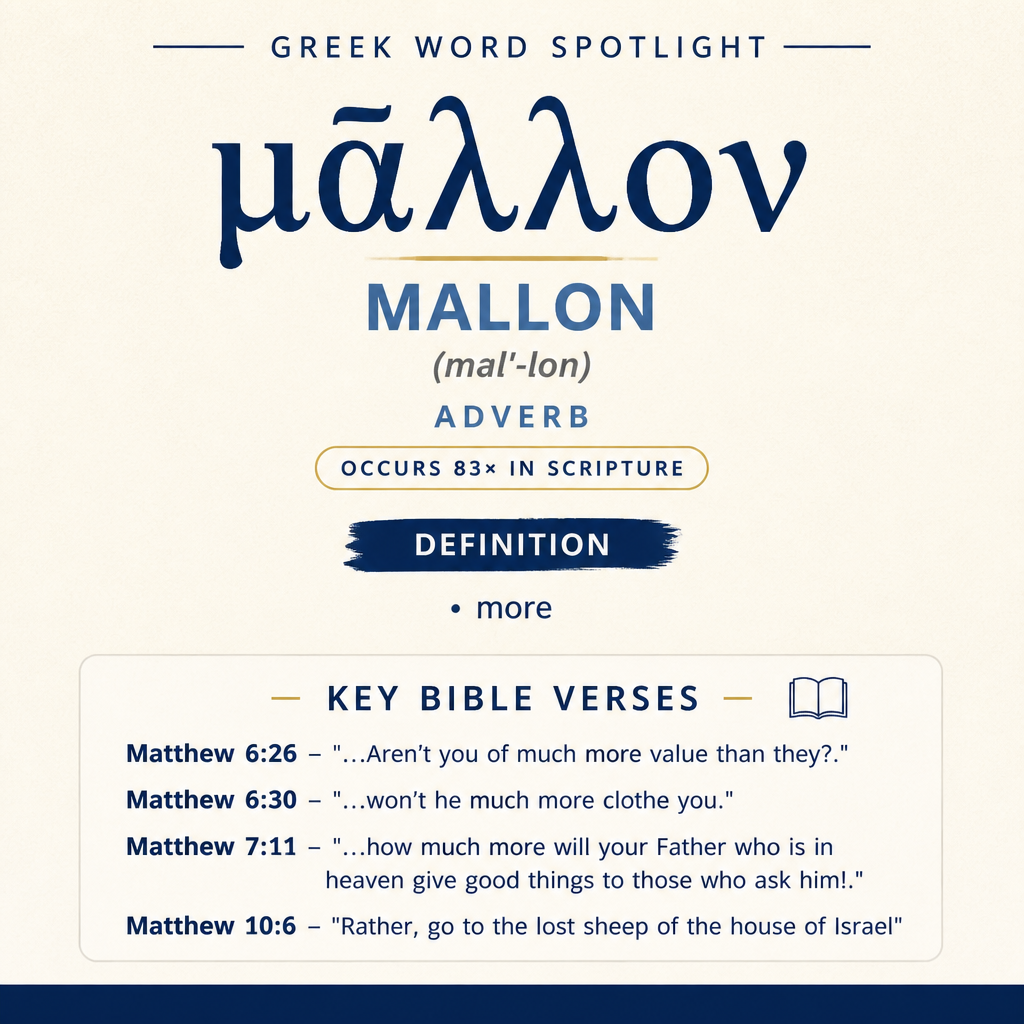
μᾶλλον (Mallon) means “more” and occurs 83 times in Scripture, including in Matthew 6:26; 6:30; 7:11; 10:6; 10:25; 10:28; 18:13; and 25:9.
Core Meaning
μᾶλλον means “more.” It functions in comparisons and contrasts in the listed passages.
Learn More →Scripture Footprint
It occurs 83 times in Scripture. Examples include multiple uses across Matthew 6, 7, 10, 18, and 25.
Learn More →Matthew Examples
In Matthew 10:6 and 25:9 it appears with “rather.” In Matthew 18:13 it marks rejoicing “more than” over the ninety-nine.
Learn More →μᾶλλον expresses an increase on a scale—“more”—and it regularly marks a comparison or preferred alternative in the Gospel scenes where it appears. In the verses below it sharpens contrasts (less/more, worse/more, hidden/more widely known) and intensifies arguments from the lesser to the greater.
Occurrences
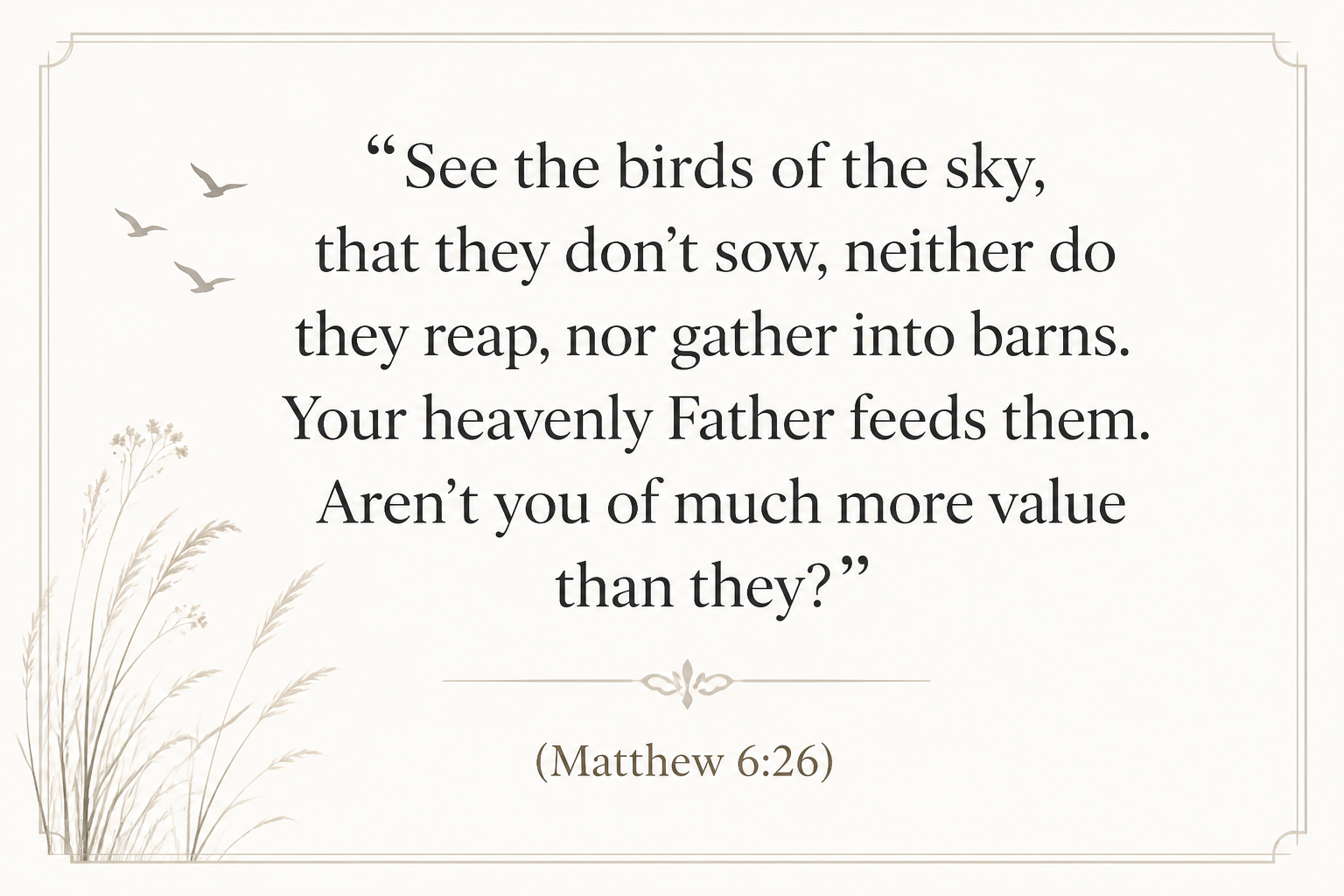
“See the birds of the sky, that they don’t sow, neither do they reap, nor gather into barns. Your heavenly Father feeds them. Aren’t you of much more value than they?” (Matthew 6:26)
Here μᾶλλον pushes the comparison beyond mere difference and onto a stronger scale of worth. The logic depends on a contrast: birds neither farm nor store, yet God feeds them; the question turns on whether the hearers stand as “much more” valuable, raising the expected conclusion that their needs will be met as well.
“But if God so clothes the grass of the field, which today exists, and tomorrow is thrown into the oven, won’t he much more clothe you, you of little faith?” (Matthew 6:30)
μᾶλλον heightens an argument from temporary to enduring concern. Grass is pictured as short-lived and disposable (“tomorrow is thrown into the oven”), yet it receives God’s clothing; “much more” intensifies the inference that God’s care extends even more strongly to the addressed “you,” while the final address (“you of little faith”) frames the comparison as a challenge to anxiety.
“If you then, being evil, know how to give good gifts to your children, how much more will your Father who is in heaven give good things to those who ask him!” (Matthew 7:11)
μᾶλλον strengthens a “how much more” reasoning from imperfect human parents to the heavenly Father. The verse sets up an unequal comparison: “being evil” yet still giving “good gifts” within a family relationship; μᾶλλον then drives the expectation upward—God’s giving is presented as surpassing the human pattern when people ask.
“Rather, go to the lost sheep of the house of Israel.” (Matthew 10:6)
μᾶλλον here signals preference and redirection: not an increase of quantity, but a chosen alternative course. The instruction narrows the mission focus by urging a “rather” movement toward a specific group (“the lost sheep of the house of Israel”), presenting that destination as the priority over other possibilities.
“It is enough for the disciple that he be like his teacher, and the servant like his lord. If they have called the master of the house Beelzebul, how much more those of his household!” (Matthew 10:25)
μᾶλλον intensifies the expected extension of hostility from leader to followers. The proverb-like setup links disciple to teacher and servant to lord, then argues that if insult reaches “the master of the house,” it will fall “how much more” on “those of his household,” portraying increased likelihood or intensity of mistreatment for the subordinate group.
“Don’t be afraid of those who kill the body, but are not able to kill the soul. Rather, fear him who is able to destroy both soul and body in Gehenna.” (Matthew 10:28)
μᾶλλον again functions as a decisive “rather,” shifting fear from one object to another on the basis of capability. The contrast is explicit: some can kill “the body” but cannot reach “the soul”; μᾶλλον marks the stronger, more appropriate fear toward the one able to destroy “both soul and body,” setting a hierarchy of threats.
“If he finds it, most certainly I tell you, he rejoices over it more than over the ninety-nine which have not gone astray.” (Matthew 18:13)
μᾶλλον here measures joy comparatively within a story of recovery. The rejoicing is not merely equal but “more than” the joy over “the ninety-nine” that stayed; μᾶλλον places the recovered one at the peak of celebration, emphasizing the heightened response when what was lost is found.
“But the wise answered, saying, ‘What if there isn’t enough for us and you? You go rather to those who sell, and buy for yourselves.’” (Matthew 25:9)
μᾶλλον marks a practical alternative in a moment of shortage. The wise foresee insufficiency (“What if there isn’t enough for us and you?”) and therefore direct the others to a different action: “go rather… and buy,” with μᾶλλον presenting that option as the appropriate response under the constraint.
“So when Pilate saw that nothing was being gained, but rather that a disturbance was starting, he took water, and washed his hands before the multitude, saying, “I am innocent of the blood of this righteous person. You see to it.”” (Matthew 27:24)
μᾶλλον contrasts outcomes as the situation deteriorates. Pilate observes a failed attempt at progress (“nothing was being gained”) and sets against it the opposite trend: “rather that a disturbance was starting.” μᾶλλον thus frames the pivot from hoped-for resolution to escalating disorder, leading into his public handwashing and declaration.
“and had suffered many things by many physicians, and had spent all that she had, and was no better, but rather grew worse,” (Mark 5:26)
μᾶλλον draws a stark contrast between expectation and result in the woman’s long suffering. After “many physicians” and total expense, the anticipated improvement fails (“was no better”), and μᾶλλον sets in its place the grim reversal: she “rather grew worse,” intensifying the sense of decline after exhaustive effort.
“He commanded them that they should tell no one, but the more he commanded them, so much the more widely they proclaimed it.” (Mark 7:36)
μᾶλλον here describes an ironic escalation: increased prohibition produces increased publicity. The verse balances two rising measures—“the more he commanded them” and “so much the more widely they proclaimed it”—with μᾶλλον marking the upward movement in proclamation as a response to repeated commands to silence.
“Whoever will cause one of these little ones who believe in me to stumble, it would be better for him if he were thrown into the sea with a millstone hung around his neck.” (Mark 9:42)
μᾶλλον presents “better” as a grim comparative, weighing two dreadful outcomes. Causing a believing “little one” to stumble is so serious that an extreme fate—being thrown into the sea with a millstone—stands as the preferable option; μᾶλλον thus intensifies the warning by defining a severe alternative as “better” than the offense.

Sense and Usage
Across these passages μᾶλλον works in two main ways. First, it strengthens comparisons on a scale of degree: “much more” in arguments that move from a lesser case to a greater one (God feeding birds versus valuing people in Matthew 6:26; clothing grass versus clothing people in Matthew 6:30; flawed parents giving gifts versus the heavenly Father giving good things in Matthew 7:11). In these scenes the adverb is not decorative; it is the hinge of the reasoning, pressing the listener to accept the stronger conclusion implied by the weaker premise.
Second, μᾶλλον marks a preferred alternative—often translated “rather”—where two paths are set side by side and one is urged as the proper choice. That sense appears in mission direction (Matthew 10:6), in reordering fear (Matthew 10:28), in pragmatic instruction under scarcity (Matthew 25:9), and in Pilate’s observation that events are moving toward unrest instead of resolution (Matthew 27:24). Even when the choice is not a command, μᾶλλον still presents the contrast as decisive: one situation is displaced by another as the more fitting description.
A third pattern emerges where μᾶλλον measures outcomes that run counter to expectation: the sufferer “rather grew worse” after many attempts at healing (Mark 5:26), and the crowd “the more widely… proclaimed it” the more they were commanded not to (Mark 7:36). In such cases μᾶλλον gives narrative texture by tracing an increase—whether in misery or publicity—so that the reader feels the direction of the movement within the story.
Imagery
Several verses attach μᾶλλον to vivid pictures that make “more” tangible: birds fed without barns (Matthew 6:26), grass clothed today and burned tomorrow (Matthew 6:30), a household sharing in the master’s reproach (Matthew 10:25), joy that rises higher over a found wanderer than over ninety-nine who stayed (Matthew 18:13), a disturbance swelling in a crowd (Matthew 27:24), an illness worsening despite many physicians (Mark 5:26), a message spreading wider under a command to silence (Mark 7:36), and a millstone dragging down into the sea as a “better” alternative than causing a vulnerable believer to stumble (Mark 9:42). In each case μᾶλλον turns the scene into a comparison that the reader can weigh and feel.
Sources: Lexical data from Strong’s Exhaustive Concordance and the Translators Brief Lexicon of Extended Strongs for Greek (STEPBible, CC BY). Occurrence data from the Translators Amalgamated Greek New Testament (STEPBible, CC BY). Scripture quotations from the World English Bible (public domain).