Exploring the Meaning of Malista in Greek
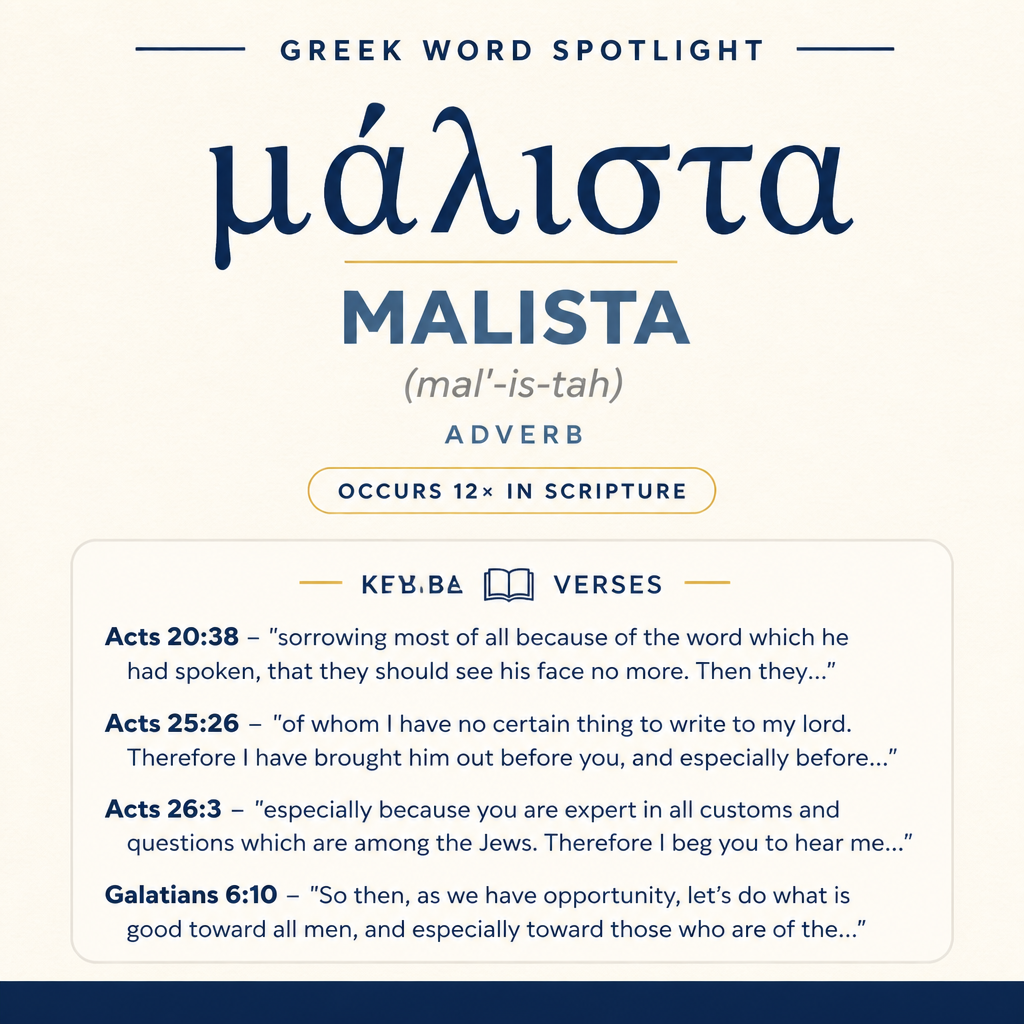
μάλιστα means “most of all” or “especially” and appears 12 times in Scripture, including Acts, Galatians, Philippians, and 1 Timothy.
Core Meaning
μάλιστα strengthens emphasis, expressed in English as “most of all” or “especially.”
Learn More →Acts Examples
In Acts 20:38 it marks deepest grief: “sorrowing most of all.” In Acts 25:26 and 26:3 it highlights special focus “especially before you” and “especially because you are expert.”
Learn More →Pauline Emphasis
Paul uses μάλιστα to prioritize care and honor: “especially toward those… of the household,” “especially those… of Caesar’s household,” and “especially his own household.”
Learn More →μάλιστα (Malista) is an adverb that marks a superlative focus within a larger statement, highlighting what stands out most or what is singled out in particular. It appears across narrative (Acts) and letter material (Pauline letters, Pastoral Epistles, Catholic Epistle), repeatedly sharpening attention to a chief reason, a primary group, or a specially selected item.
Occurrences
“sorrowing most of all because of the word which he had spoken, that they should see his face no more. Then they accompanied him to the ship.” (Acts 20:38)
Here μάλιστα intensifies grief by locating its peak cause: their sorrow has many facets, but it reaches its strongest point “because of the word” that they will “see his face no more.” The adverb functions as an emotional highlighter—within a scene of farewell, it names what hurts most in that moment, not merely that they are sad.

“of whom I have no certain thing to write to my lord. Therefore I have brought him out before you, and especially before you, King Agrippa, that, after examination, I may have something to write.” (Acts 25:26)
μάλιστα narrows the intended audience inside a wider address. Festus brings the man out “before you” (plural), but then tightens the focus “especially before you, King Agrippa,” because Agrippa’s examination is expected to yield “something to write.” The adverb marks Agrippa as the most relevant hearer for the stated purpose.
“especially because you are expert in all customs and questions which are among the Jews. Therefore I beg you to hear me patiently.” (Acts 26:3)
In Paul’s appeal, μάλιστα introduces the principal ground for his request. The patience he asks is linked to Agrippa’s competence: Paul begs to be heard “especially because” Agrippa is “expert” in the matters at issue. The adverb does not add new content; it ranks reasons, presenting this one as foremost.
“So then, as we have opportunity, let’s do what is good toward all men, and especially toward those who are of the household of the faith.” (Galatians 6:10)
μάλιστα structures a two-tier scope of beneficence. The instruction is broad—“toward all men”—yet it gives a prioritized concentration “especially toward those who are of the household of the faith.” The adverb does not cancel the universal “all”; it establishes a particular center of attention within it.
“All the saints greet you, especially those who are of Caesar’s household.” (Philippians 4:22)
In a closing greeting, μάλιστα singles out a subset within “All the saints.” The greeting is inclusive, but particular interest is drawn to “those who are of Caesar’s household,” who are presented as an especially noteworthy group among the greeters. The adverb creates prominence without excluding the rest.
“For to this end we both labor and suffer reproach, because we have set our trust in the living God, who is the Savior of all men, especially of those who believe.” (1 Timothy 4:10)
μάλιστα works inside a doctrinal statement to draw a specific class into special view. The sentence affirms God as “the Savior of all men,” then adds “especially of those who believe.” The adverb places “those who believe” in a highlighted relation to the claim just made, presenting them as the group brought most pointedly into focus by the assertion.
“But if anyone doesn’t provide for his own, and especially his own household, he has denied the faith, and is worse than an unbeliever.” (1 Timothy 5:8)
μάλιστα sharpens ethical obligation by identifying the closest circle where neglect is most culpable. “His own” is broad; “especially his own household” draws the moral spotlight to the immediate domestic sphere. The adverb makes the duty concrete and prioritized: within one’s own people, the household carries special weight.
“Let the elders who rule well be counted worthy of double honor, especially those who labor in the word and in teaching.” (1 Timothy 5:17)
μάλιστα differentiates within a recognized group. The class “elders who rule well” is to receive “double honor,” and within that class special emphasis is placed on “those who labor in the word and in teaching.” The adverb directs esteem with added specificity, identifying a subset whose work warrants particular recognition in the stated framework.
“Bring the cloak that I left at Troas with Carpus when you come, and the books, especially the parchments.” (2 Timothy 4:13)
μάλιστα moves from general to most urgent within a list of requested items. “The books” are requested, but “especially the parchments” are set apart as the items of special concern. The adverb helps the reader hear the practical emphasis of the request: among the reading materials, one category is most insisted upon.
“For there are also many unruly men, vain talkers and deceivers, especially those of the circumcision,” (Titus 1:10)
μάλιστα identifies a particularly prominent segment among the troubling figures described. The verse names “many” who are “unruly,” “vain talkers,” and “deceivers,” and then brings “those of the circumcision” into special view as an especially marked group within that broader problem set. The adverb focuses attention for the ensuing concern implied by the description.
“no longer as a slave, but more than a slave, a beloved brother, especially to me, but how much rather to you, both in the flesh and in the Lord.” (Philemon 1:16)
μάλιστα marks personal intensity in a relational redefinition. Onesimus is “a beloved brother,” and that brotherhood is “especially to me” (Paul), while also urged as even more fitting “to you” (Philemon) in two spheres—“in the flesh and in the Lord.” The adverb highlights Paul’s particular affection while leaving room for an even fuller reception by the letter’s recipient.
“but chiefly those who walk after the flesh in the lust of defilement and despise authority. Daring, self-willed, they are not afraid to speak evil of dignitaries;” (2 Peter 2:10)
μάλιστα here (rendered “chiefly”) selects the primary targets within a larger judgment context. The description concentrates on “those who walk after the flesh in the lust of defilement and despise authority,” then expands with character traits—“Daring, self-willed”—and behavior—“not afraid to speak evil of dignitaries.” The adverb functions as a pointer to the chief class in view, defining the center of the warning by naming the foremost kind of person addressed.

Sense and Usage
Across these passages, μάλιστα consistently performs a focusing role: it signals that what follows is the most salient element within a broader set—whether reasons, audiences, groups, obligations, honors, items, or persons. Its contribution is not to add a new topic but to rank or weight what is already present, so the reader knows where the main emphasis lies.
Several occurrences show μάλιστα working with inclusive language. In Galatians 6:10, the call to do good reaches “all men,” yet a particular circle is brought into the foreground. In Philippians 4:22, “All the saints” greet, but one subset is placed under a brighter light. In 1 Timothy 4:10, “all men” is paired with a highlighted group, and μάλιστα makes that pairing rhetorically pointed: it indicates that, within the breadth of the statement, a specific group is being specially marked for attention.
Other uses revolve around personal or situational emphasis. Acts 20:38 uses μάλιστα to locate the sharpest edge of sorrow in a farewell scene; the narrative does not merely report emotion but specifies what intensifies it. Acts 25:26 and 26:3 use μάλιστα to refine courtroom dynamics: one participant is singled out as especially relevant, and one reason is placed in the foremost position. In Philemon 1:16, μάλιστα highlights a relational claim in a persuasive appeal, showing how a general reclassification (“beloved brother”) has a particularly strong personal application (“especially to me”) while inviting an even stronger reception by the addressee.
A further pattern is practical prioritization. In 1 Timothy 5:8, μάλιστα narrows responsibility toward the household as the most immediate claim within “his own.” In 1 Timothy 5:17, it narrows honor toward those who labor in teaching within the group of elders who rule well. In 2 Timothy 4:13, it separates out “the parchments” as the especially desired subset among requested materials. In Titus 1:10 and 2 Peter 2:10, μάλιστα has a polemical edge: it concentrates concern on a chief segment within a wider category of wrongdoers, making the warning more pointed by identifying who stands out most in the problem.
Imagery and Emphasis
The repeated effect of μάλιστα in these texts is a kind of verbal spotlight. It can fall on a breaking heart at a ship’s side (Acts 20:38), a key hearer in a legal examination (Acts 25:26; 26:3), a prioritized circle within broader goodwill (Galatians 6:10), a notable cluster of greeters (Philippians 4:22), or a particularly weighty moral and communal responsibility (1 Timothy 5:8; 5:17). Even in the most ordinary setting—asking for a cloak and books—μάλιστα gives the sentence a clear center of gravity by marking what the speaker most wants remembered and done (2 Timothy 4:13).
Sources: Lexical data from Strong’s Exhaustive Concordance and the Translators Brief Lexicon of Extended Strongs for Greek (STEPBible, CC BY). Occurrence data from the Translators Amalgamated Greek New Testament (STEPBible, CC BY). Scripture quotations from the World English Bible (public domain).