Exploring the Meaning of Malchos in Greek
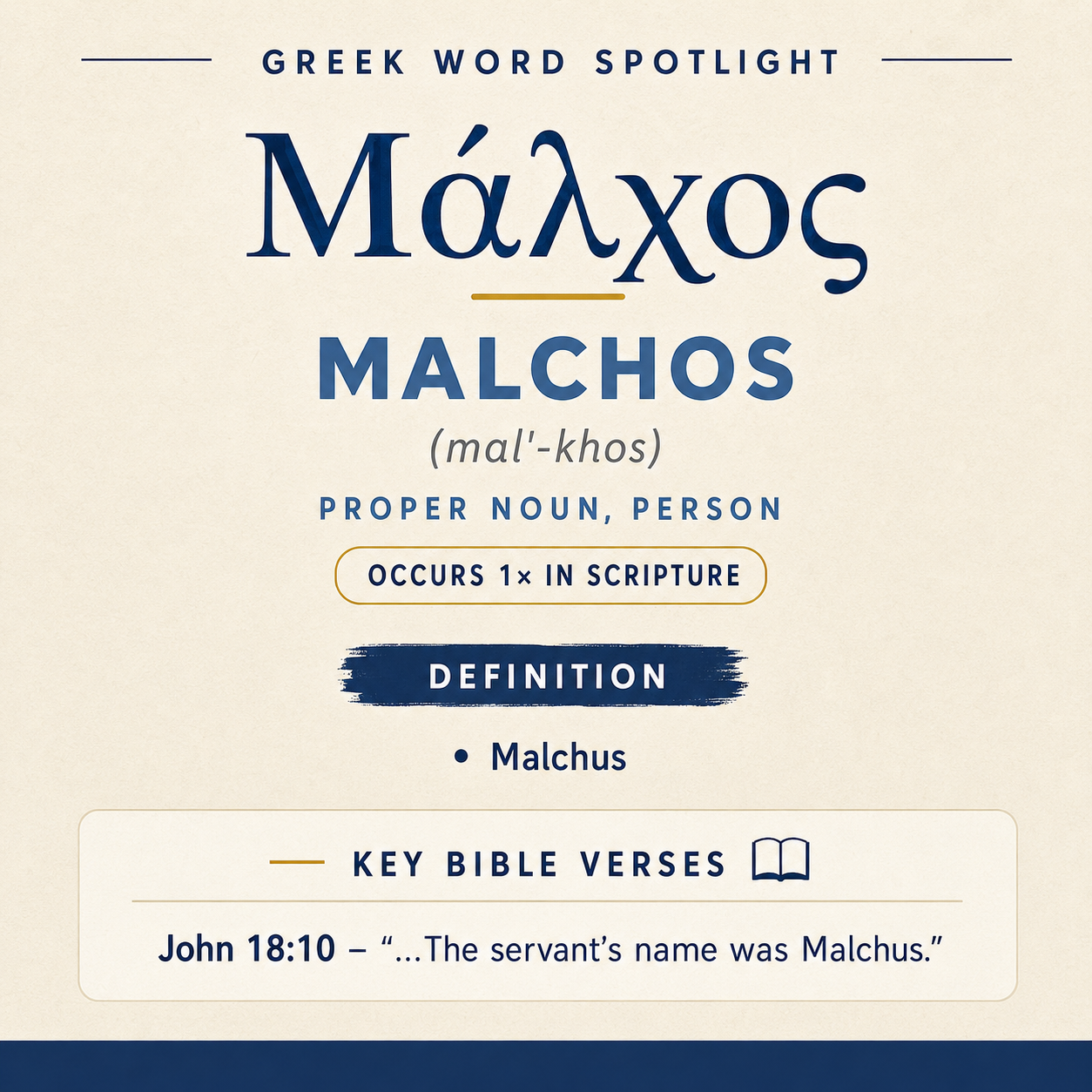
Μάλχος means Malchus and appears in John 18:10, where the high priest’s servant is struck and his right ear is cut off.
Narrative Context
In John 18:10, Malchus is the high priest’s servant whose right ear is cut off when Simon Peter strikes him.
Learn More →Malchos is the personal name “Malchus,” appearing once in the New Testament. It occurs in the passion narrative, where the name identifies the specific servant of the high priest who is injured when Simon Peter uses a sword.
Occurrences
“Simon Peter therefore, having a sword, drew it, struck the high priest’s servant, and cut off his right ear. The servant’s name was Malchus.” (John 18:10)
Here Malchos functions as a precise identifier within a fast-moving sequence of actions. The verse first sets the actor (“Simon Peter”) and his weapon (“a sword”), then narrates two linked acts of violence (“struck the high priest’s servant” and “cut off his right ear”). Only after the injury is described does the text supply the servant’s name: “Malchus.” The placement of the name at the end does not add new action; it anchors the event to a particular individual rather than leaving him as an anonymous “servant.”
The title “the high priest’s servant” locates Malchus socially and institutionally within the high priest’s household. The naming therefore does more than satisfy curiosity: it turns a generic role into a known person within the narrative’s world. In the immediate scene, this makes the wound concrete and particular—an injury inflicted on someone with a personal name—while keeping his identity tied to the high priest through the descriptive phrase that precedes it. The sentence thus holds together three elements: the aggressor (Simon Peter), the victim’s status (the high priest’s servant), and the victim’s personal identity (Malchus).
The detail “his right ear” heightens the specificity of what happened, and the name “Malchus” heightens the specificity of who it happened to. Together they make the incident report-like in its precision: a named person suffers a described injury in a scene of armed confrontation. By giving the servant a name, the verse invites the reader to register the cost of the moment not as an abstract clash but as harm done to a definite member of the opposing party’s household.

Sense and Usage
As a proper name, Malchos in John 18:10 does not describe a trait, office, or action; it identifies. The definition “Malchus” is carried entirely by its referential force: the word points to the individual called “the high priest’s servant” in that specific narrated moment. The name’s function is therefore relational and contextual. It is relational because the man is introduced through his connection to the high priest (“the high priest’s servant”), and contextual because the naming is bound to a particular event—being struck and having the right ear cut off.
This use of a personal name serves several narrative purposes evident from the single verse. First, it distinguishes the servant from other possible servants. Without the name, the reader would be left with an unidentified member of a household; with the name, the text singles him out as the one who was wounded. Second, it stabilizes the memory of the episode. The event becomes something that can be recounted with a “who” as well as a “what”: a specific act was done to Malchus. Third, it intensifies the concreteness of the scene. In a story that includes titles and roles (disciple, high priest, servant), the name collapses distance: the injured figure is not only a functionary but also an individual.
The verse also shows how the name operates alongside role language. Malchos is not introduced in isolation; it is appended after “The servant’s name was Malchus.” The narrative first frames him by role, then adds personal identity. This order keeps the servant’s institutional connection in view even as he is individualized. In other words, the name does not detach him from the high priest; it attaches a personal identity to someone already defined by service to the high priest. The name therefore works within a layered identification: status first, name second.
Because the naming occurs after the injury is described, Malchos is linked in the reader’s mind to the consequence of Peter’s action. The name becomes the label for the harmed party in this encounter. It does not explain motives or outcomes within the verse; it marks the human subject of the wound. The text’s focus remains on the immediacy of the act (“drew it, struck… cut off”), yet the final clause slows the pace to identify the injured man. That slowing effect gives the act moral and narrative weight by refusing to let the injured person remain faceless.
In the economy of the sentence, Malchos is the final piece of information, functioning almost like a caption to what precedes: the high priest’s servant who lost his right ear has a known name. The definition “Malchus” is thus realized not through description but through the act of naming itself. The word’s contribution is to make the narrative’s particulars more exact: an exact person, connected to the high priest, wounded in a particular way, in a particular moment of conflict.
Imagery and Focus
John 18:10 pairs the sharp physical imagery of a sword strike with the quiet, matter-of-fact clarity of a name. The verse depicts a close-range act—drawing a sword and cutting off “his right ear”—and then fixes the scene on a single wounded individual: “The servant’s name was Malchus.” The name functions like a spotlight on the victim in the middle of turmoil, turning what could be a generalized scuffle into an incident that happened to a known person within the high priest’s service.
Sources: Lexical data from Strong’s Exhaustive Concordance and the Translators Brief Lexicon of Extended Strongs for Greek (STEPBible, CC BY). Occurrence data from the Translators Amalgamated Greek New Testament (STEPBible, CC BY). Scripture quotations from the World English Bible (public domain).