Exploring the Meaning of Machaira in Greek
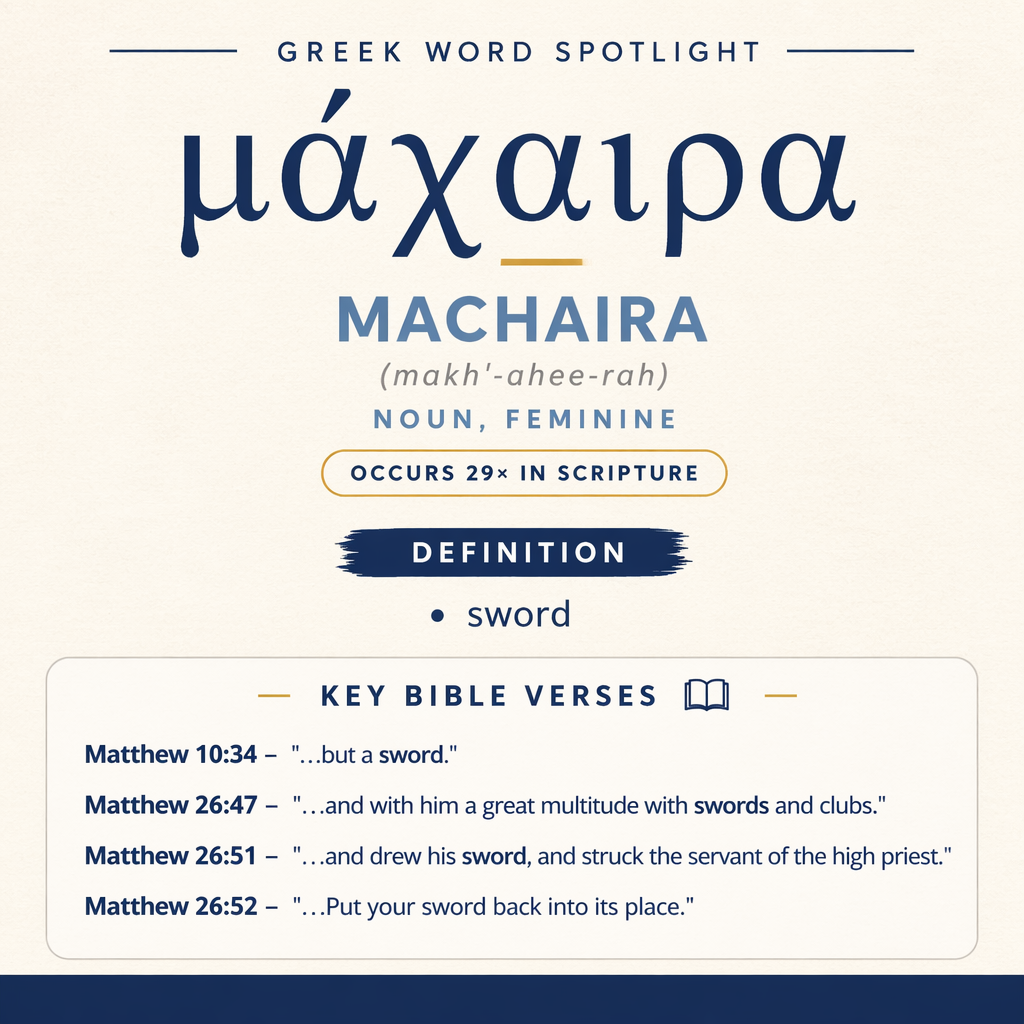
μάχαιρα means “sword” in Greek and occurs 29 times in Scripture, including Matthew 10:34 and Matthew 26:47–55 and Mark 14:43–48.
Gospel Scenes
In Matthew 26:47–55 and Mark 14:43–48, it appears with “swords and clubs” at Jesus’ arrest, and a disciple draws a sword.
Learn More →Jesus’ Teaching
In Matthew 10:34, Jesus says he came not to send peace, but a sword. In Matthew 26:52, Jesus warns that those who take the sword will die by the sword.
Learn More →μάχαιρα names a sword, a concrete weapon that appears in sayings of Jesus and in the arrest narratives, where it marks both the threat of violence and the instrument of violence. In these passages it can function as a literal blade carried by crowds and disciples, and also as an image for conflict that Jesus says will arise.
Occurrences
“Don’t think that I came to send peace on the earth. I didn’t come to send peace, but a sword.” (Matthew 10:34)
Here μάχαιρα is placed in direct contrast with “peace on the earth.” The point is not a description of anyone drawing a weapon but the stark alternative: what Jesus brings will not be experienced as social calm. The word’s force comes from how a sword divides and wounds; set against “peace,” it depicts the disruptive, conflict-laden outcome that his coming will occasion.
While he was still speaking, behold, Judas, one of the twelve, came, and with him a great multitude with swords and clubs, from the chief priests and elders of the people. (Matthew 26:47)
In the arrest scene, μάχαιρα is one of the items that marks the crowd as equipped for coercion: “swords and clubs.” The pairing highlights readiness for force at close range. The sword here is not yet used in the verse, but it signals the posture of the approaching “great multitude” as they come under the authority of the “chief priests and elders of the people.”
Behold, one of those who were with Jesus stretched out his hand, and drew his sword, and struck the servant of the high priest, and struck off his ear. (Matthew 26:51)
μάχαιρα becomes the immediate means of violent resistance. The narrative sequence—“stretched out his hand,” “drew his sword,” “struck”—presents the sword as something worn or carried in a way that can be quickly brought into action. The effect is concrete and bodily: the blow “struck off his ear,” showing the sword’s capacity for injury in the chaos of the arrest.
Then Jesus said to him, “Put your sword back into its place, for all those who take the sword will die by the sword.” (Matthew 26:52)
The sword is commanded to return “into its place,” treating it as an object that belongs somewhere other than the disciple’s hand in this moment. Jesus’ saying then uses μάχαιρα as a measure of violent life: “take the sword” describes adopting it as one’s means, and “die by the sword” answers it with the same instrument. Within the sentence, the sword stands for a whole pattern of action and consequence.
In that hour Jesus said to the multitudes, “Have you come out as against a robber with swords and clubs to seize me? I sat daily in the temple teaching, and you didn’t arrest me. (Matthew 26:55)
μάχαιρα is part of the accusation that the arresting party has treated Jesus “as against a robber.” The “swords and clubs” signify an assumption of danger and the intent to overpower. Jesus contrasts this armed approach with his public presence—“I sat daily in the temple teaching”—to expose the mismatch between their show of force and his prior, open activity.
Immediately, while he was still speaking, Judas, one of the twelve, came—and with him a multitude with swords and clubs, from the chief priests, the scribes, and the elders. (Mark 14:43)
This parallel description again uses μάχαιρα to characterize the arresting group as a “multitude” equipped for violence. The verse also highlights the institutional backing—“chief priests, the scribes, and the elders”—so the swords are not merely personal possessions but part of a coordinated, authorized seizure.
But a certain one of those who stood by drew his sword, and struck the servant of the high priest, and cut off his ear. (Mark 14:47)
As in Matthew, μάχαιρα is drawn and used against “the servant of the high priest,” resulting in a severed ear. The sword here is the pivot from tense confrontation to bloodshed. The brevity of the action—draw, strike, cut—underscores how quickly a carried sword turns a crowded moment into injury.
Jesus answered them, “Have you come out, as against a robber, with swords and clubs to seize me? (Mark 14:48)
μάχαιρα appears within Jesus’ protest over the arrest’s manner. The rhetorical question presses the implication of their equipment: the presence of swords frames Jesus as though he were a violent threat. The sword thus functions as evidence of their presumption and their chosen mode of control—seizing by force.
They will fall by the edge of the sword, and will be led captive into all the nations. Jerusalem will be trampled down by the Gentiles, until the times of the Gentiles are fulfilled. (Luke 21:24)
Here μάχαιρα is the agent of lethal judgment in a wider disaster affecting many: “They will fall by the edge of the sword.” The phrase “edge of the sword” depicts death in battle or massacre with the sword’s cutting side. The verse couples this with captivity and trampling, placing the sword within a sequence of violence and humiliation that overtakes Jerusalem.
Then he said to them, “But now, whoever has a purse, let him take it, and likewise a wallet. Whoever has none, let him sell his cloak, and buy a sword. (Luke 22:36)
μάχαιρα is named as an item to be acquired, alongside money-container and travel provisions (“purse,” “wallet”). The instruction “sell his cloak, and buy a sword” heightens urgency: the sword is treated as valuable enough to warrant sacrifice of a basic garment. In this setting the sword represents preparedness for the changed circumstances implied by “But now,” where ordinary provisions are no longer sufficient.
They said, “Lord, behold, here are two swords.” He said to them, “That is enough.” (Luke 22:38)
μάχαιρα is counted—“two swords”—indicating tangible weapons present among the disciples. Jesus’ response, “That is enough,” closes the exchange without elaboration. Within the dialogue, the sword is not abstract: it is inventory, something they can produce and number when asked to buy one.
When those who were around him saw what was about to happen, they said to him, “Lord, shall we strike with the sword?” (Luke 22:49)
μάχαιρα here is framed as a possible response to the unfolding arrest: “shall we strike with the sword?” The question treats the sword as an available tool and asks for authorization to use it. In context with the earlier mention of buying swords and the later drawing of one, the word carries the tension between readiness and restraint at the moment conflict becomes unavoidable.
Sense and Usage
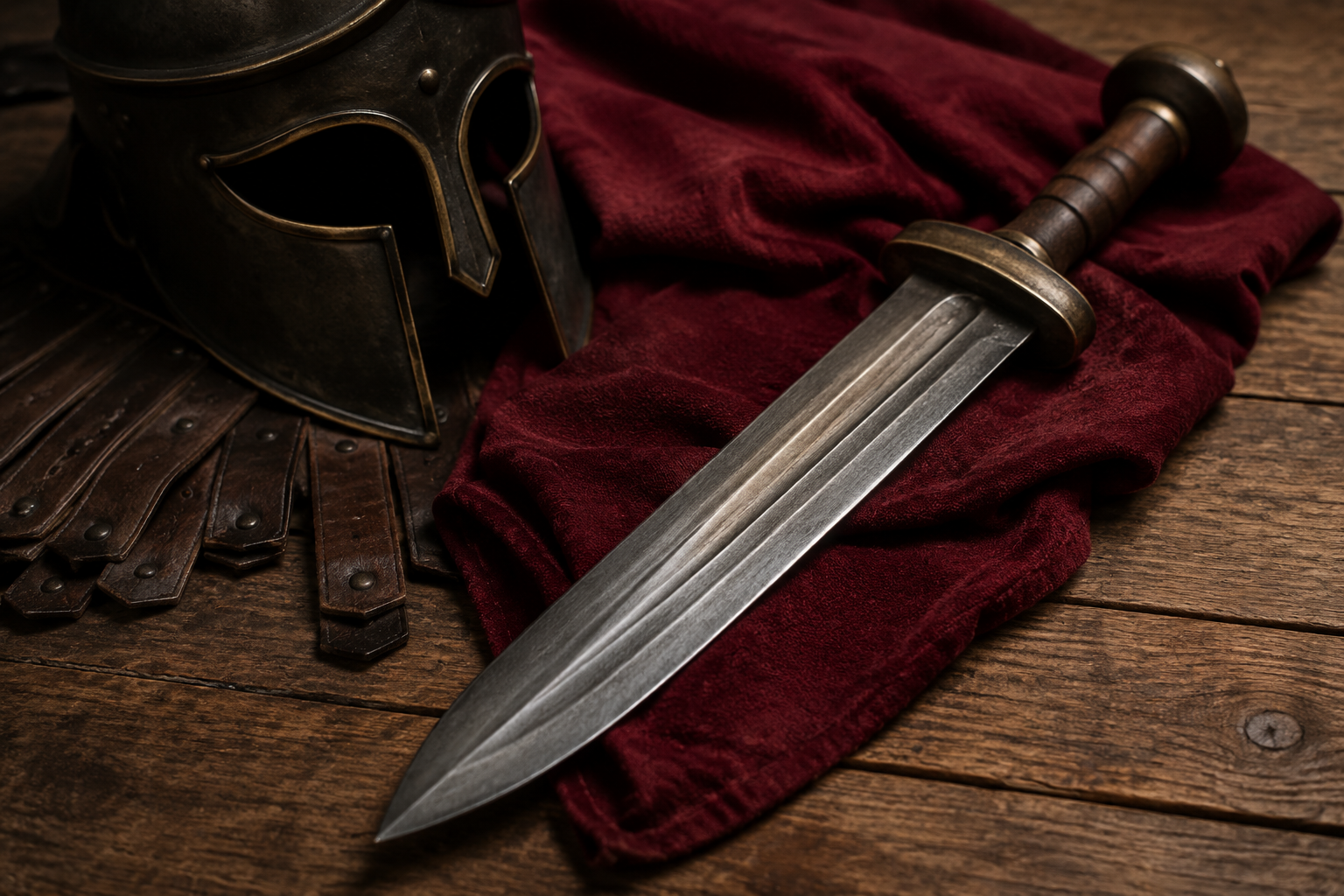
Across these passages μάχαιρα consistently denotes the sword as a close-quarters weapon—something carried, drawn, wielded, and capable of cutting. The arrest narratives emphasize its physicality: it is held in the hand, it has a “place” where it is put away, and it inflicts a specific wound (“cut off his ear”). In the descriptions of the arresting parties, swords appear in the plural and are paired with “clubs,” portraying a forceful seizure shaped by intimidation and readiness to strike. The sword in these scenes marks escalation: a crowd arrives armed, a disciple responds with steel, and Jesus addresses the logic of violence by naming the sword as both instrument and destiny—“take the sword… die by the sword.”
At the same time, μάχαιra can extend beyond an immediately visible blade into a vivid image for conflict. In Matthew 10:34, “peace” and “a sword” form a blunt opposition that uses the weapon’s associations—harm, division, and the threat of death—to express the kind of rupture that will accompany Jesus’ mission in human relationships and communities. Luke 21:24 uses the sword in a collective calamity: “fall by the edge of the sword” portrays mass death, and the phrase’s concreteness adds weight to the broader picture of defeat and displacement. Thus, even when no one is shown drawing a weapon, the sword-language remains anchored in the sword’s tangible effect.
Luke 22 adds a further nuance by placing the sword among travel necessities (“purse… wallet”) and by treating it as a purchasable item worth the price of a cloak. The ensuing count—“two swords”—and the question—“shall we strike with the sword?”—show how quickly the presence of swords turns into the possibility of using them. In this cluster of sayings and actions, μάχαιρα sits at the intersection of preparedness, misunderstanding, and violence about to erupt.
Imagery
The imagery attached to μάχαιρα in these verses is sharp and immediate. A sword is what an armed crowd brings when it means to seize; it is what a defender draws when fear and loyalty flare; it is what Jesus tells his follower to return to its place; it is what can become the very standard by which a violent life ends. Even when used figuratively—“not peace, but a sword”—the image retains the weight of the literal weapon seen elsewhere in the same Gospel tradition, where metal in hand becomes injury in a moment.
Sources: Lexical data from Strong’s Exhaustive Concordance and the Translators Brief Lexicon of Extended Strongs for Greek (STEPBible, CC BY). Occurrence data from the Translators Amalgamated Greek New Testament (STEPBible, CC BY). Scripture quotations from the World English Bible (public domain).