Exploring the Meaning of Logia in Greek
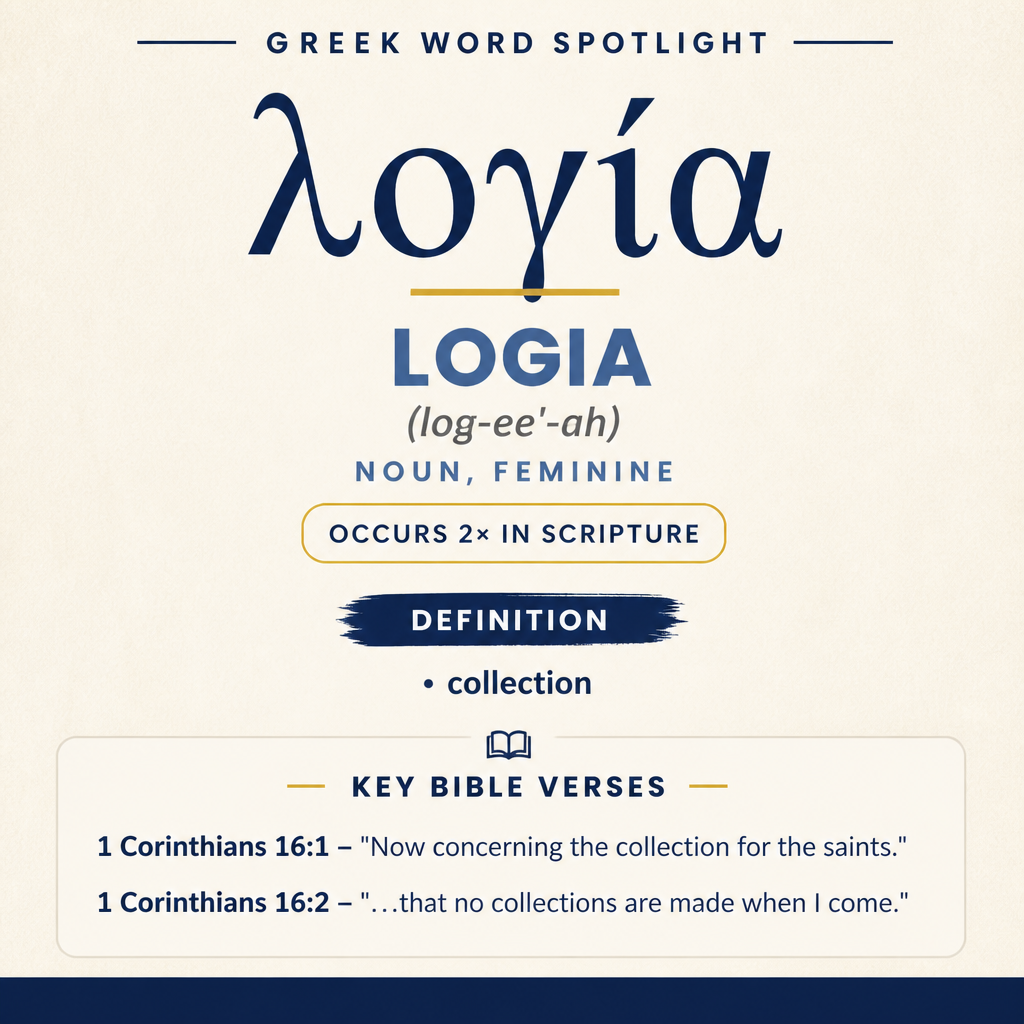
λογία (Logia) means “collection” and appears twice in Scripture, in 1 Corinthians 16:1–2.
Scripture Occurrences
λογία occurs 2 times in Scripture. Both occurrences are in 1 Corinthians 16:1 and 1 Corinthians 16:2.
Learn More →Context In Corinthians
In 1 Corinthians 16:1, it refers to “the collection for the saints.” In 1 Corinthians 16:2, Paul instructs weekly saving so no collections are needed when he comes.
Learn More →λογία refers to a “collection,” and it appears in Paul’s practical instructions to the Corinthian church about gathering material support for fellow believers. In these verses the word is set in the ordinary rhythms of weekly life and the planning needed for an orderly gift.
Root and Related Words
λογία is related to the Greek word logos (λόγος), “word.”

Occurrences
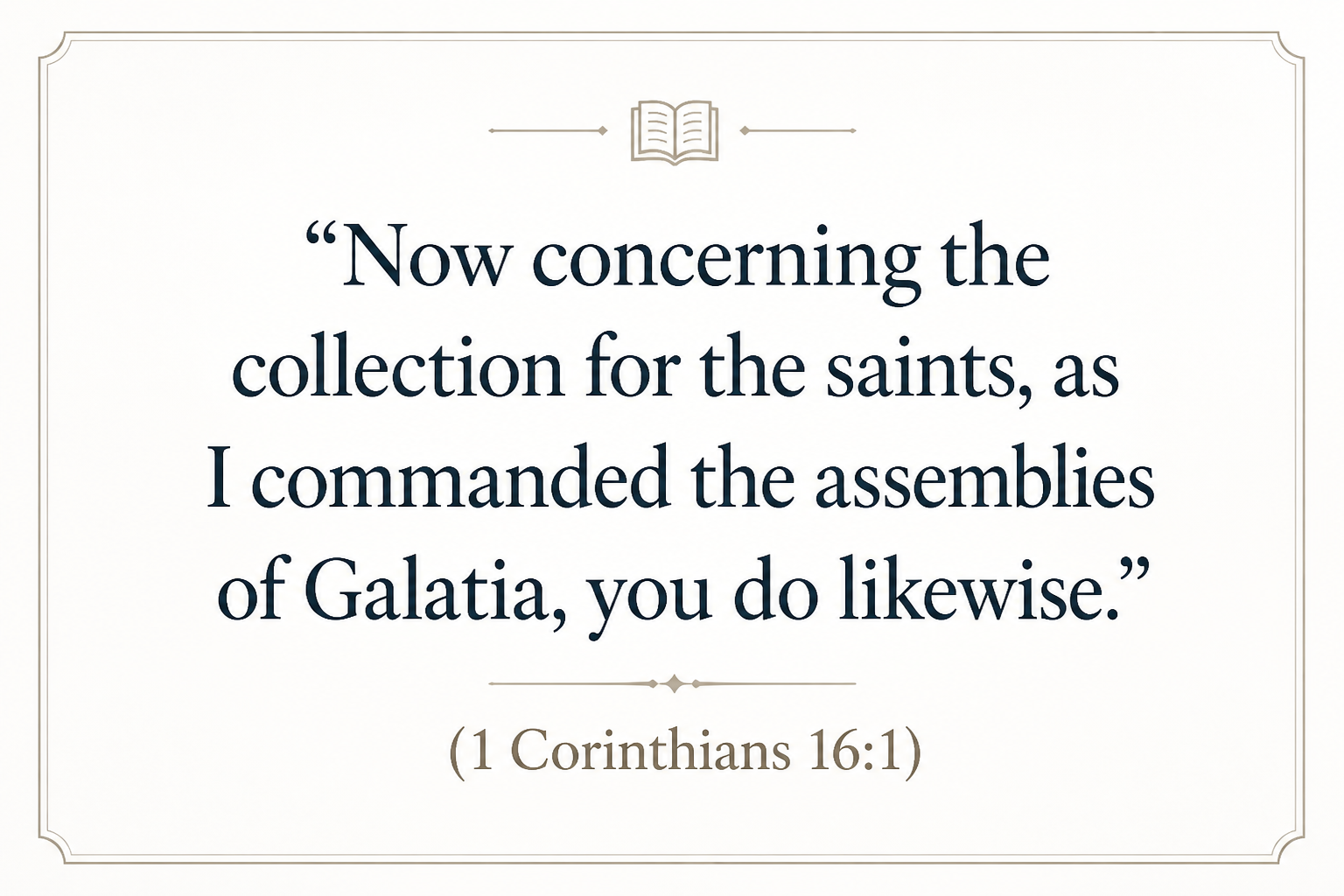
“Now concerning the collection for the saints, as I commanded the assemblies of Galatia, you do likewise.” (1 Corinthians 16:1)
Here λογία is framed as a defined, shared responsibility: “the collection for the saints.” The phrase ties the act of gathering to a clear purpose (“for the saints”) and places it under apostolic direction (“as I commanded”). The word therefore sits inside an instruction that is both pastoral and administrative: Paul is not merely announcing a need, but establishing a practice that the Corinthians are to mirror (“you do likewise”) in step with other churches (“the assemblies of Galatia”). Within this sentence, λογία functions as the concrete object of “concerning” and becomes the topic that governs what follows—an organized effort rather than an unstructured impulse.
The wording also locates the collection inside the life of the churches as churches: Paul speaks in terms of assemblies and saints, and λογία becomes the practical expression of inter-church concern. In this setting, the word carries the weight of communal coordination. The collection is something that can be commanded, imitated, and presumably managed; it is not presented as a spontaneous one-time act but as a recognizable project with a known goal.
“On the first day of every week, let each one of you save, as he may prosper, that no collections are made when I come.” (1 Corinthians 16:2)
In this verse λογία appears in the plural (“collections”), and the sentence explains the method by which the Corinthians are to handle the matter. The time marker—“On the first day of every week”—places the action into a regular cadence. The instruction “let each one of you save” shifts the focus from a single public gathering to personal, repeated preparation. In other words, the collection is approached indirectly: each individual sets something aside in advance, and this steady saving is meant to prevent the need for hurried or repeated drives later.
The phrase “as he may prosper” connects the collection to varying individual means. The collection is not described in terms of a fixed amount here; instead it is linked to the prosperity of each person, which implies an adjustable participation within the shared project. The purpose clause, “that no collections are made when I come,” shows how λογία is tied to planning and timing. Paul’s arrival should not trigger emergency fundraising; the community’s earlier discipline is meant to make the final giving straightforward. Thus λογία in this verse stands at the intersection of private stewardship (“each one… save”) and corporate readiness (the church’s ability to provide without last-minute pressure).
The plural form also adds a practical nuance within the sentence’s logic: it is the avoidance of “collections” at the moment of Paul’s visit that motivates the weekly saving. The word therefore marks the kind of activity that could otherwise become disruptive—repeated collection efforts clustered around a visit—unless addressed with regular, distributed preparation.
Sense and Usage
Across these two occurrences, λογία is a tangible, organized “collection” with a defined beneficiary (“for the saints”) and an expected pattern of participation (“let each one of you save”). The word belongs to the vocabulary of ordered communal life: it is something a community can be instructed about, something that can be prepared for over time, and something that can be arranged so that it does not depend on a single moment of urgency.
The paired verses show two sides of the same reality. First, λογία is a shared obligation embraced in unity with other assemblies (“as I commanded the assemblies of Galatia, you do likewise”). Second, it is a process that begins at the level of the individual (“each one of you”) and becomes effective through consistency (“every week”). In that way the “collection” is not merely a final pile of gathered resources; it includes the whole practice by which the church makes that gathered gift possible without strain.
The definition “collection” fits both the public and private dimensions that these instructions coordinate. Paul can speak of “the collection” as a known communal project, and he can also speak of avoiding “collections” at his coming by cultivating a routine of saving. The word therefore sits naturally in a context where a community must translate intention into orderly action: a directed purpose, a repeatable schedule, proportional participation, and a goal of readiness.
Imagery
In these verses λογία evokes the picture of many small savings accumulating into a single communal gift. The repeated “first day of every week” suggests a steady pattern rather than a dramatic moment, and the aim “that no collections are made when I come” casts the collection as something best accomplished quietly ahead of time, so that generosity can be presented without the pressure of last-minute gathering.
Sources: Lexical data from Strong’s Exhaustive Concordance and the Translators Brief Lexicon of Extended Strongs for Greek (STEPBible, CC BY). Occurrence data from the Translators Amalgamated Greek New Testament (STEPBible, CC BY). Scripture quotations from the World English Bible (public domain).