
Exploring the Meaning of Logikos in Greek
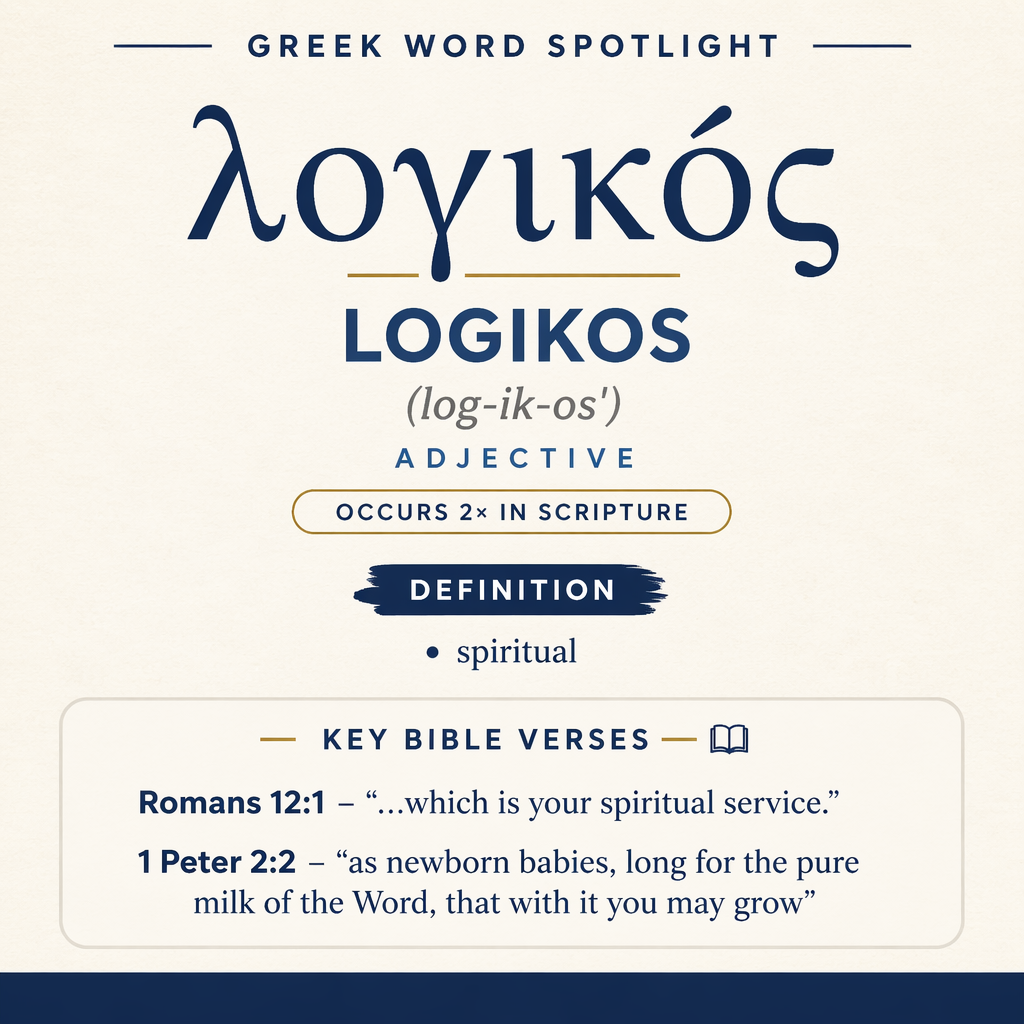
λογικός (Logikos) means “spiritual” and appears twice in Scripture: Romans 12:1 and 1 Peter 2:2.
Scripture Occurrences
This word occurs 2 times in Scripture. It appears in Romans 12:1 and 1 Peter 2:2.
Learn More →Context Snapshots
Romans 12:1 uses it in an appeal to present bodies as a living sacrifice. 1 Peter 2:2 uses it with newborn babies longing for pure milk of the Word for growth.
Learn More →λογικός means “spiritual” and appears twice in the New Testament: once in Paul’s appeal for devoted worship in Romans and once in Peter’s picture of newborn desire for the Word in 1 Peter. In both places it qualifies an act of Christian life in a way that frames it as belonging to the sphere of spiritual response rather than mere outward performance.
Root and Related Words
λογικός is related to logos (λόγος), “word” (Strong’s G3056). This connection helps explain why the term naturally attaches to contexts where God’s mercies and God’s Word shape the believer’s response.

Occurrences
“Therefore I urge you, brothers, by the mercies of God, to present your bodies a living sacrifice, holy, acceptable to God, which is your spiritual service.” (Romans 12:1)
Here λογικός modifies “service,” and the verse sets that “service” inside a carefully structured appeal: “Therefore… by the mercies of God… to present your bodies.” The action is concrete—“present your bodies”—yet Paul’s description places that bodily offering within a spiritual category. The adjective marks the service as more than a ritual act; it belongs to the realm defined by “the mercies of God” and by what God finds “holy” and “acceptable.” In this sentence, λογικός helps hold together two realities that could be wrongly separated: the tangible act of offering one’s body and the spiritual character of worship that is shaped by God’s mercy. The sacrificial language (“living sacrifice”) already implies devotion that encompasses the whole person; calling this service “spiritual” signals that its defining feature is not the external form of sacrifice but the God-directed, mercy-grounded worship to which Paul urges “brothers.”
The placement of the adjective at the end of the verse (“which is your spiritual service”) gives it a summarizing force. Paul does not add a new command after “present your bodies”; instead, he interprets that presentation. λογικός functions as an evaluative description: the bodily offering is not merely a personal discipline or ethical self-improvement but an act of worshipful service characterized as spiritual in nature. Within the verse’s own wording, the spiritual quality is tied to God’s evaluation (“acceptable to God”) and God’s initiative (“mercies of God”), not to the intensity of human feeling.
“as newborn babies, long for the pure milk of the Word, that with it you may grow,” (1 Peter 2:2)
In Peter’s exhortation, λογικός describes the “milk” for which believers are to long. The comparison is vivid and bodily—“newborn babies”—yet the object of desire is defined in terms of the Word: “the pure milk of the Word.” Calling that milk “spiritual” aligns the infant imagery with a non-material nourishment: the growth in view is fostered by what comes through the Word. The adjective helps prevent the metaphor from collapsing into mere sentimentality about babies; it specifies what kind of “milk” is meant by locating it in the sphere of spiritual nourishment.
Peter’s imperative is about appetite and growth: “long for… that with it you may grow.” The word λογικός contributes by qualifying the milk as spiritual, so the longing is directed toward what feeds the inner life shaped by the Word, and the growth envisioned is the kind that results from that nourishment. The verse’s compact structure links three elements—desire (“long for”), nourishment (“milk of the Word”), and outcome (“you may grow”)—and λογικός helps define the nourishment as spiritual so that the resulting growth is framed by the same category. The term thus works with the metaphor to depict an essential, ongoing dependence on the Word as the believer’s sustaining food.
Sense and Usage
Across these two passages, “spiritual” functions as a qualifier that directs attention to the character and source of Christian practice. In Romans 12:1, it characterizes “service” offered to God; in 1 Peter 2:2, it characterizes “milk” received through the Word. The word stands at two complementary points of the Christian life: offering and receiving. The believer offers the self to God in worshipful service, and the believer receives nourishment that enables growth. In both directions, λογικός identifies what is taking place as belonging to the spiritual sphere rather than being reducible to external action or physical sustenance.
The adjective also links spiritual life to God’s own provision as named in each verse. Romans grounds spiritual service in “the mercies of God” and measures it by what is “acceptable to God.” The spiritual character of the service is not detached from the body (“present your bodies”) but is expressed through embodied obedience interpreted as worship. 1 Peter grounds spiritual nourishment in “the Word” and highlights its purity: “pure milk of the Word.” The spiritual character of the milk is not an abstract label added to an otherwise generic metaphor; it is anchored in the Word as the means by which growth occurs.
Because λογικός appears in two different metaphors—sacrifice and infancy—it shows flexibility while retaining a consistent direction. It can qualify an act of worship (“service”) and it can qualify a means of nurture (“milk”). In both cases it marks something as fitting for life before God: worship that is shaped by God’s mercy and nourished longing that is shaped by God’s Word. The adjective’s role is not to introduce a new topic but to define the nature of what is already being described: service that is truly service to God, and milk that truly nourishes growth. The spiritual quality is thus shown not by removing life from the body or the everyday, but by framing ordinary, tangible images (presenting bodies; drinking milk) as vehicles of a God-centered reality.
Within the immediate wording of these verses, λογικός also serves a clarifying function. “Present your bodies” could be heard as a purely outward gesture; “milk” could be heard as purely physical. By adding “spiritual,” each author signals that the decisive reference point is God’s mercy and acceptability (Romans) and the Word’s purity and growth-giving power (1 Peter). The adjective guides interpretation: it tells the reader what kind of service this is, and what kind of milk this is, without changing the concreteness of the imagery.
Imagery
The two scenes that carry λογικός are intentionally concrete: a worshiper presenting the body as a “living sacrifice,” and a newborn longing for milk. In Romans 12:1 the adjective infuses sacrificial language with spiritual purpose, so the offering is not a mere gesture but an act of service directed to God. In 1 Peter 2:2 the adjective infuses the infant image with spiritual content, so the longing is for “pure milk of the Word” that enables growth. Together these pictures show spiritual life as both devoted worship and continual dependence: a life offered to God and a life nourished by the Word.
Sources: Lexical data from Strong’s Exhaustive Concordance and the Translators Brief Lexicon of Extended Strongs for Greek (STEPBible, CC BY). Occurrence data from the Translators Amalgamated Greek New Testament (STEPBible, CC BY). Scripture quotations from the World English Bible (public domain).





